7 Tiny Off-Grid Towns In South Australia
South Australia's smaller towns draw travellers from around the world for their stunning wine country and laid-back outdoor experiences. In Quorn, the standout experience is riding the Pichi Richi Explorer, a restored steam train that travels through hand-carved cuttings and dry creek beds in the Flinders Ranges. In Penola, the biggest draw is tasting estate-grown Cabernet Sauvignon right on the main street at Koonara Wines in the middle of the famous Coonawarra wine region. Wherever it is you decide to go, South Australia is sure to impress, even in its tiniest of towns.
Quorn

At the southern entrance to South Australia’s Flinders Ranges, Quorn grew in the late 1800s as a major junction on the state’s narrow gauge railway network. Steam trains remain part of daily life at the Pichi Richi Railway, where restored locomotives run through the narrow Pichi Richi Pass. The Pichi Richi Explorer travels about 32 kilometers return between Quorn and Woolshed Flat along the original line built in the 1870s. The trip passes dry creek beds, old railway bridges, and stone cuttings carved by hand when the railway first pushed into the ranges. On the other hand, the climb to Devil’s Peak begins on the edge of town and quickly rises above the streets. The walking trail is about 2.5 kilometers round-trip and gains over 250 meters in elevation. The last stretch requires some scrambling across exposed rock. From the summit, you can see Quorn’s grid of streets, the rail corridor cutting through the valley, and the long ridges of the southern Flinders Ranges.
About 20 kilometers north of town, Warren Gorge offers one of the best wildlife walks in the region. The 5.2 kilometer loop follows a creek line beneath tall quartzite cliffs. Yellow-footed rock wallabies live among the boulders and often appear near the watercourse early in the morning or late in the evening. Meanwhile in town, Flinders Gin distills small-batch spirits using native ingredients such as quandong and desert lime. Tastings show how local botanicals shape the flavor of each batch.
Hawker

Hawker calls out to people traveling through the Flinders Ranges. The Jeff Morgan Gallery holds two circular panoramic paintings that took the artist years to complete. The Wilpena Panorama measures 33 meters in circumference and stands 3 meters high. The Arkaroola Waterhole panorama is even bigger at 46 meters around and 4.5 meters wide. You climb 14 steps to a viewing platform where the paintings surround you on all sides. Real foliage and taxidermied animals sit in front of the painted landscapes. A few blocks away, Fred Teague's Museum operates inside Hawker Motors. Teague spent 60 years collecting geological specimens from the Flinders Ranges. His collection includes beryl, bornite, and scholzite crystals from Reaphook Hill.
In the center of town, Hawker War Memorial was built on the site of the old War Memorial Swimming Pool at the corner of Chace View Terrace and Wilpena Road. Two life-size wire mesh sculptures of Australian Light Horsemen stand among hand painted honour rolls and plaques. The sculptures are the brainchild of Queensland artist Ivan Lovett. A replica field gun from the 1987 film "The Lighthorsemen" sits on display.
Melrose

Proclaimed in 1853, Melrose is among the oldest towns in the Flinders Ranges at the base of 960-meter Mount Remarkable. The Mount Remarkable Summit Hike is one of the good ones, and it climbs 14 kilometers round-trip through terrain that shifts from lush, carpeted slopes to rocky hillsides and dry eucalypt forest. You'll pass remnants of a small plane that crashed on the scree slopes in 1980. The track follows part of the Heysen Trail and loops back. From the mountain, you can drive or hike about 25 kilometers to Alligator Gorge, where around 250 steps descend into the canyon floor. The Narrows is the highlight, with quartzite walls close together, just a few meters apart, for several hundred meters.
The town center features the Melrose Heritage Museum, spread across five buildings. It tells the story of European settlement, starting with the police and judicial presence established in 1848. Exhibits cover Goyder's Line, which runs through this area and marks the boundary between land suitable for agriculture and land too dry to reliably farm. Mining history, workingmen's blocks, a village settlement, and a returned soldier training farm all get space. The Nukunu Aboriginal people's story is also interpreted. A cooling off period takes for a trip to Jacka Brothers Brewery. They make beer using water from the ranges and local ingredients where possible. The taproom serves flights and full pours alongside wood fired pizza. Live music happens on weekends.
Penola

Penola welcomes travelers to the heart of the Coonawarra wine region, where terra rossa soil produces some of Australia's best Cabernet Sauvignon. It would be a nice idea to start with a trip to Koonara Wines. The cellar door is on the main street, where you can taste Coonawarra wines without driving out to the vineyards. The tasting room pours estate-grown Cabernet Sauvignon, Shiraz, and Chardonnay from vines planted in the distinctive red terra rossa soil that sits over porous limestone and draws from pure underground water. Nearby, the Mary MacKillop Penola Centre also attracts visitors, with two separate galleries filling the 1998 glass fronted building. The Mary MacKillop Gallery traces her path from governess to Australia's first Catholic saint, including a reliquary containing a strand of her hair, similar to the one presented to Pope Benedict XVI at her 2010 canonization.
Steps away, Petticoat Lane runs through Penola's oldest residential area, where timber and stone cottages date from 1850 to World War I. Sharam's First Cottage was built in 1850 from blackwood slabs with a bark roof using timber from a nearby swamp. Wilson Cottage went up in 1856 using Mount Gambier stone and local clay. Davidson Cottage followed in 1861 with pit-sawn timber. The National Trust now owns eight of these buildings. About 21 kilometers north on the Riddoch Highway, Father Woods Park displays seven chainsaw sculptures carved by Kevin Gilders from pine tree stumps. Each depicts a different role Woods played: bush priest, scientist, educator, founder, explorer, and good citizen.
Strathalbyn

Antique shops line High Street in a town that earned its reputation as South Australia's antique capital without ever officially claiming the title. Among those shops, the Antique Bazaar of Strathalbyn holds the largest collection on High Street. The space fills with furniture, glassware, china, silverware, tools, books, and collectibles from estate sales and dealers across the region. Items span the Victorian era through mid-century modern. Down High Street, Gilbert's Motor Museum is located in the building that the Gilbert family owned since the early 1900s, until Gilbert Motors closed in December 2018. The family manufactured Treblig bicycles and motorcycles here and sold Buicks and Holdens. Over 100 vehicles now fill the showroom and back sheds. The collection includes cars originally sold new from these premises, alongside veteran, vintage, classic, and motorsport vehicles. Racing cars from Rowley Park Speedway get their own display curated by the South Australian Vintage Speedcar Association.
The townscape is dominated by St Andrew's Uniting Church, which was first built in 1844 and expanded over the next 94 years as the Presbyterian congregation outgrew each addition. The nave dates to 1848. Four spirelets crown the tower. Inside, you'll find stained glass windows depicting The Good Shepherd and The Good Samaritan, plus Scottish thistles used in memorial windows along the sides. The church sits on a rise above the Soldiers Memorial Gardens, where the River Angas Walkway begins at Children's Bridge. The walkway runs five kilometers and passes an 1885 swimming pool that's actually a cordoned section of the river. You'll walk under St Andrew's Bridge for views of the church's four spires.
Robe

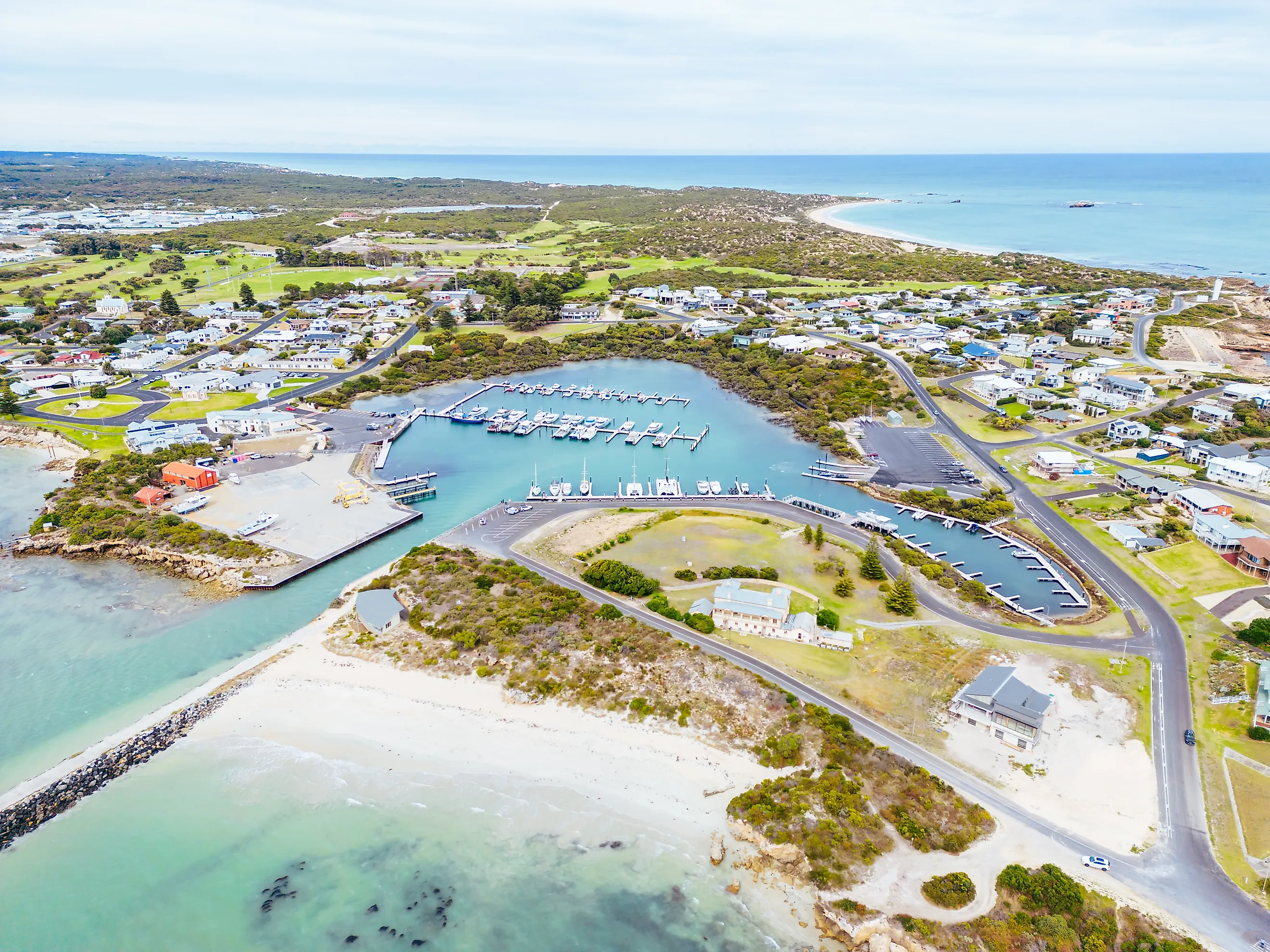
Robe is where Guichen Bay curves into the limestone coast, and the same sheltered waters made it one of South Australia's busiest ports in the 1850s and 60s. Between 1857 and 1863, roughly 17,000 Chinese miners landed here to avoid Victoria's ten pound poll tax. The Chinese Monument is on Mundy Terrace near where those thousands came ashore. A red gate faces the ocean, boasting Chinese characters that signify courage, strength, and perseverance. The stone memorial beside it explains how the miners paid 10 to 12 pounds for ship passage, then walked cross country to discover the Canton lead near Ararat, the richest shallow alluvial goldfield in Australian history. Along the same waterfront, Cape Dombey Obelisk stands 12 meters tall on an eroding limestone cliff. Built in the 1850s, it guided ships into the bay while storing rocket lifesaving equipment inside.
For local drinks, Robe Town Brewery makes ales, including Camel Dung Porter. The taproom pours session IPA, red IPA, and light stout alongside food and live music on weekends. Alternatively, Karatta Wine Room & Gallery fills a heritage building on Victoria Street with estate-grown cool-climate wines from the Limestone Coast region. Shared platters pair with glasses of local Cabernet Sauvignon, Shiraz, and Sauvignon Blanc. The same space holds an art gallery displaying regional works.
Streaky Bay

A hidden gem in the Great Southern Reef region, Matthew Flinders named this bay in 1802 after noticing streaky discoloration in the water, likely caused by oils released from seaweed species that still grow here. About 40 kilometers south of town, Murphy's Haystacks rise from a wheat field as pink granite formations, dating back 1,500 million years. According to folklore, a Scottish agricultural expert traveling by mail coach in the early 1900s mistook them for haystacks and asked how the farmer produced so much hay. The owner was Denis Murphy, and the name stuck. From the haystacks, you can continue 40 kilometers via Calca to Point Labatt Conservation Park, home to Australia's only permanent mainland sea lion colony. A viewing platform sits 50 meters above the beach, where Australian sea lions and New Zealand fur seals rest on the rocks year round. Binoculars help you watch pups learning to swim or adults hauling out after spending weeks at sea fishing.
Closer to town, the Westall Way Loop runs 30 kilometers south from Sceale Bay Road as an unsealed scenic drive. Smooth Pool sits along this route as a series of calm, rock lined pools formed by a flat granite shelf. Crabs, small fish, seaweed, barnacles, and occasional starfish live in the intertidal pools. The clear, sheltered water makes it good for swimming and snorkeling. Further along the loop, The Granites features a lagoon style rock pool with 100+ steps descending from the cliff top car park. Granite rocks of varying shapes, sizes, and colors cover the shoreline. Surfers catch waves out the back while families swim in the protected lagoon below.
Hidden Destinations In South Australia
South Australia offers the kind of quiet escape many travelers look for when planning a relaxed Southern Hemisphere getaway. The seven tiny off-grid towns in South Australia highlight places where the pace slows, and the landscapes take center stage. In Quorn, steam trains still run through the Flinders Ranges, while Streaky Bay draws visitors to granite headlands and nearby sea lion colonies at Point Labatt. Together, these towns show how rewarding it can be to follow the quieter roads and spend time where history, nature, and small communities meet.