Maps of Nigeria
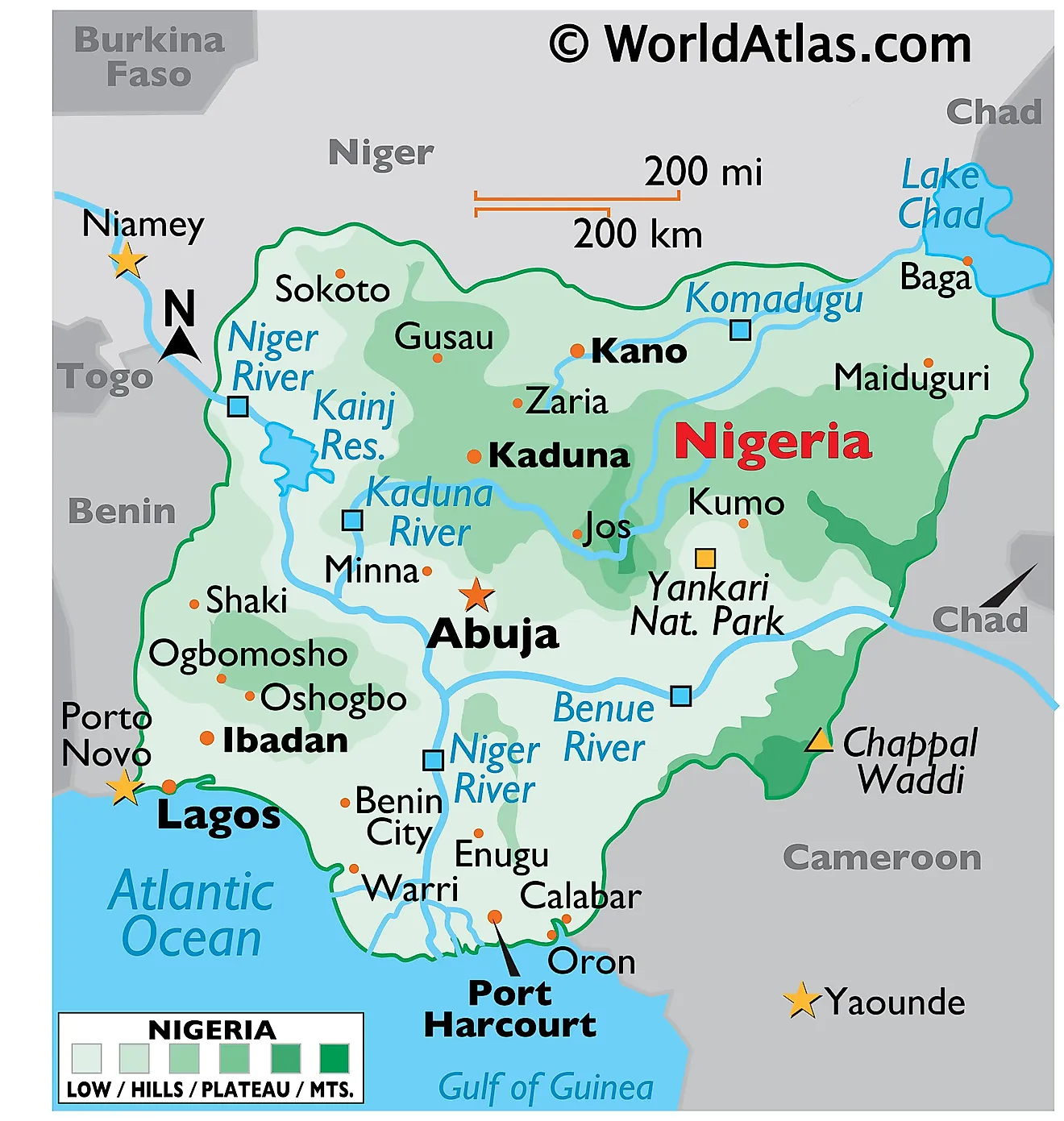
Nigeria, situated in West Africa, borders the Republic of Benin to the west, Chad and Cameroon to the east, and Niger to the north. To the south, the coastline extends for approximately 853 kilometers (530 miles) along the Gulf of Guinea in the Atlantic Ocean. With a total area of about 923,769 km2 (356,669 mi2), Nigeria takes a significant position in the African continent.
The Northern Savanna: The northern part of Nigeria predominantly features an extensive savanna region. This area remains characterized by grasslands, scattered trees, and shrubbery, which form an ideal environment for herding cattle and cultivating grains. As one moves further north, the savanna transitions into the Sahel, a semi-arid zone that acts as a transitional area between the dry Sahara Desert to the north and the savannas to the south. The Sahel experiences sparse and unpredictable rainfall, contributing to its inherently arid nature. Agriculture in this region primarily revolves around hardy, drought-resistant crops and extensive pastoralism.
The Central Highlands: Towards the central region of the country, a series of highlands emerge, including the Jos Plateau. This plateau, peaking at an elevation of about 1,295 meters (4,250 feet), is famous for its unique rock formations and abundant mineral resources. Tin mining is a significant activity in this area. The region's mild climate and rich volcanic soils also promote the growth of a variety of crops, including vegetables, fruits, and tubers.
The Guinea Savanna: Moving southward from the highlands, Nigeria exhibits a transition to the Guinea Savanna, a tropical grassland belt. This region experiences more rainfall than the northern savanna, enabling the growth of taller grasses and more densely populated trees. The region is also the mainstay of Nigeria's agricultural economy, with the cultivation of yam, cassava, and maize dominating the agricultural landscape. The eastern section also contains Chappal Waddi, the highest peak in Nigeria at 2,419 m.
The Rainforest Belt: Further south, Nigeria transitions into the rainforest belt. This region is marked by heavy rainfall, high humidity, and lush vegetation, which includes various species of hardwood trees. The rainforest belt has suffered extensive deforestation due to logging and the conversion of forestland to agricultural uses. However, it still plays a critical role in providing timber and other non-timber forest products.
The Niger Delta: Nigeria's coastal area, also known as the Niger Delta region, is characterized by mangrove forests, swamps, and lagoons. The Niger River, the country's most significant waterway, and its tributaries, drain into the Atlantic Ocean through this delta. The delta is densely populated and constitutes the heart of Nigeria's oil industry. However, this has led to significant environmental challenges, including oil spills and land degradation.
Bodies of Water: In terms of bodies of water, the Niger River and its main tributary, the Benue River, dominate Nigeria's aquatic landscape. The Niger River, originating from the highlands of Guinea, travels through Nigeria before emptying into the Gulf of Guinea.
In the southern part of the country, along the coastline, numerous small islands exist, most notably Lagos Island, where the one of Nigeria's largest cities rests.
States of Nigeria Map
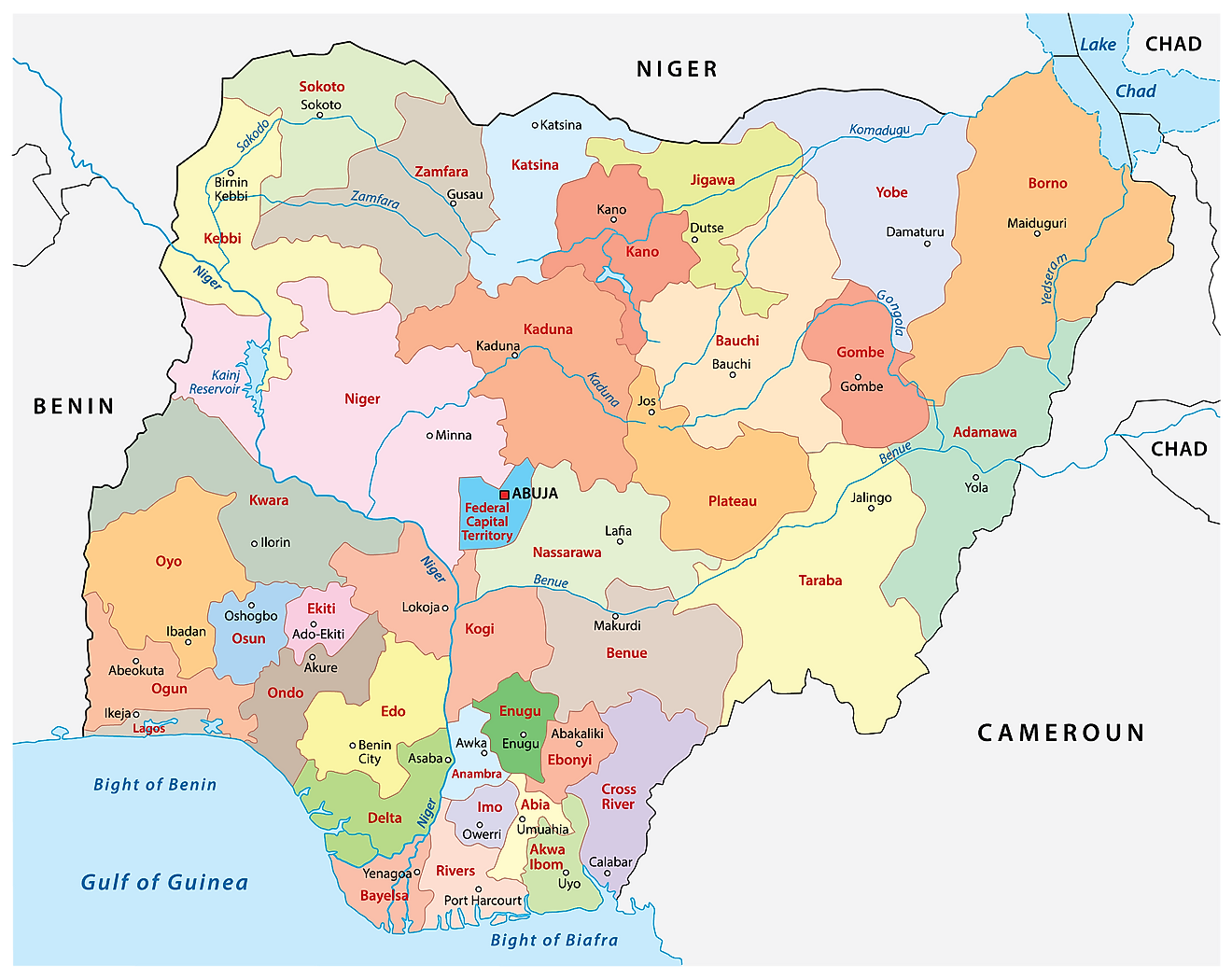
Nigeria has 36 states and a Federal Capital Territory. In alphabetical order, the states are as follows: Abia, Adamawa, Akwa Ibom, Anambra, Bauchi, Bayelsa, Benue, Borno, Cross River, Delta, Ebonyi, Edo, Ekiti, Enugu, Gombe, Imo, Jigawa, Kaduna, Kano, Katsina, Kebbi, Kogi, Kwara, Lagos, Nasarawa, Niger, Ogun, Ondo, Osun, Oyo, Plateau, Rivers, Sokoto, Taraba, Yobe, Zamfara.
The states are further divided into 774 Local Government Areas.
The Federal Capital Territory is located in Abuja, the national capital city of Nigeria.
Where is Nigeria?
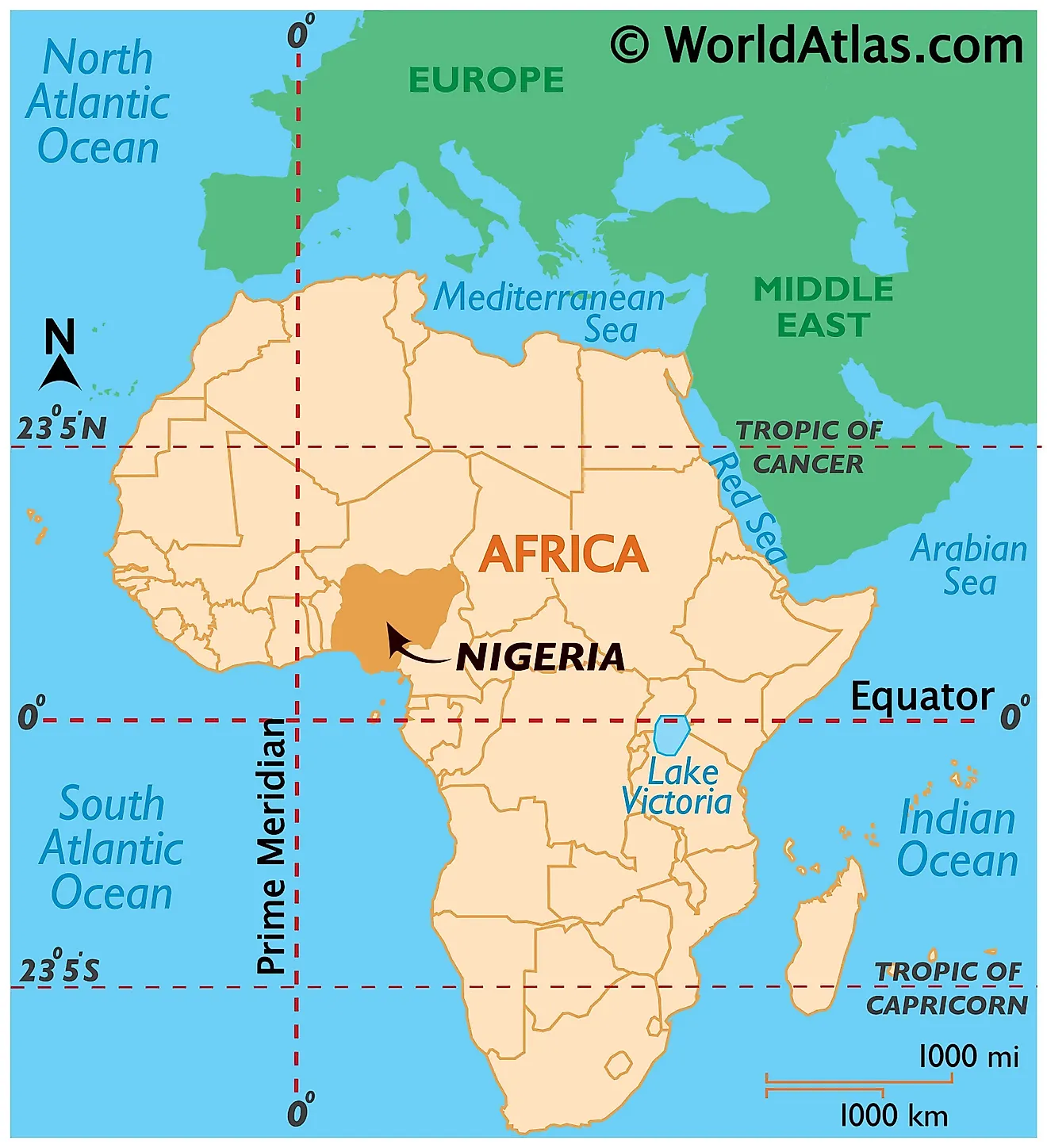
Nigeria is a West African country located in the Northern and Eastern Hemispheres of the Earth. It is bordered by four countries. These are Niger, Chad, Cameroon, and Benin to the north, northeast, east, and west respectively. Nigeria also has a coastline on the Gulf of Guinea.
Nigeria Bordering Countries: Cameroon, Chad, The Niger, Benin.
Regional Maps: Map of Africa
Outline Map of Nigeria
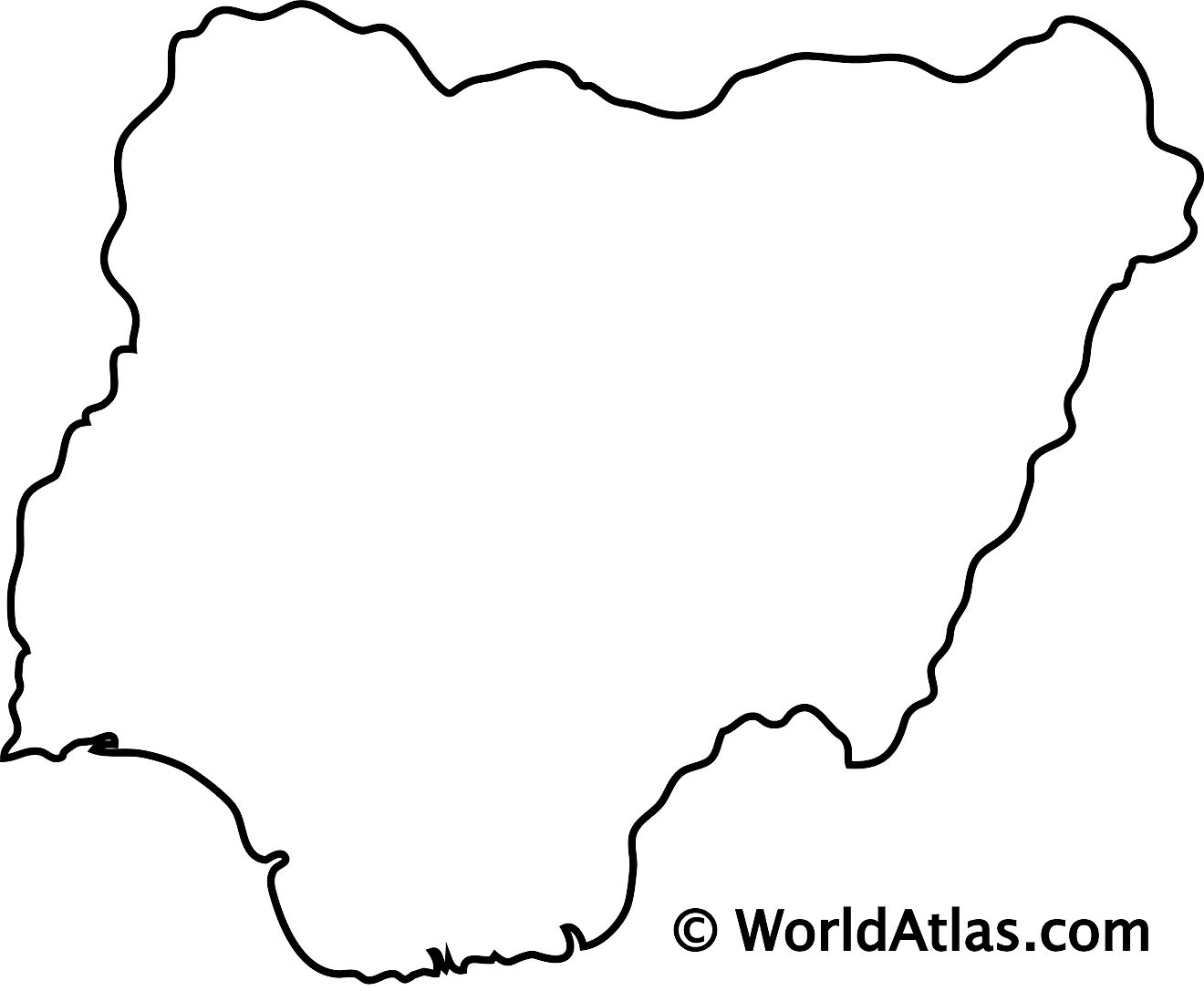
The blank outline map represents mainland Nigeria. The map can be downloaded for free and used for coloring or educational purposes like map-pointing activities.
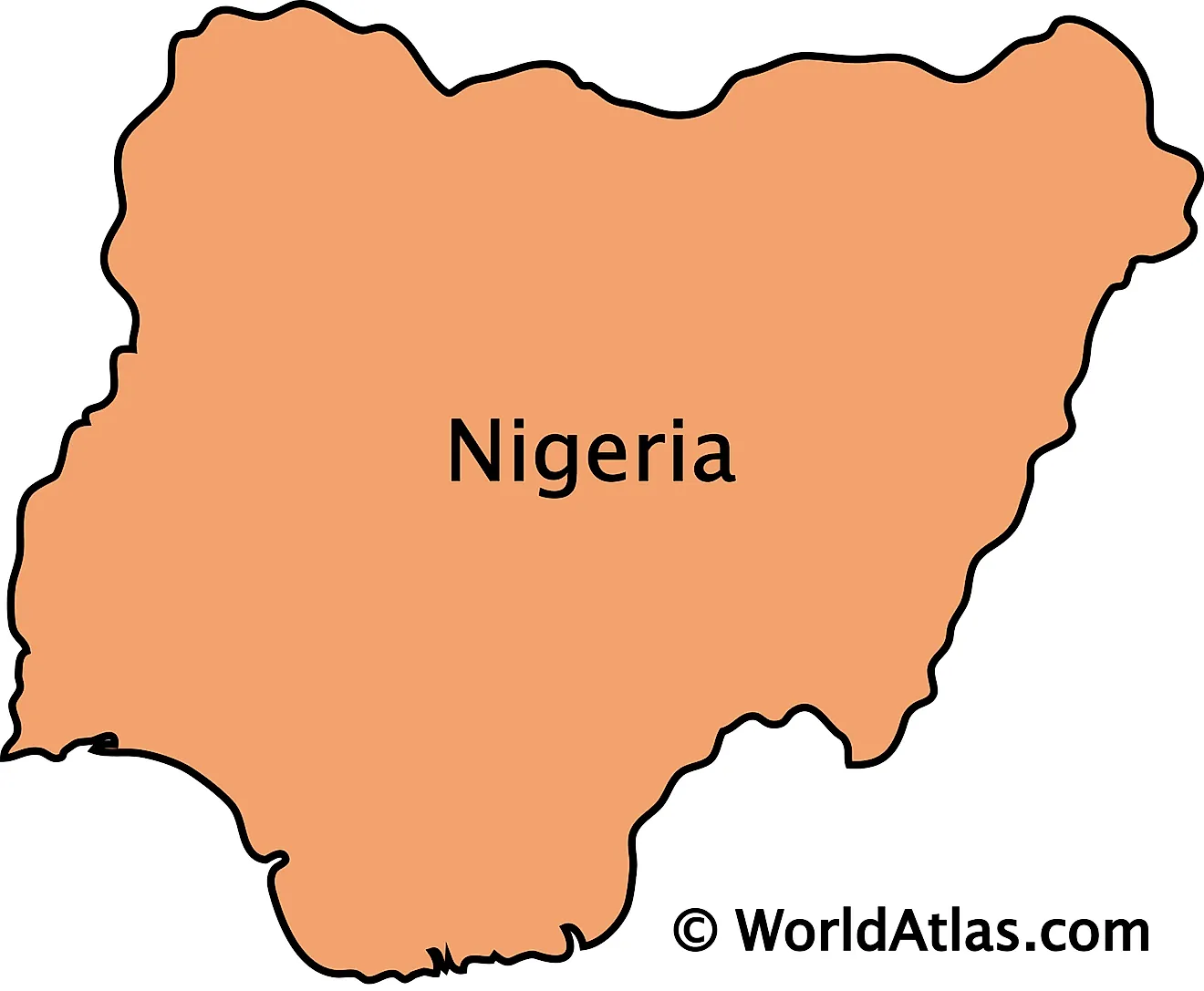
The outline map represents the mainland territory of the sovereign country of Nigeria. It also has several islands on the South Atlantic Ocean.
Key Facts
| Legal Name | Federal Republic of Nigeria |
|---|---|
| Flag |
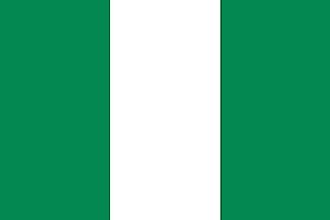
|
| Capital City | Abuja |
| 9 05 N, 7 32 E | |
| Total Area | 923,768.00 km2 |
| Land Area | 910,768.00 km2 |
| Water Area | 13,000.00 km2 |
| Population | 200,963,599 |
| Major Cities |
|
| Currency | Nairas (NGN) |
| GDP | $448.12 Billion |
| GDP Per Capita | $2,229.86 |
This page was last updated on July 31, 2023