7 Snake Infested State Parks In Indiana
When people think of snake-filled places in the U.S., they typically envision the dry deserts of the Western states of Arizona, New Mexico, and Utah. But snakes can also be found in the Midwest as well, especially hiding in the streams and woods of state forests. Indiana's state parks are prime territories for all manner of snakes, from harmless watersnakes to venomous copperheads and rattlesnakes.
There are 32 snake species in Indiana, which include four venomous ones: Copperheads, Cottonmouths, Eastern Massasauga Rattlesnake, and Timber Rattlesnake. While many believe snakes thrive in dry environments, many snakes are also strong swimmers and can flourish in creeks, streams, or swamps that you can find in state parks all across Indiana. Here are seven snake-infested state parks in Indiana to be aware of.
Brown County State Park

Brown County State Park is one of the most visited parks in Indiana. Located in Nashville, it's noteworthy for its rolling hills, historic fire towers, lakes, endangered Yellowwood trees, and, of course, many hiking, biking, and horse trails. Locals call it the "Little Smokies" due to its similarity to the Great Smoky Mountains National Park.
However, these hills contain more than just dirt trails; they are also home to a rich ecosystem of animals. This includes the many snakes that slither through the hills of Brown County.

Most of the snakes one will find in the park are harmless, such as milk snakes, water snakes, and garter snakes. However, there are two main types of venomous snakes one may encounter in this park: Timber Rattlesnakes and Copperheads. While snake bites are rare, there was a reported incident of a Copperhead bite in 2016 at the park. A camper was walking to a shower house in the park, wearing flip flops, when he was bitten by the snake. He was taken to the hospital and survived the incident.
It is key to always wear good shoes when walking through a wooded area and to be aware of your surroundings. Most of these snakes are not aggressive, but they will attack if threatened or stepped on.
Turkey Run State Park

Hikers who are looking for a challenge love to go to Turkey Run State Park. Its steep sandstone ravines and canyons are beautiful to look at and to hike through. The park's 5 Mile Challenge pits hikers against three canyons, a suspension bridge, and a ladder to ascend. There are plenty of other activities for those less interested in a challenge, like fishing on the Sugar Creek, visiting the planetarium at the Nature Center, renting a horse from the Saddle Barn, and visiting the historic Richard Lieber Log Cabin, named after the father of Indiana's state parks.

As you're running through Turkey Run State Park, be mindful of snakes underfoot. Of nonvenomous snakes, you're likely to find watersnakes along Sugar Creek or garter snakes hiding in trees, rocks, or underbrush. Residents have also reported seeing ratsnakes. As for venomous snakes, it's too far north to see timber rattlesnakes, but it is possible to encounter a Copperhead or the highly endangered Eastern Massasauga Rattlesnake.
This shy rattlesnake is between 18 and 30 inches long and blends in with its environment through its brown blotches on a grey body. They are noted for being slow-moving and primarily feed on mice, frogs, birds, and other snakes.
McCormick's Creek State Park

This lesser-known state park in Spencer, Indiana, is a lovely destination that is a part of the Bloomington metro area in the southern central region of the state. This was the first state park established in Indiana in 1916. It sees nearly 640,000 visitors each year who are eager to explore McCormick's Creek Canyon, see a waterfall at the Falls Trail, or explore the Wolf Cave Nature Preserve. Explorers have noted that this quarter-mile cave is quite narrow, so you have to crawl to get out at the end of it.
The park also contains the historic Old Statehouse Quarry, which provided limestone for use at the Indianapolis Statehouse. The Nature Center at the park provides information on some of the wildlife you might find at the park, such as turtles and snakes.

Most snakes in this park are harmless water snakes and can be spotted both in the waters of the falls or out on the trail. One you might encounter is the ring-necked snake. This is a tiny nonvenomous snake that measures about 10 to 15 inches and earns their name for a small sliver of color near its neck, which is usually bright red.
The park is too far north to encounter most timber rattlesnakes, but it is a known habitat of the venomous copperhead. Copperheads are used to being around people, which is why in some states like North Carolina, they account for the vast majority of snake bites. The venom is painful but is not life-threatening. The best advice to avoid them is not to try to interact with, kill, or otherwise harass these snakes.
Shades State Park

Located around 50 miles to the west of Indianapolis, Shades State Park is a little-known park with a very unusual name. Before becoming a park in the 1940s, the area was called the "Shades of Death." It's debated where it got that morbid name. Some claim it comes from the shadows of the trees, Native American battles, or a murder that took place in 1836, where the wife of Moses Rush killed him with an axe. She was later acquitted on grounds of self-defense.
Today, the park is a picturesque landscape with access to Sugar Creek canoeing and shady ravines. Determined hikers can hike and climb up six of these ravines via the 6 Ravine Challenge. The park truly comes alive at night, as it has one of the darkest skies in Indiana due to the lack of artificial light. The Wabash Valley Astronomical Society holds star-gazing parties regularly here.

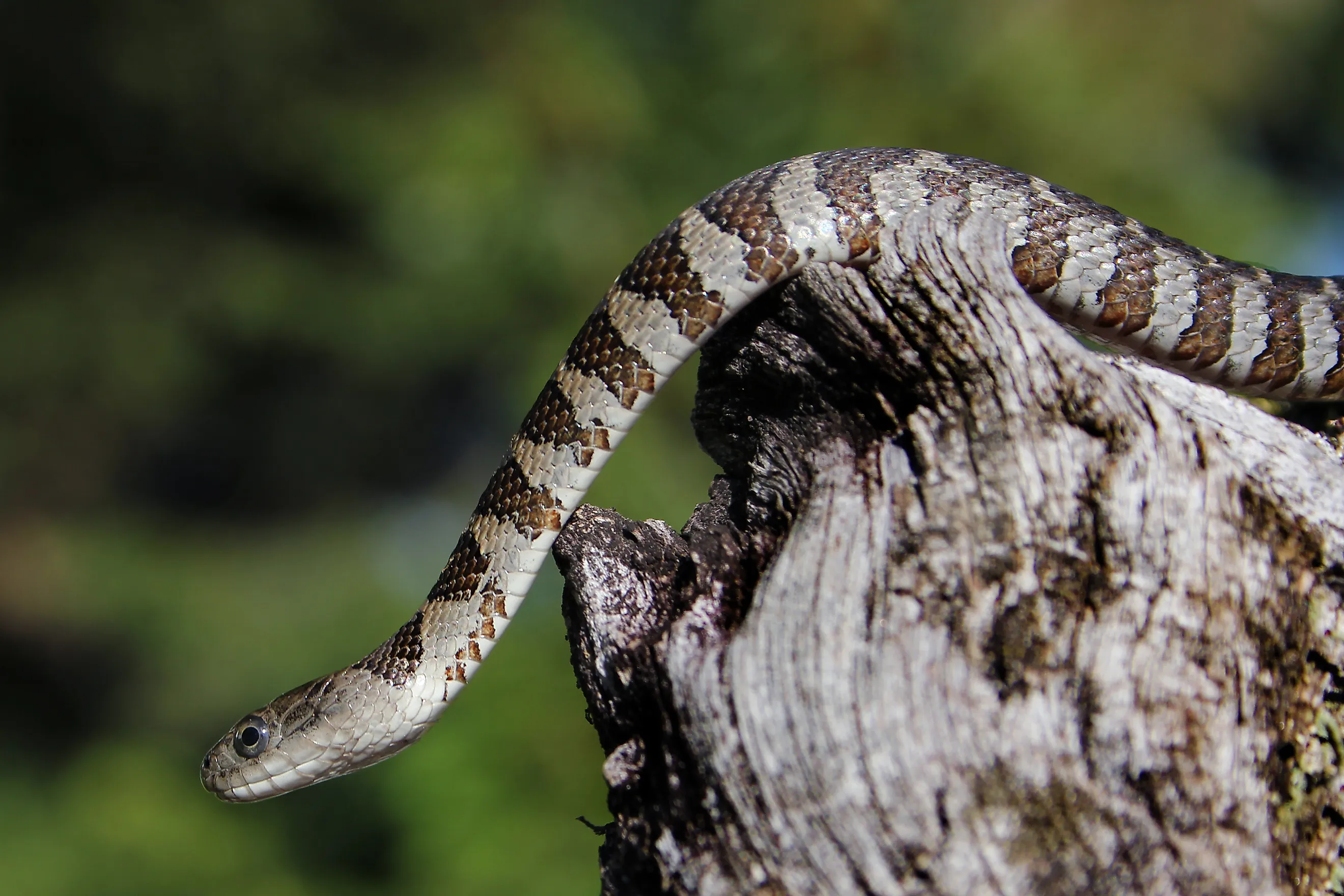
You also might run into snakes in the shadows of the ravines and waters. These include Hognosed Snake, water snakes, garter snakes, ring-necked snakes, milk shakes, and Black Rat Snakes. Rat snakes are usually black or brown with black patches. Interestingly, these snakes may hibernate in dens with a more venomous relative, the copperhead or timber rattlesnake.
Copperheads can be found at the Shades Creek Park, as it is only a 15-minute drive away from Turkey Run State Park. It can be easy to confuse snake species, especially from a distance, so it's good to give all of them some space if you encounter them.
Clifty Falls State Park

Located in the beautiful river town of Madison, Indiana, Clifty Falls State Park is a Hoosier treasure. Madison itself has a beautiful landscape with one of the largest contiguous historic districts in the U.S., and the limestone cliffs at Clifty Falls. It is primarily known for its waterfalls, including the 60-foot Big and Little Clifty, the 78-foot Hoffman, and the 83-foot Tunnel waterfall. Much like Turkey Run, it also has canyons and ravines to explore on foot.
Hikers and explorers have reported seeing many snakes in the park, including king and black rat snakes. The park also has a large population of copperheads. Hikers have seen nests of copperheads on trails, and folks who are passionate about these snakes will drive out just to see them.

Copperheads are identifiable by their dark brown hourglass blotches on their reddish brown bodies. They grow to be about 20 to 37 inches long. Typically, they prefer the woods, rock outcroppings, and swampy areas, all of which can be found in Clifty Falls State Park. Bites from these creatures are rare, but if you are bitten, it's important to stay calm, keep the bite at heart level, remove all clothing from the bite, and seek medical attention promptly.
Pokagon State Park

Pokagon State Park sits within the Home of 100 Lakes: Steuben County. The park is on the shores of one of the best lakes in the region, called Lake James. Founded in 1925, it's one of the earliest state parks in Indiana and still contains many stone and log structures that were designed by the Civilian Conservation Corps during the Great Depression. While many state parks wind down during the winter, Pokagon kicks into high gear with its twin-track toboggan run, which zips you down a track at 40 miles per hour.
Due to Lake James, Pokagon contains many different types of snakes. For example, there are garter snakes, water snakes, and the hognose snake. The hognose snake gets its name from its upturned snout, which looks like a pig's nose. They are 12 to 47 inches long and are mostly harmless.

The one venomous snake you might encounter in Pokagon is the rare Eastern Massasauga Rattlesnake. The word massasauga itself is a Chippewa word that translates to great river mouth. This reflects the fact that they are commonly found in and around water or marshes. Experts have noted that all the lakes in Steuben County make it an ideal habitat for these snakes.
As these snakes are smaller than other rattlesnakes, their rattles are not very loud and may be confused for an insect. As a result, it's important to be careful so as not to disturb these rare creatures.
Chain O' Lakes State Park

Every Hoosier knows the best way to have a good time is to spend some time out on the lake. As for which lake to choose, Hoosiers can pick more than one at places like the Chain O'Lakes State Park. Located in Northeastern Indiana in Albion, this park has nine lakes connected together in a "chain" of creeks and streams. Interestingly, only electric motors are allowed out on the lakes, but there are other fun activities at the park, such as 23 miles of trails, a one-room Stanley Schoolhouse, and a beach.

There have been no reports of venomous snakes at the park, but there have been quite a few sightings of nonvenomous snakes. These include garter snakes and the Northern Banded Water Snake. These aquatic creatures grow between 25 and 40 inches long and can be quite heavy. They are typically dark in coloration with a reddish belly. They usually eat small fish and amphibians, and prefer to hang out in shallow waters such as one of the nine lakes in Chain O' Lakes State Park.
These Indiana Snakes Are Mostly Harmless
Odds are, if you see a snake at this park, it will be harmless. Most of them are nonvenomous, and even the venomous ones want to be left alone. However, as the story from Brown County Park demonstrates, there is always a possibility of getting bitten by a snake, either by accident or by not being careful.
If you are bitten by a snake while in these state parks, you shouldn't try to capture the snake. Instead, you should keep the bite clean and seek medical attention as soon as possible. While these bites usually aren't deadly, they can be painful, and it's better to be safe than sorry.