Wildebeests, also known as gnu, are an iconic symbol of Africa. They are large, fast, and resilient animals native to the African Savanna, and often travel in massive herds on their profound journey known as the Great Migration, in search of food and water. Their movements, diet, and breeding are dictated by the rainfall and rainy seasons; their lives revolve around this never-ending search for grass and water. A fascinating fact about the blue wildebeest is that their fossils date back more than 2.5 million years and have been found in caves near Johannesburg, South Africa. Learn more about these special animals below.
Wildebeest crossing the Mara River during the Great Migration.
Wildebeests, or gnu, are scientifically known as Connochaetes. Gnu are in the kingdom Animalia, the phylum Chordata, the class Mammalia, the order Artiodactyla, and the family Bovidae.
Physical Description
Two wildebeests standing in the African grasslands.
They have a large, box-shaped head with curved horns. The front of their body is built strong and heavy, while their backside is slender, with long, thin legs. They have a gray coat with a black mane that resembles a horse's mane. Their beard, which extends down the length of their neck, can also be black, gray, or white. There are several types of wildebeests: the western white-bearded wildebeest that lives in the Mara-Serengeti ecosystem of Kenya and Tanzania, the eastern white-bearded wildebeest, which lives near the Gregory Rift, and the brindled blue species, which lives near the Zambezi River. They can weigh between 260 and 600 lbs, and they stand about 4.5 feet tall and 8 feet long. They normally live up to 20 years old, but in some cases can live up to 40.
Range and Habitat
A herd of wildebeests in the savannah in Kenya.
Wildebeests live in sub-Saharan Africa. Mostly in the plains of Eastern Africa and the edges of the forested woodlands of Southern Africa. Their population has been rising, and recent migrations from Tanzania's Serengeti National Park to Kenya’s Maasai Mara National Reserve include 1.2 to 1.5 million wildebeests. They primarily live in open woodlands, grasslands, and open plains. Their natural habitat is extremely drought-prone, forcing them to migrate and move frequently in search of new and different areas. They know how to follow rainfall patterns, which helps them find crucial water sources and edible grass.
Diet
A female blue wildebeest with her young calf (Connochaetes taurinus) grazing.
They are herbivores that are constantly traveling, looking for water and grass to feed on. They must drink water at least twice a day, which is why droughts can be so devastating to them. Their diet mainly consists of grass, but they will eat shrubs, trees, or even succulents when they cannot find grass. To receive the maximum amount of nutrients from the grass, they chew, swallow, regurgitate, and re-chew their food. They are able to do this because they have a four-chambered stomach. They also often roam and graze near zebras, because zebras use their incisors to eat the tough upper layers of grass, allowing for the wildebeests to eat the short, softer, undergrowth.
Behavior
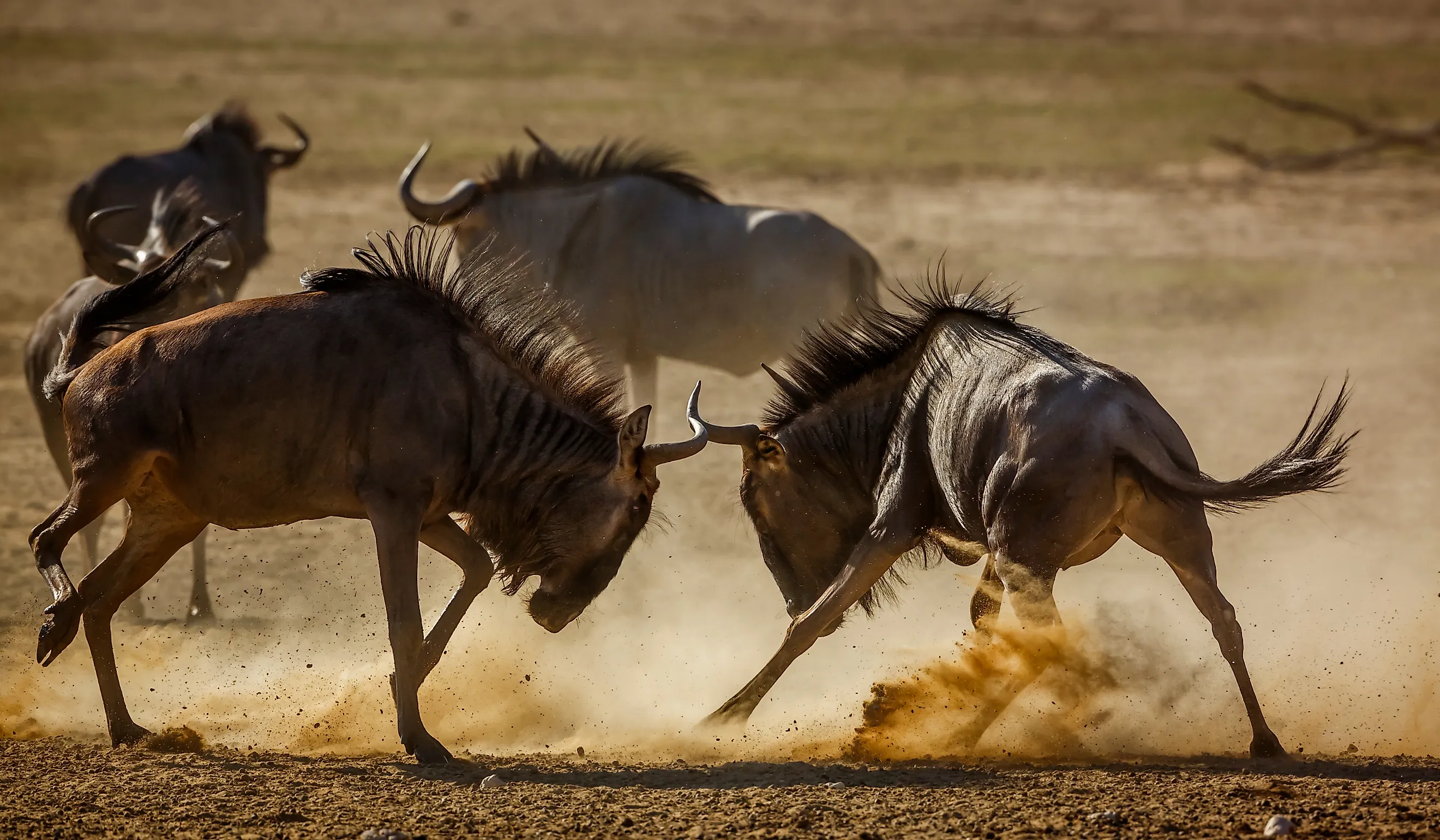
Two blue wildebeest (Connochaetes taurinus) fighting.
Wildebeests are known to be fully nomadic, although longer and broader migrations are often related to the blue wildebeest. Gnu are constantly migrating, covering over 900 miles per year, and never returning to a specific home or resting site. They are normally quite gentle and prefer to run away at the slightest threat or disturbance. They can reach speeds of almost 50 miles per hour and will run together as a herd, working together to scare away predators. They will also use vocalizations to scare off these predators, such as a wailing call, an extremely high-pitched wail, or a loud whistle. Wildebeests work cooperatively throughout their lives as a large herd. The only time they become aggressive is during mating season, known as their rut. It occurs right after the rainy season. The bulls will chase away their competitors, and male gnus will snort and make loud moaning sounds if there are females in the area. This sound is known as the big hum. It is a deep, low-pitched call.
Reproduction
Wildebeest (Connochaetes taurinus) and newborn calf.
A male wildebeest is ready to mate within three to four years of age. Males fight over territory when trying to mate with a female, and they attract that female by secreting feces, performing different movements, and making sounds. A temporary territory is created during their rut, about the size of a football field, and they defend it aggressively. Bulls will froth at the mouth, paw at the ground, leap, and rub their scent into the soil when they are ready to mate. Females that are ready to reproduce will swish their tails in the bull's face, raise them up vertically, and arch their backs with lowered legs. Their mating consists of dozens of occurrences in rapid succession. The female wildebeest's gestation period is 8.5 months long, and the mating season is timed so that calves are born during the rainy months of February and March. 80% of pregnant wildebeests give birth over the span of two to three weeks. The newly born calves can stand up and run within just a few minutes of being born, and they stay close to their mothers and their herd to avoid predators. Although they begin eating grass at just ten days old, they still receive milk from the mother for the first six months of their life. Once the wildebeest turns one, it can then go off and find their own group if they choose. Blue wildebeests can breed earlier: males at just 2 years old and females at 16 months. Although not every young calf makes it, there are around 500,000 wildebeest born in the wild every year.
Threats
Female lion (Panthera leo) hunting wildebeest.
Black wildebeest were hunted nearly to extinction in the late 19th century but recovered under protection; both black and blue wildebeest are currently assessed as Least Concern. Urban and agricultural development are not as great a threat to the gnus as they are to some other animals, because they graze and migrate through many protected parks and reserves. That does not mean those aren’t threats, though; their migration corridors have been threatened for decades due to human development, housing, roads, and agricultural expansion. If the wildebeests cannot follow their migratory routes, that is detrimental to their health and longevity, and that of their ecosystem. Water decline and drought are massive threats to wildebeests. During their Great Migration, they must cross the Mara River, which is a dangerous feat. Predators like crocodiles and lions await them on the other side, while they try to navigate the steep, soft terrain that already poses a massive threat to them as they try to enter the river.
A massive herd of wildebeest and zebras navigating a river during the Great Migration.
Besides the awaiting predators, the raging rough waters of the Mara River can cause catastrophic deaths to these beautiful wildebeests. Their predators include cheetahs, lions, leopards, crocodiles, African wild dogs, hyenas, and, sometimes, even jackals. They protect themselves from all of these predators by working cohesively as a team, letting out loud calls that alert their herd that danger is coming. They will stomp on the ground and begin running, which can cause a stampede. These stampedes are driven by threats or predators, with heightened stress within the group causing a crowd mentality, in which they all begin to run. If one wildebeest is scared and begins to run, it is likely the rest of the herd will follow before even realizing what is truly happening at that moment. They have also sadly been sought out for trophy hunting, as well as being killed for not only sport, but their meat as well.
Wildebeests are a keystone species that are vital to their ecosystems. Often referred to as climate heroes, these magnificent creatures do so much for the African savanna. They help suppress wildfires by the vast amount of grazing they do every day, keeping grasses short. As they migrate, their hooves aerate the soil, and their dung fertilizes the land, allowing for more plant growth every year. The health and function of the African savanna and the Serengeti-Mara ecosystem depend heavily on the lives and migration of wildebeests.