return to Graphic Maps

worldatlas.com
dot
maryland map description facts famous people flag landforms latitude longitude maps symbols time timeline travel weather
Africa | Antarctica | Arctic | Asia | Australia/Oceania | Caribbean | Central America | Europe | Islands of the World
Middle East | North America | South America | World Atlas | WIN $100 here

dot
MARYLAND: arrow Description Fast Facts Famous Natives Flag Land Statistics Landforms Lat/Long
MARYLAND: arrow Links Maps Symbols Time Timeline Travel Info Weather


arrow USA PAGE

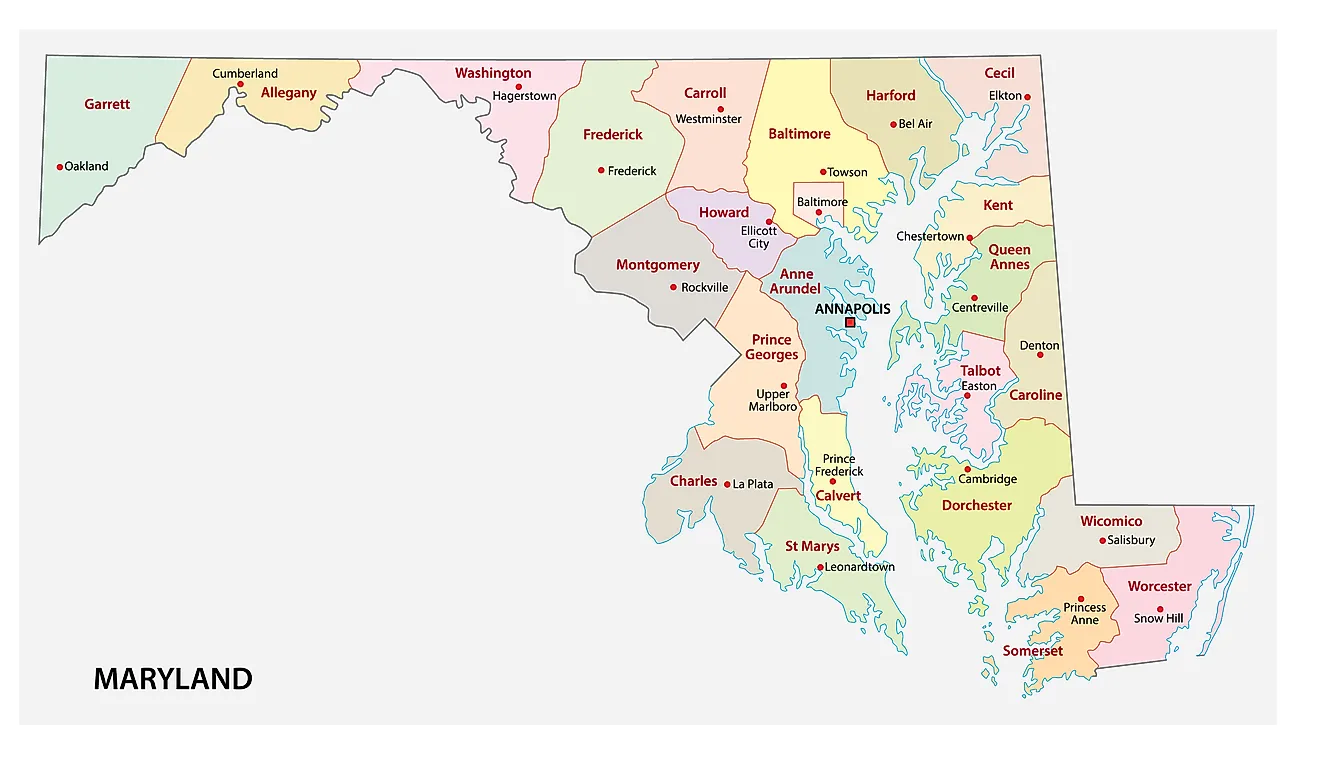
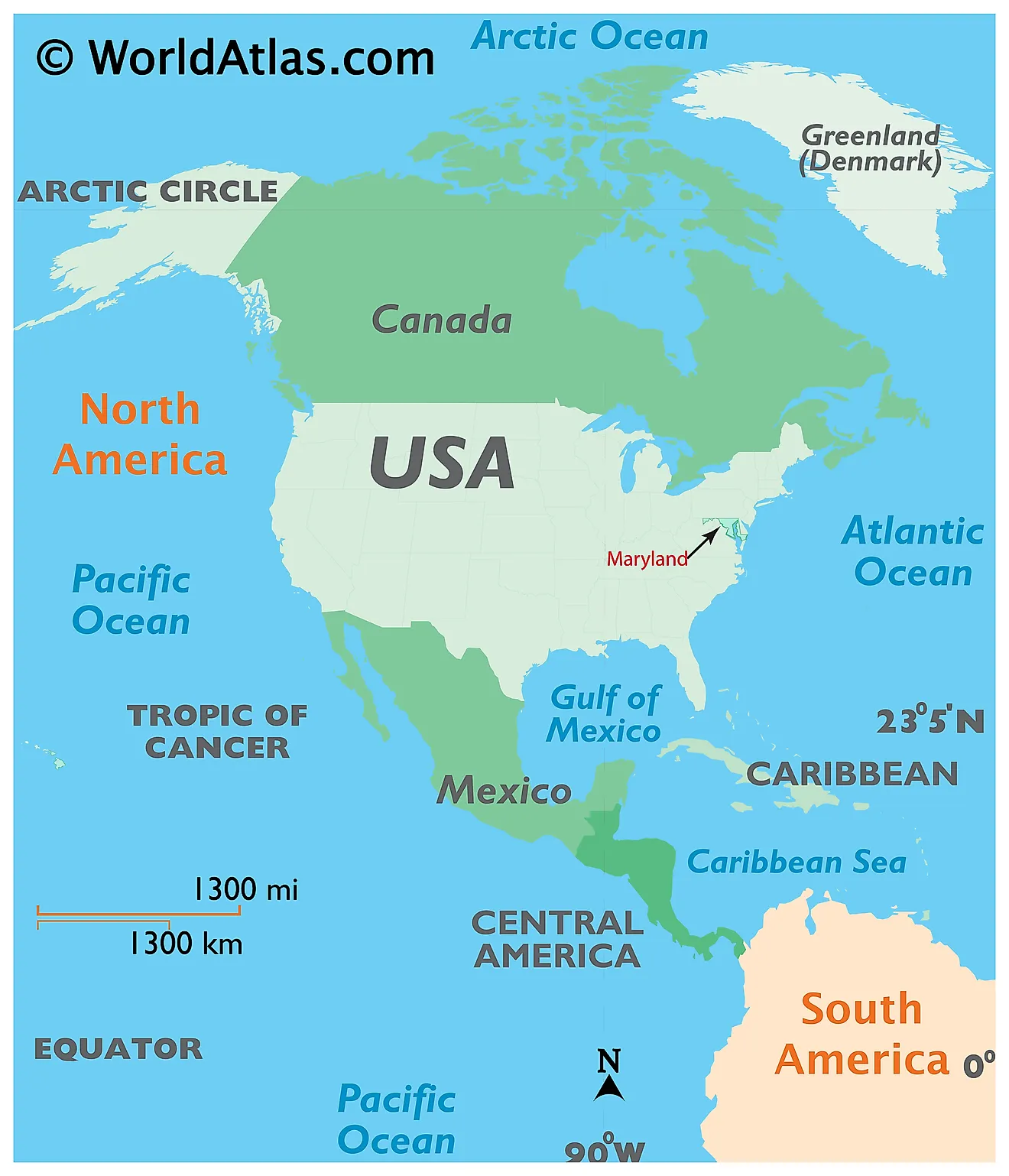
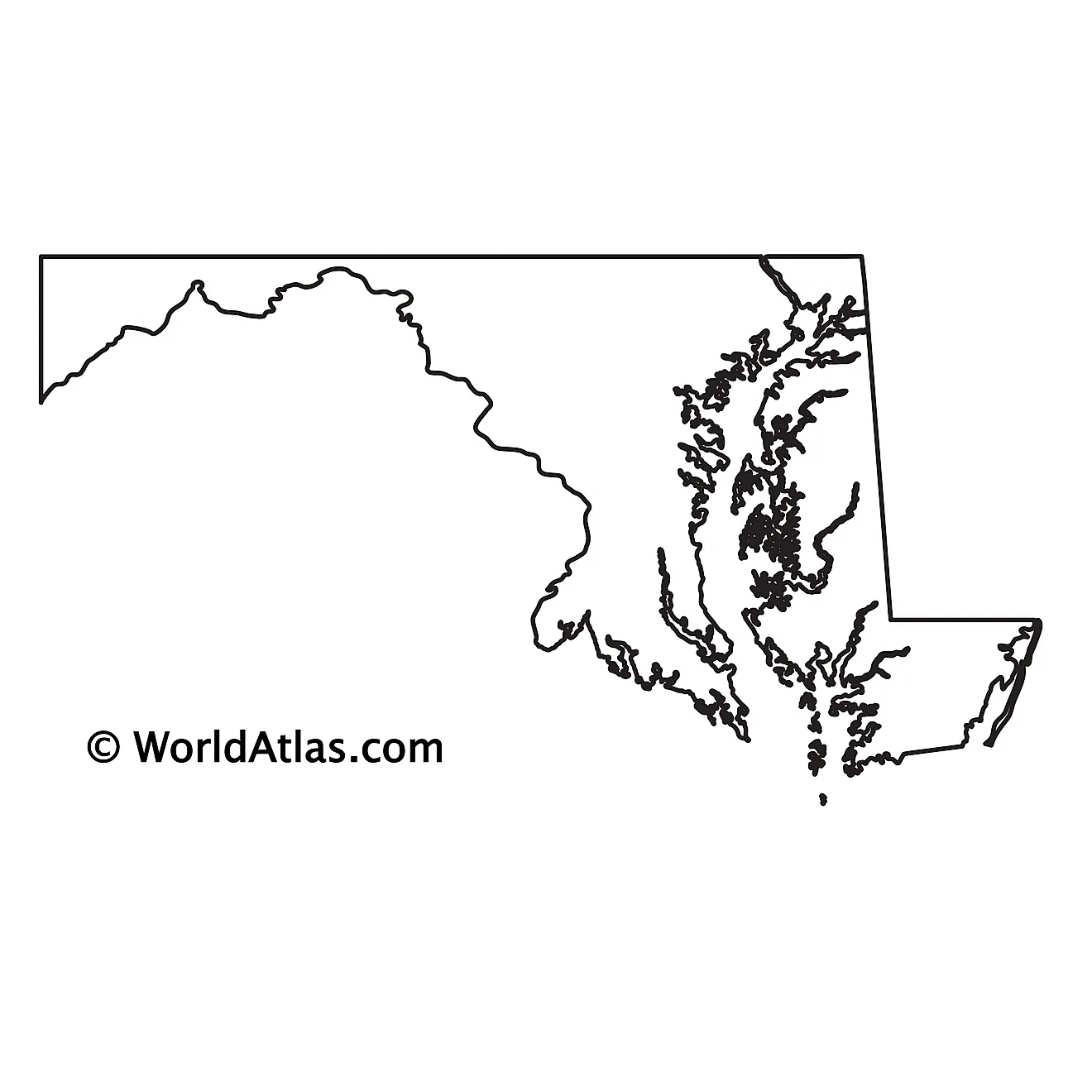
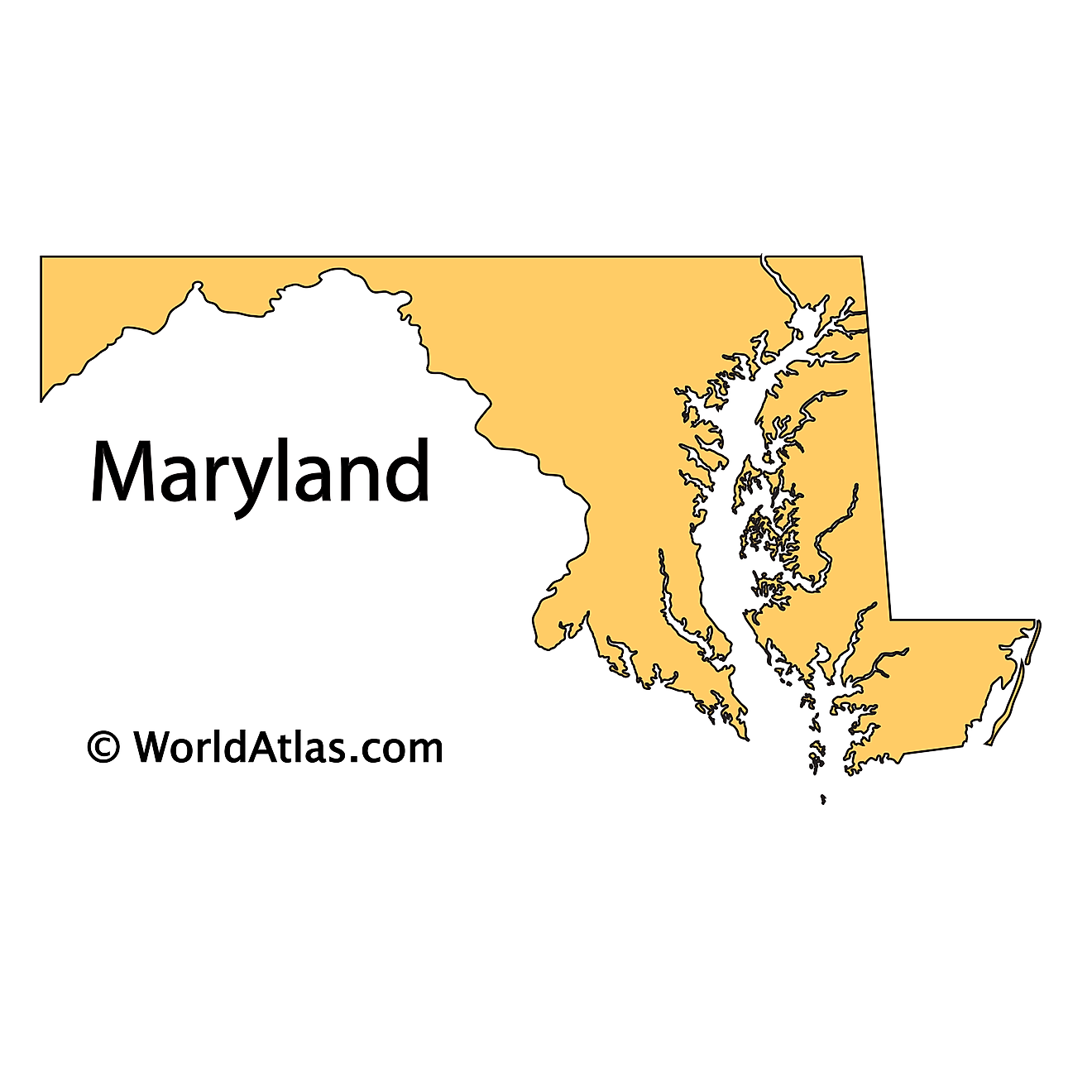
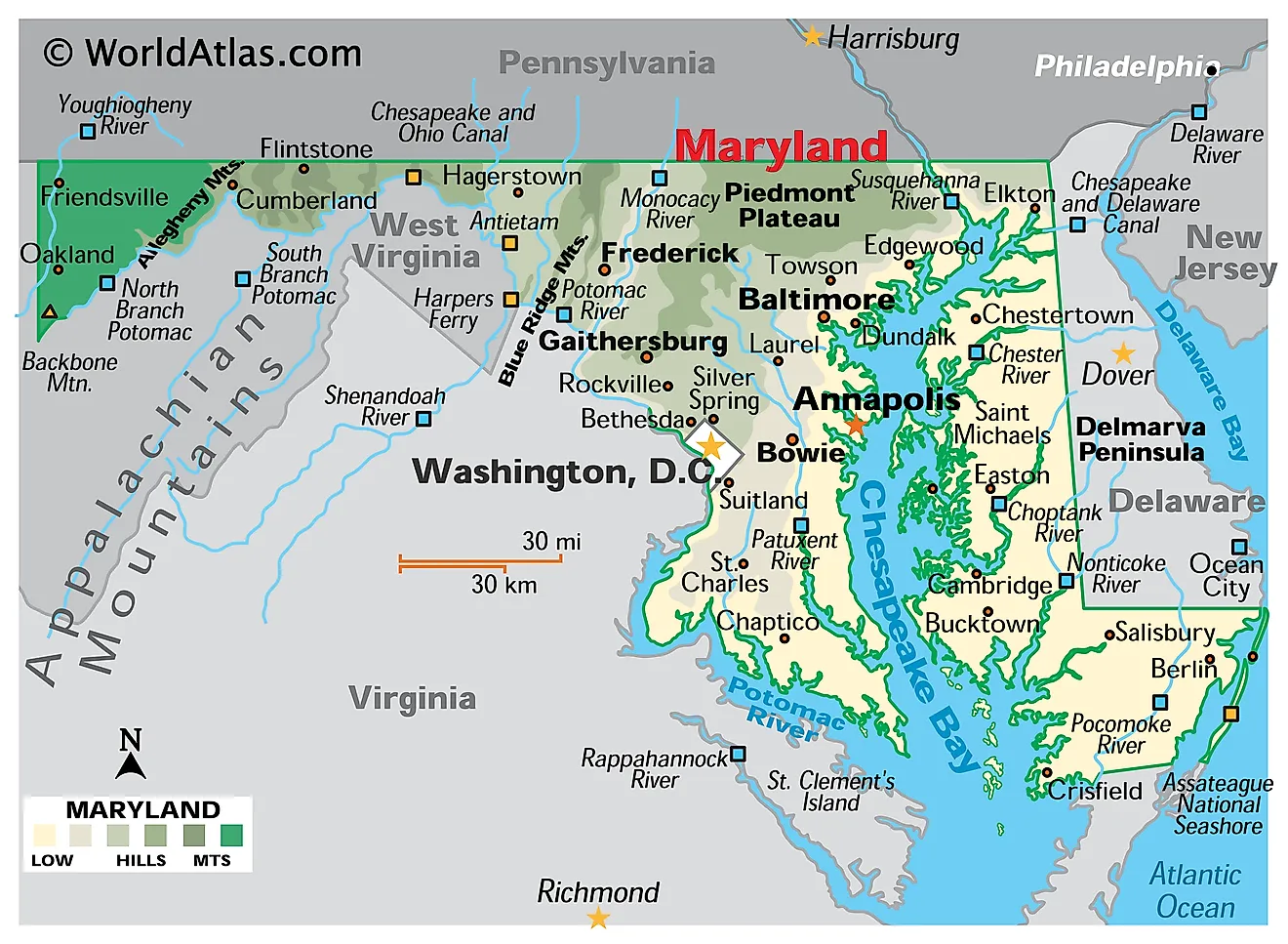
map of maryland, us maps Maryland Map PRINT THIS MAP
A Brief Description

For many centuries Native American Indians inhabited this land called Maryland. Most of those Indians belonged to a large family of tribes known as the Algonquins that lived peacefully along the Chesapeake Bay; fishing and hunting, and trading with their neighbors on the Atlantic Ocean coastline

In 1524, Giovanni da Verrazano, an Italian explorer sailing under the French flag, explored the eastern seaboard of North America, and is considered the first European to visit the Chesapeake Bay area. At the turn of the 17th century, Capt. John Smith explored the Chesapeake Bay. A few years latter, William Claiborne, a wealthy English trader from the Virginia colony established the first English settlement here.

In 1629, George Calvert, an English politician, applied to King Charles for a royal charter of land in this new world. Calvert died suddenly in 1632, but his son, Cecil Calvert (Lord Baltimore) was later granted that charter, and the new colony was named Maryland in honor of the Queen Consort of Charles I.

Cecil Calvert remained in England, but his brother, Leonard Calvert, sailed across the Atlantic in November of 1633; his ships carried a few hundred brave souls that came ashore on St. Clement's Island in the Potomac River, and the new colony was born.

As the initial inland settlements of Annapolis and St Mary's struggled to survive, English colonists continued to arrive in Maryland, most as indentured servants. Baltimore, named after Cecil Calvert, soon emerged as a viable and vital seaport and the colony began to prosper. Subsequently, African slaves were imported to work in the fields of the growing tobacco industry.

The on-going dispute between the Penn family of Pennsylvania, and the Calvert family of Maryland over the border between the two colonies finally erupted into war in 1730. After years of violent and bloody conflicts, England's King George II negotiated a cease-fire in 1738. Shortly thereafter, the English surveyors, Charles Mason and Jeremiah Dixon, delineated the official border, and this original property dispute decision, the Mason-Dixon Line, would later become a symbolic dividing line between the Northern and Southern states during America's Civil War.

In the 1770's, trade restrictions and high taxes (the Stamp Act) imposed by England's parliament and King George did not sit well with the citizens and merchants of Maryland, and for that matter, in all of the original thirteen colonies. Though originally opposed to independence from Great Britain, it was Maryland that suggested representatives from each colony meet in Philadelphia to find a solution. That meeting, or the First Continental Congress, occurred in 1774, and the Revolutionary War was just around the corner.

In June of 1776, a committee of the Second Continental Congress consisting of John Adams of Massachusetts, Benjamin Franklin of Pennsylvania, Thomas Jefferson of Virginia, Robert R. Livingston of New York, and Roger Sherman of Connecticut (the "Committee of Five") was formed to draft a declaration of independence from Britain. Church bells rang out across Philadelphia on July 4, 1776.... signaling that the Declaration of Independence was approved and officially adopted and signed in Philadelphia's Independence Hall.

That War of Independence was successfully fought on many fronts, and Maryland certainly played its part. In 1787, the U.S. Constitution was drafted and signed, and Maryland became the 7th state to join the new country, with Annapolis as its capital. In 1791, Washington D.C., designed by the French architect Major Pierre-Charles L'Enfant, was created from land donated by Maryland and Virginia, and became the nation's permanent capital.

During the War of 1812, a 2 1/2 year conflict between America and Great Britain, there were fifteen states in the Union. The British raided towns along the Potomac River and Chesapeake Bay, even burning the Capital Building and the Whitehouse in Washington D.C., forcing President James Madison to flee. The British later tried (unsuccessfully) to capture the port of Baltimore by bombarding Fort McHenry, Baltimore's main defensive structure. That battled lasted over 24 hours, and Francis Scott Key, a native of Frederick, Maryland, after witnessing the nighttime assault was inspired to pen the Star Spangled Banner, the National Anthem of the United States of America.

State's rights, and the continuation of slavery within the southern states were the primary catalysts for America's bloody Civil War (1861–1865); the deadliest war in American history. In Maryland some plantation owners sided with the Confederacy and many of those secessionists were ordered imprisoned by President Lincoln.

On the other hand Maryland's government joined the Union, eventually adopting a new constitution that ended slavery forever. With Marylanders fighting on both sides, neighbors fought neighbors, and the state witnessed many battles, including the Battle of Antietam, the first major conflict of the war to take place on Northern soil. It was the bloodiest single-day battle in American history, with about 23,000 casualties.

Because Maryland remained (for the most part) within the Union during the Civil War, it didn't undergo reconstruction like the other Southern States. However, as a one-time "slave state," Maryland experienced its share of racial tensions, and those social divisions took many years to resolve.

In 1904, as the state's economy began to surge back to life, The Great Baltimore Fire raged in Baltimore. It was a significant event for Maryland's largest city and the state as a whole; 1,500 buildings were destroyed and over 35,000 were homeless.

World War I brought expansion and new jobs to Maryland's military bases and facilities. That growth was tempered somewhat by the Great Depression of the 1930's, but the economics of World War II changed everything; many new businesses opened their doors and the state built the needed airports, bridges and highways.

Maryland experienced tremendous suburban growth in the 1980's, especially surrounding the metropolitan Washington, D.C. area. Manufacturing industries diversified across the state, and Baltimore soon ranked as the nation's second busiest port in foreign tonnage.

In the 21st century, Maryland morphed into one of the nation's premier vacation destinations. Its major attraction (without doubt) is the Chesapeake Bay, the largest estuary in the United States. Today both sides of the Bay are ringed with beaches, small fishing towns and vacation homes, and its waters are a seafood paradise, replete with huge quantities of blue crabs, calms, oysters and rockfish.

From the popular resort of Ocean City to the capital city of Annapolis, on westward to the Allegheny Mountains, the "Old Line State" of Maryland has numerous (quality) family attractions and historic points-of-interest, including Antietam National Battlefield, Fort McHenry National Monument, Harpers Ferry, Baltimore's Inner Harbor; U.S. Naval Academy in Annapolis and the Assateague Island National Seashore, to name but a few.

In Affiliation with AllPosters.com
Maryland Postcard
Travel the World through Poster Art!


Contact Us | Privacy Statement

Copyrighted by Graphic Maps
All rights reserved!

All maps, graphics, flags and original descriptions created by Graphic Maps, a d/b/a of the Woolwine-Moen Group, unless otherwise noted and/or directly linked to the source, and use of same for any application whatsoever (with the exception of outline maps) requires written permission.

We make no copyright claim on any statistical data on this page, nor on any non-original graphics, and/or pictures not produced by us. Certain statistical data is gathered from the CIA World Factbook, as well as numerous public domain reference materials.

Every effort is made to be as accurate as possible when disseminating information on any worldwide destination. We are not responsible for unintentional data entry errors or omissions. If you would like to submit an addition, change or correction, or suggest a new link, please forward it to our map department and we will give it our immediate attention.


return to Graphic Maps
worldatlas.com

dot maryland map PRINT THIS MAP
Attractions

ANNAPOLIS - here!
BALTIMORE - here!
Famous Natives

MARYLAND FAMOUS NATIVES - here!

Fast Facts

MARYLAND FAST FACTS - here!

In Affiliation with AllPosters.com
Baltimore Harbor at night
Travel the World through Poster Art!


Flag and Symbols

MARYLAND FLAG AND SYMBOLS - here!

Landforms

MARYLAND LANDFORMS - here!

Land Statistics

MARYLAND LAND STATISTICS - here!

Latitude and Longitude

MARYLAND LATITUDE AND LONGITUDE - here!

Links

MARYLAND LINKS - here!

Maps

MARYLAND MAPS - (a large selection)
here!

Time

TIME IN MARYLAND - here!

Timeline of History

MARYLAND TIMELINE - here!

In Affiliation with AllPosters.com
Maryland Statehouse
Travel the World through Poster Art!


Travel Information

MARYLAND TRAVEL - here!

Weather

MARYLAND WEATHER - here!

dot


search and find


dot U.S. States

arrow Alabama

arrow Alaska

arrow Arizona

arrow Arkansas

arrow California

arrow Colorado

arrow Connecticut

arrow Delaware

arrow Florida

arrow Georgia

arrow Hawaii

arrow Idaho

arrow Illinois

arrow Indiana

arrow Iowa

arrow Kansas

arrow Kentucky

arrow Louisiana

arrow Maine

arrow Maryland

arrow Massachusetts

arrow Michigan

arrow Minnesota

arrow Mississippi

arrow Missouri

arrow Montana

arrow Nebraska

arrow Nevada

arrow New Hampshire

arrow New Jersey

arrow New Mexico

arrow New York

arrow North Carolina

arrow North Dakota

arrow Ohio

arrow Oklahoma

arrow Oregon

arrow Pennsylvania

arrow Rhode Island

arrow South Carolina

arrow South Dakota

arrow Tennessee

arrow Texas

arrow Utah

arrow Vermont

arrow Virginia

arrow Washington

arrow West Virginia

arrow Wisconsin

arrow Wyoming

arrow Washington D.C.


arrow USA PAGE