What's Outside the Universe?
Imagine reaching the edge of everything that has ever existed, every galaxy, every star, every planet, and discovering there is ... nothing. Or perhaps something even stranger. Scientists still don't know what, if anything, lies beyond the universe, making it one of the greatest unsolved mysteries in science.
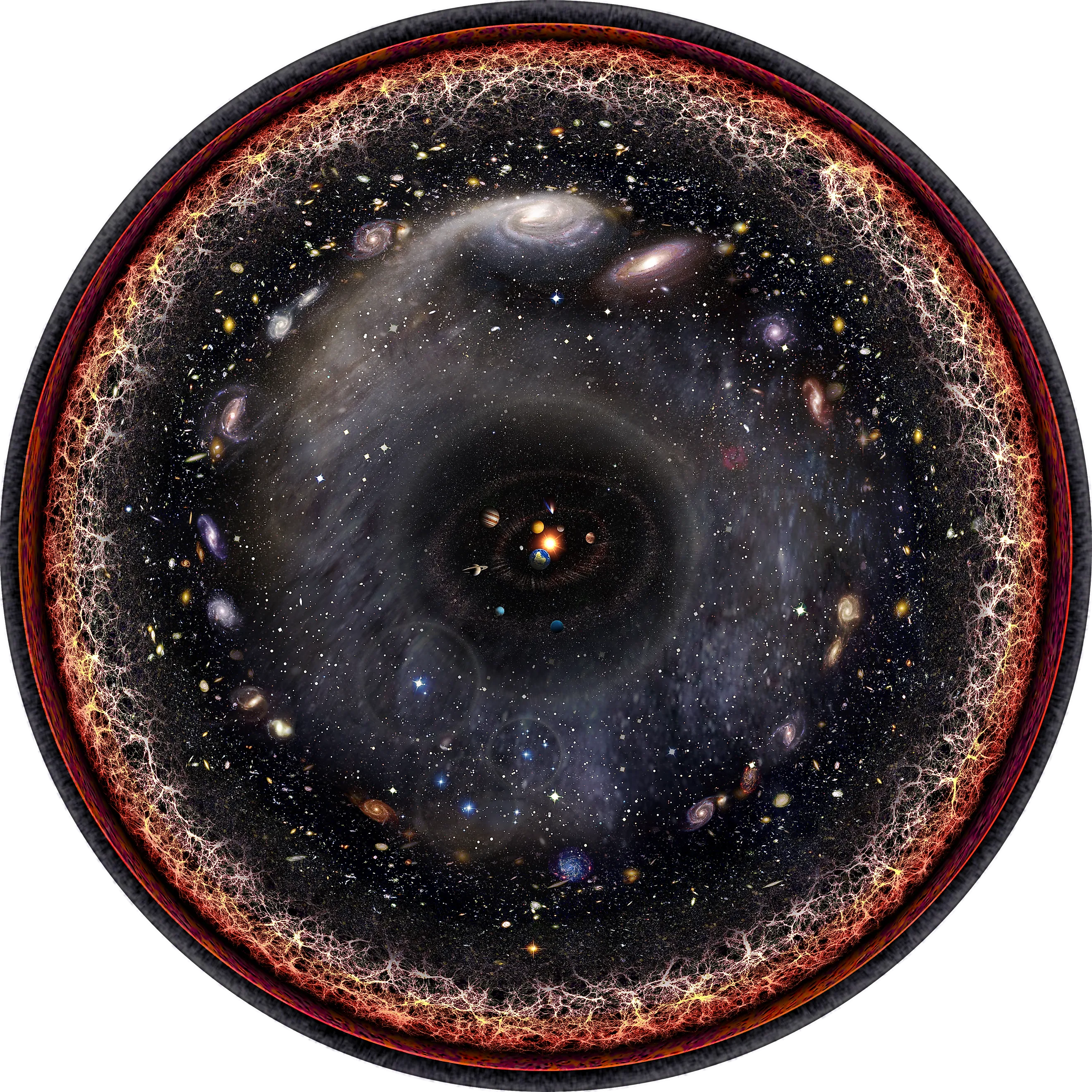
The observable universe is about 93 billion light-years across, yet it could be only one visible patch of a far larger cosmos. Scientists do not know whether the entire universe is finite or infinite, and the idea of something existing "outside" it may have no physical meaning at all.
The boundary astronomers can identify is not a wall, cliff, or shell. It is a cosmic horizon created by the universe's 13.8-billion-year age and the limited time light has had to reach us. Beyond that horizon may lie more galaxies and space, but they would still be part of the universe rather than something outside it.
Does The Universe Actually Have An Edge?
Current observations reveal no cosmic wall or outer border. The universe may extend infinitely, or it may be finite but unbounded, meaning space could connect with itself without presenting an edge that a traveler could reach. The observable universe is different. Its horizon surrounds every observer, much as every person standing in a landscape has a horizon centered on their own position. It marks the limit of what we can currently see, not necessarily the end of space.
93 billion light years is difficult to imagine, so here's another comparison: If Earth were shrunk to a grain of sand and the observable universe were reduced by the same scale, the visible cosmos would still stretch several light-years.
Even more surprising, scientists believe the observable universe is only a small portion of the whole universe. Beyond what we can see may be countless more galaxies, hidden because their light has not had enough time to reach us.
Why We Can't Currently See Beyond It

The universe is about 13.8 billion years old, and light travels at the fastest speed possible, about 186,000 miles (300,000 kilometers) every second. Even at that incredible speed, light from extremely distant regions still hasn't had enough time to arrive.
It's a bit like standing in a dense fog. The landscape continues beyond the mist, but you can't see it because the light hasn't reached your eyes. That means unimaginably large regions may exist beyond today's observable horizon. Some could become visible as their ancient light finally reaches us, while others may remain permanently inaccessible if cosmic expansion continues to accelerate.
Could There Be Something Outside?

Here's where the mystery deepens. Some scientists think asking what's outside the universe is similar to asking what's north of the North Pole. The question itself may not have an answer because the universe includes space itself, leaving no known external location that could be described as "outside."
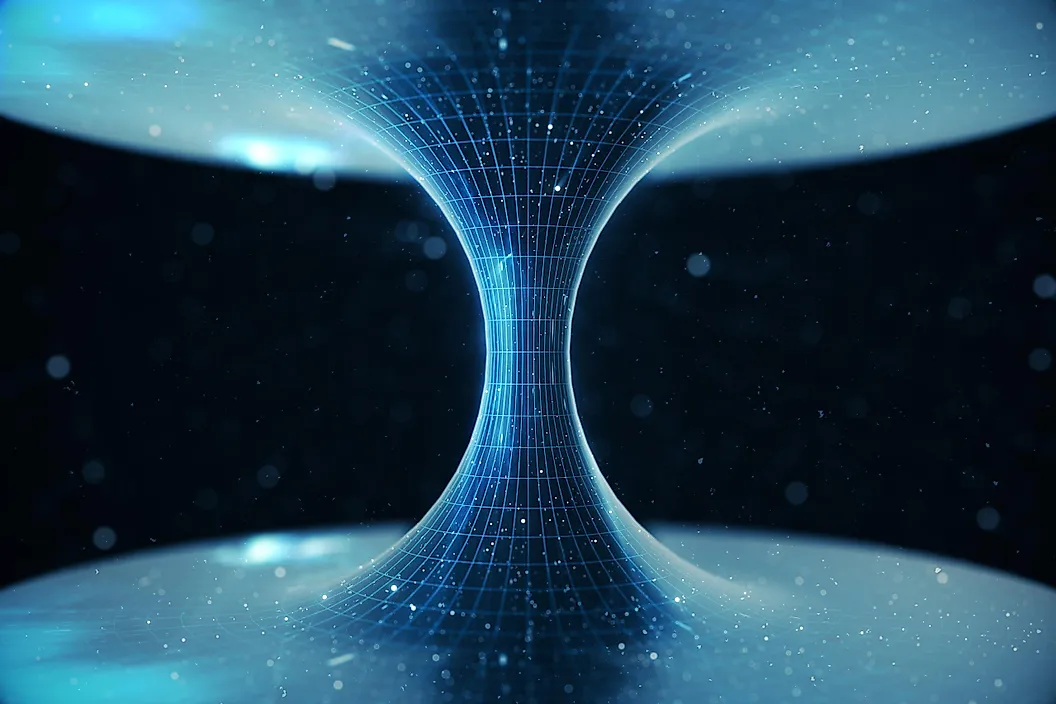
Imagine an ant crawling across the two-dimensional surface of a balloon. It could continue without reaching an edge even though the surface has a finite area. The analogy illustrates how space might be finite yet unbounded; the balloon's interior and the room surrounding it do not represent known features of the real universe. This doesn't prove our universe sits inside something bigger, but it offers one way to visualize an otherwise impossible concept.
Another possibility is that our universe is only one of many, a vast "multiverse" filled with separate universes that may have completely different laws of physics. If that idea is correct, some universes might contain stars unlike anything we know, while others may never have formed galaxies at all. So far, however, there is no direct observational evidence that these other universes exist.
Could You Reach The Cosmic Horizon?

There is no known direction in which a spacecraft could "leave" the universe because the universe includes space itself. Even reaching the farthest regions we can currently observe is not simply an engineering problem. Under the standard cosmological model, much of the observable universe is already beyond the distance that a signal leaving Earth today could ever cross.
If future engineering breakthroughs allowed a craft to travel at a fraction of the speed of light, the universe itself adds another barrier. Space does not expand outward from a central point. Instead, distances between widely separated, gravitationally unbound galaxies increase as the universe expands.
It's like trying to swim across an ocean while the shoreline is constantly pulling away faster than you can move forward. No matter how powerful the engine, the destination keeps shifting farther into the distance. This is why the idea of "reaching the edge of the universe" breaks down. At sufficiently great distances, galaxies can recede from us faster than light because the space between us is expanding. Locally, however, no spacecraft, particle, or signal can move through space faster than light.
The Universe May Be Far Bigger Than We Imagine

One of the strangest discoveries of modern astronomy is that the universe appears remarkably flat on enormous scales. That doesn't mean it's flat like a sheet of paper. Instead, it describes the geometry of space itself. Planck measurements, particularly when combined with other cosmological observations, are consistent with spatial flatness to extremely high precision. If that continues beyond what we can observe, the universe could extend far beyond our cosmic horizon.
Flatness does not prove that the universe is infinite. Space could be flat and endless, or it could possess a finite topology that loops back on itself at scales larger than we can currently detect.
Will We Ever Know?
Every deeper observation is like climbing a taller mountain. The view gets bigger, but the horizon never disappears. Scientists continue searching for clues by studying the oldest light in the universe, mapping galaxies, and measuring how quickly space expands. More powerful telescopes can reveal fainter galaxies and earlier chapters of cosmic history within the observable universe, but no telescope can collect light that has never had time to reach us.
The ultimate answer may require entirely new physics, or it may turn out to be a question that nature simply doesn't allow us to answer. For now, the greatest mystery isn't that we haven't found the edge of the universe. It's that everything we've ever known may be only a small window into something vastly larger. Beyond that window could lie trillions more galaxies, or a reality so different that today's physics cannot yet describe it.