Maps of Florida
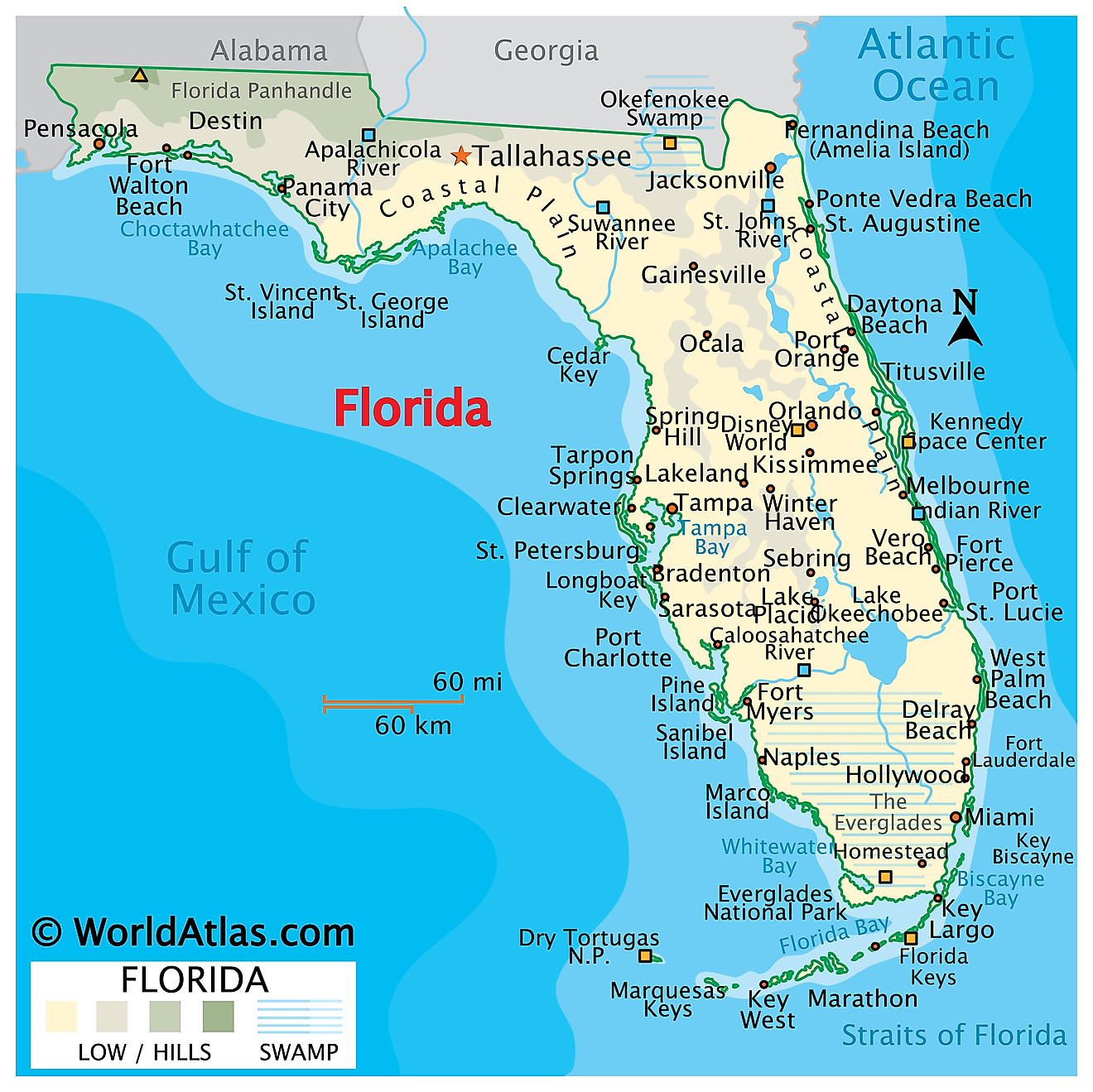
Florida, also known as the Sunshine State, is a peninsula located in the Southeastern United States. It shares a border with Alabama and Georgia and is the only state with a coastline along both the Atlantic Ocean and the Gulf of Mexico. The capital, Tallahassee, is in the state's northern panhandle region. In Northeast Florida, along the St. Johns River, sits Jacksonville, the most populous city.
The United States ratified Florida as a territory in 1821 after acquiring it from Spain. It later became a US State in 1845, making it the 27th US state.
Area
Spanning an area of 65,758 mi2 (170,312 km2), Florida is the 22nd largest state in the United States. It is about half the size of Finland and about twice that of Maine. Around 12,133 mi2 (31,424 km2) of the state's area is water, which accounts for nearly one-fifth of the state's total area.
Bodies Of Water
Florida contains over 7,700 lakes, the largest being Lake Okeechobee, spanning approximately 730 mi2 (1891 km2). The state also has many rivers, totaling more than 25,000 miles (40,000 kilometers) in overall length. The longest river in the state is St. Johns River, which is over 300 miles (483 kilometers). St. Johns River is particularly unique, as the Atlantic Ocean tide causes it to reverse its direction of flow twice a day. The Suwanee River is the second largest at 246 miles (396 kilometers). The Miami River is only about 5.5 miles (8.9 kilometers) long but is a significant body of water in Florida due to its presence running through the city of Miami.
Geographical Characteristics
Florida is extremely flat. The state's highest point of altitude is Britton Hill, at 345 feet (105 meters). Popular tourist destinations include the Florida Keys, The Everglades, and the Big Cypress Swamp. The state has a humid, subtropical climate, and it rains about 40 to 60 inches (101 to 152 centimeters) every year.
Florida is divisible into four primary geographical regions: The Coastal Plains, the North Central region, the Everglades, and the Keys.
The Coastal Plains
The Coastal Plains region accounts for a large portion of the state's land. It is generally flat, with sand, gravel, and clay sediments that slope towards the Atlantic Ocean and the Gulf of Mexico. This region is filled with marshes and wetlands, specifically the Big Bend area in the panhandle, which is sparsely populated due to dense marshes and woodlands. Nationally, the Coastal Plains extend from the New Jersey coastline all the way down to the Texas-Mexican border coast.
North Central
The North Central region is located in the northern part of the state. It is slightly hilly compared to the rest of Florida's flat topography. Pine forests, magnolia trees, and Spanish moss populate the area. Britton Hill (Florida's highest point) is located in this region as well.
The Everglades
The Everglades region, often referred to as the "River of Grass," is located in the southern part of Florida and has a marshy, swampy terrain. This large tropical wetland area houses a wide variety of plant and animal species, such as Bromeliads, native wildflowers, the West Indian Manatee, the American Crocodile, the American Alligator, and the Florida Panther. The Everglades National Park is a UNESCO World Heritage site.
The Florida Keys
The Florida Keys, near the southern tip of Florida, is an archipelago consisting of over 1,700 small islands. One of the most famous tourist destinations in this region is Dry Tortugas, a 100 mi2 (259 km2), remote national park with an impressive variety of bird species, coral reefs, and marine life.
Counties Map
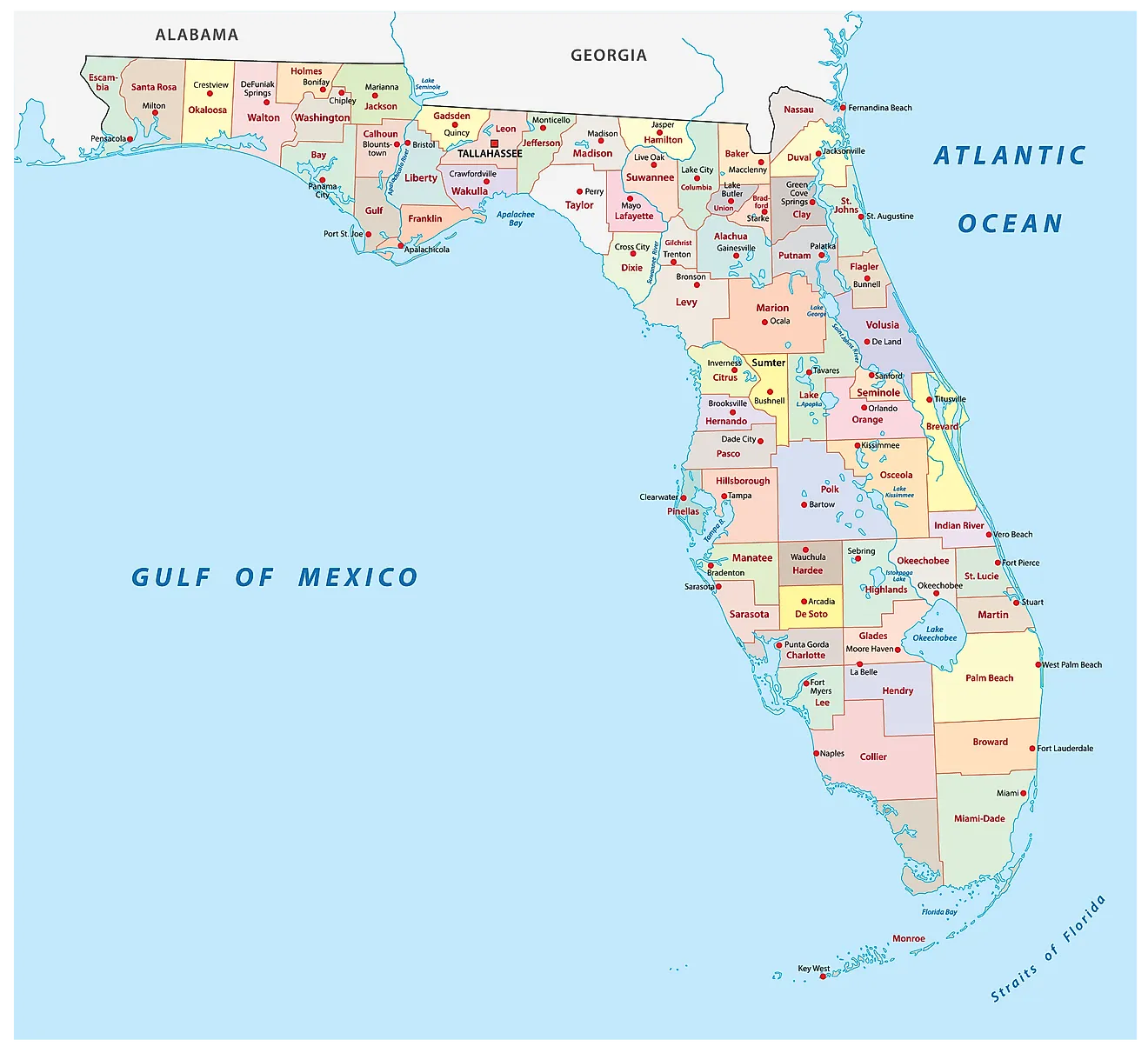
The State of Florida is divided into 67 counties. In alphabetical order, these counties are: Alachua, Baker, Bay, Bradford, Brevard, Broward, Calhoun, Charlotte, Citrus, Clay, Collier, Columbia, DeSoto, Dixie, Duval, Escambia, Flagler, Franklin, Gadsden, Gilchrist, Glades, Gulf, Hamilton, Hardee, Hendry, Hernando, Highlands, Hillsborough, Holmes, Indian River, Jackson, Jefferson, Lafayette, Lake, Lee, Leon, Levy, Liberty, Madison, Manatee, Marion, Martin, Miami-Dade, Monroe, Nassau, Okaloosa, Okeechobee, Orange, Osceola, Palm Beach, Pasco, Pinellas, Polk, Putnam, Saint Johns, Saint Lucie, Santa Rosa, Sarasota, Seminole, Sumter, Suwannee, Taylor, Union, Volusia, Wakulla, Walton, and Washington.
With an area of 65,758 mi2, the State of Florida is the 3rd most populous state in the USA. Located in Leon County, in the heart of the state’s northern panhandle region is Tallahassee – the capital city of Florida. Tallahassee serves as an educational hub for both Florida and the USA. Situated along the banks of St. Johns River, in northeastern Florida is Jacksonville – the state’s largest and the most populous city.
Where is Florida?
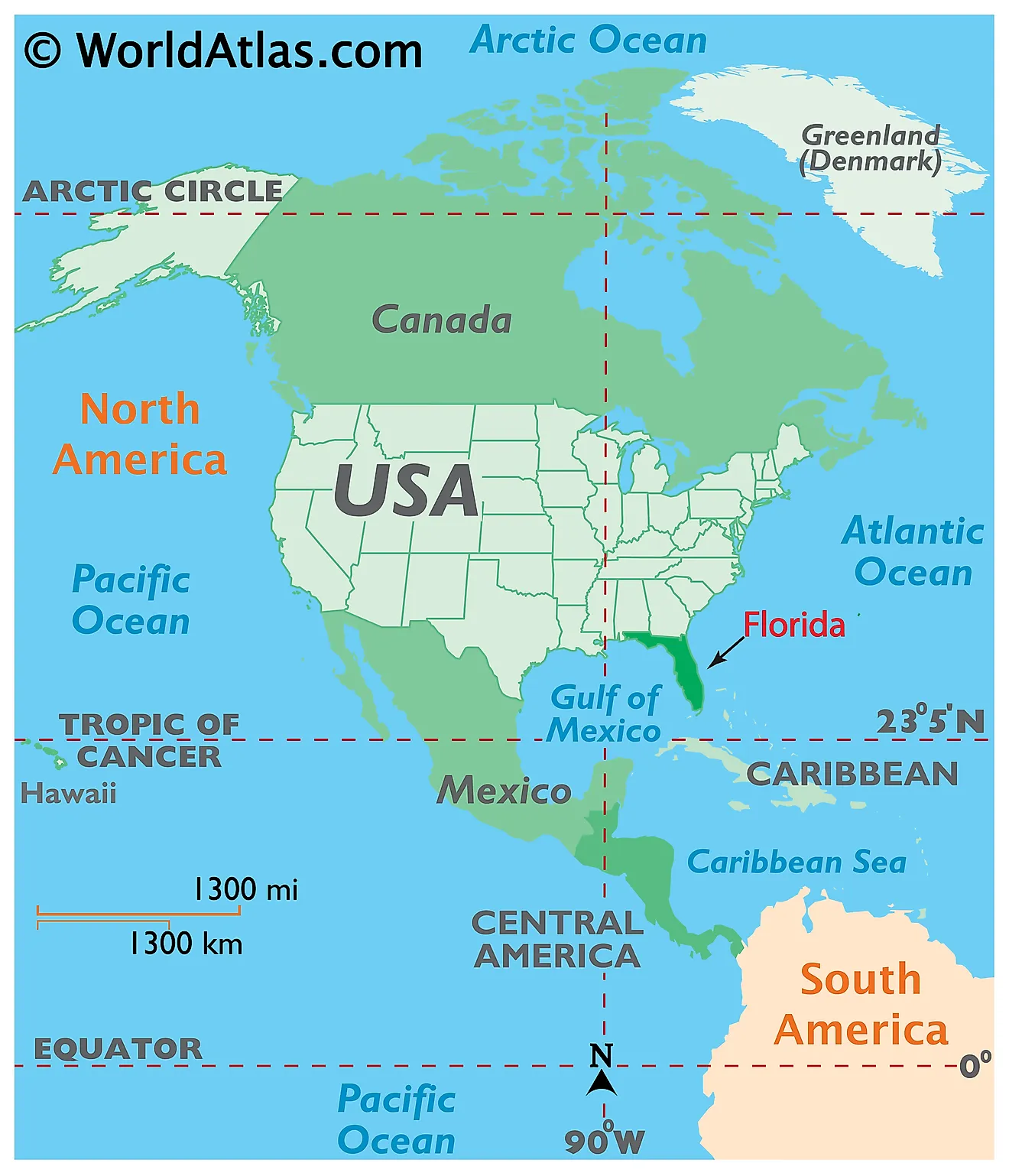
The State of Florida is located in the far southeastern region of the United States. Florida shares its land border with the State of Alabama in the northwest, and with the State of Georgia in the north. Florida has the largest coastline in the contiguous United States and is surrounded by the Gulf of Mexico to the west; by the Atlantic Ocean to the east and by the Straits of Florida to the south.
Regional Maps: Map of North America
Outline Map of Florida
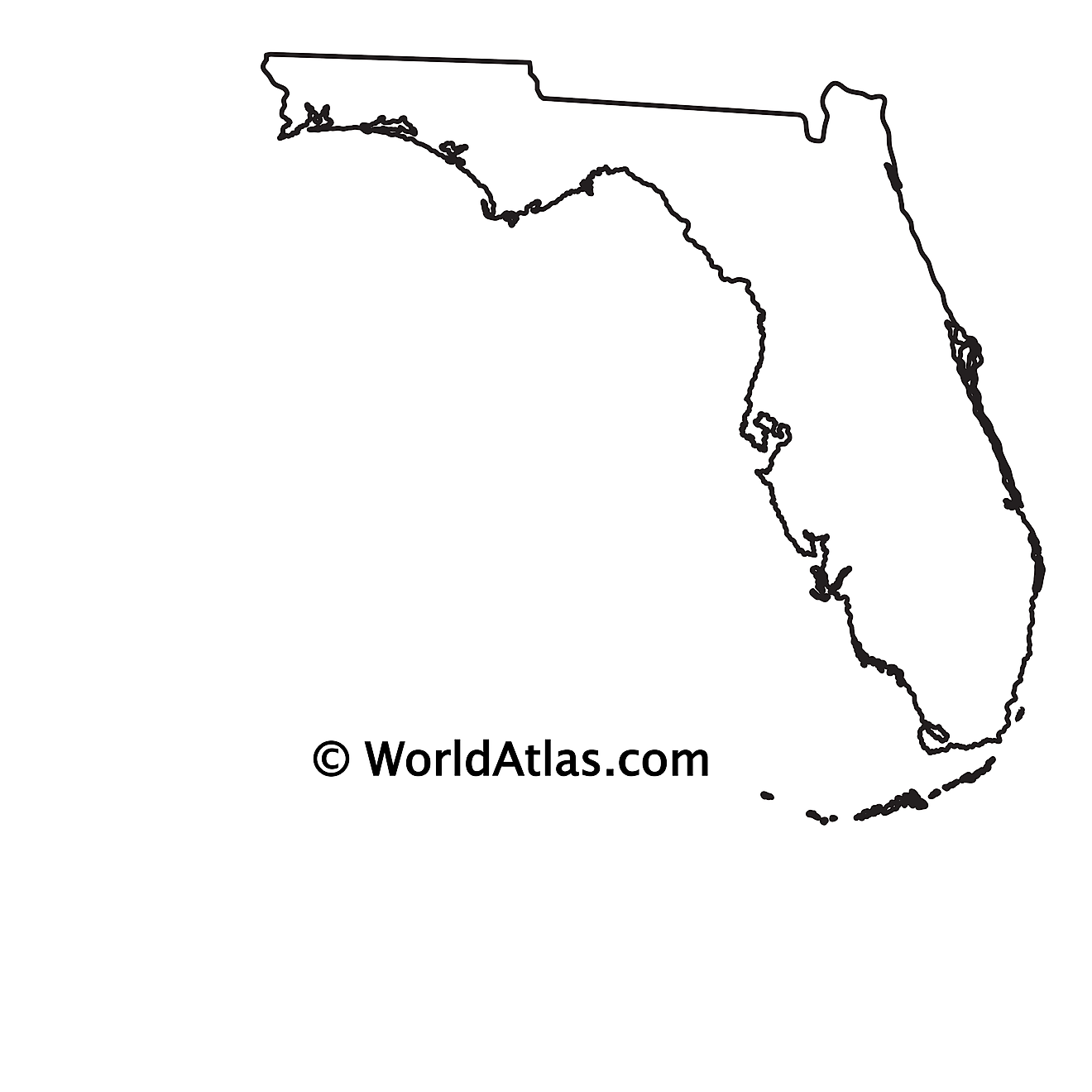
The above blank map represents the State of Florida, located in the far southeastern region of the United States. The above map can be downloaded, printed and used for geography education purposes like map-pointing and coloring activities.
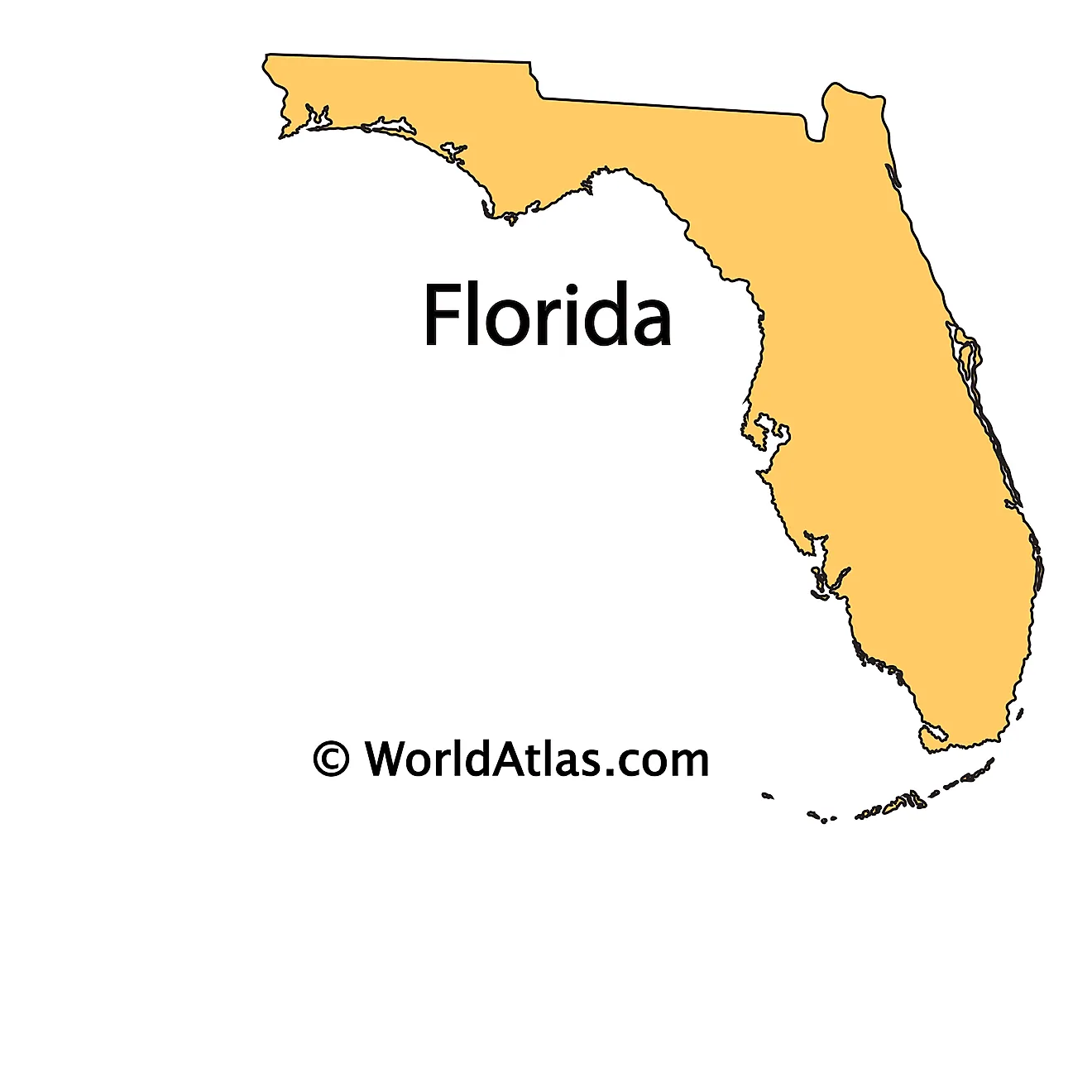
The above outline map represents the State of Florida, located in the far southeastern region of the United States. Florida has been nicknamed as the "Sunshine State."
Key Facts
| Legal Name | State of Florida |
|---|---|
| ISO 3166 Code | US-FL |
| Capital City | Tallahassee |
| Major Cities |
|
This page was last updated on March 28, 2024