5 Most Beautiful Gothic Churches In Kansas
The state of Kansas's variety of Gothic churches, built around the late 19th and early 20th centuries, serves as an important reminder of the creative and cultural aspirations of the state's founders, regardless of whether they were made with local limestone, imported stone, or red brick. It goes without saying that they also share the objective of endowing the plains with beauty and refuge. Without a doubt, these churches serve as significant representations of architectural ambition, talent, and faith. Whether you live in Kansas or you're passing through, consider visiting these five beautiful Gothic churches.
Holy Cross Church

Inside the Holy Cross Church in Pfeifer, Kansas.
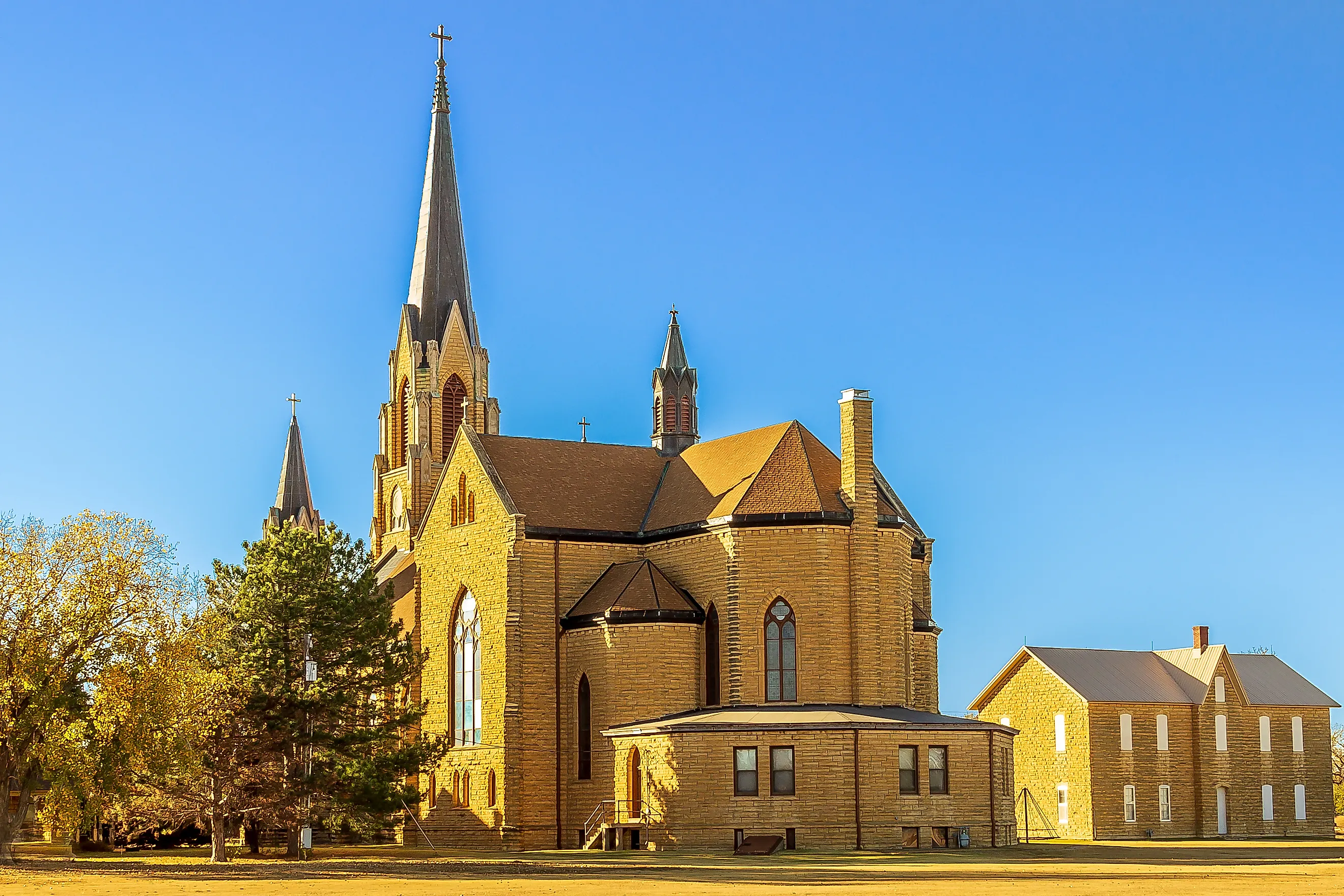
The Holy Cross Church in Pfeifer is one of Kansas’s most extraordinary expressions of Gothic Revival architecture. Built between 1915 and 1918, the church stands as a testament to Bavarian immigrant craftsmanship, community labor, and architectural aspiration. Constructed from native post-rock limestone, the church’s façade features three soaring spires, the center rising approximately 165 feet, flanked by twin towers of about 100 feet each.
Large stained-glass windows — installed during the early decades of the 20th century — fill the interior with a gentle, multicolored glow. Today, it remains open to visitors and continues to inspire admiration for its craftsmanship and serene beauty.
Christ Cathedral

Christ Cathedral in Salina is perhaps the most academically faithful example of Gothic Revival architecture in Kansas. The cathedral was built from 1906 to 1908 through a substantial memorial bequest. The structure is laid out in a traditional cruciform plan, imitating the floor plans of medieval English parish churches and collegiate chapels.
Finished with pinnacles and detailed stonework that echo classic Gothic silhouettes, the exterior walls consist of limestone blocks, giving the building a rugged solidity, while the pointed-arch windows, buttresses, and traceried stonework bring finesse to the massing. Christ Cathedral serves as the seat of the Episcopal Diocese of Western Kansas, enhancing its importance not just architecturally, but also spiritually.
Grace Episcopal Cathedral

Grace Episcopal Cathedral in Topeka offers one of the most compelling combinations of Gothic Revival style and regional limestone craftsmanship in Kansas. The current stone cathedral was constructed primarily between 1910 and 1917, although its twin western towers were completed later. The towers were inspired by those of Magdalen College in Oxford, England, giving the façade a distinctly Collegiate Gothic character.
Built from Kansas Silverdale limestone, the cathedral features pointed arches, buttresses, stained-glass windows, a cruciform layout, and a nave supported by hammer-beam style oak trusses rather than stone vaulting, creating a balance between Gothic drama and Midwestern simplicity. In 1975, a devastating fire destroyed much of the roof and interior fittings. Restoration began swiftly, and by 1978, the cathedral was reopened, sparking one of the most significant late-20th-century preservation achievements in Kansas.
English Lutheran Church

Built around 1870 with additions in 1900, the English Lutheran Church in Lawrence is a great example of Late Gothic Revival architecture on the Kansas frontier. The rusticated limestone structure features steeply pitched roofs, pointed-arch windows, nave buttresses, and simple yet well-proportioned stone massing.
After falling into disrepair in the mid-20th century, preservation efforts by the Lawrence Historic Preservation Alliance and the Kansas State Historical Society saved the building. It was reopened in 1993 as office space, and the adaptive reuse preserved its major architectural features.
St. Bridget Church

A noteworthy example of Gothic Revival architecture suited for rural Kansas is St. Bridget Church, which is tucked away in the small town of Axtell. Built between 1902 and 1908, its red brick exterior, pointed-arch windows, tall gabled roof, and symmetrical stone-trimmed façade reflect both the parish’s modest means and its dedication to the Gothic style.
Measuring roughly 50 by 100 feet, the church remained in use until 1967, after which the St. Bridget Historical Society was formed to save it from demolition. Now preserved as a historic landmark, its natural rural setting and well-maintained exterior make it a photogenic favorite for those capturing Gothic architecture against the prairie sky.
Whether you're drawn to intricate stone sanctuaries or humble red-brick chapels, all of these five churches provide an opportunity to witness how Kansans in earlier generations attempted to create hallowed places that mirrored the majesty of European Gothic architecture while making a living from farms and the plains.
By visiting these churches, visitors and locals are able to connect with a history that never stops inspiring the creation of new buildings and serves as a reminder that reverence and beauty can thrive in remote locations.