Are There Anacondas In The Florida Everglades?
In recent decades, the swamps and marshlands of the Florida Everglades have become overwhelmed with invasive populations of Burmese pythons. As daunting of a challenge as these powerful snakes pose, there is another non-native, non-venomous constrictor that has been sighted and even successfully captured in this region: the python-dwarfing anaconda. The green anaconda is the heaviest species of snake on the planet. Females have been recorded in excess of 29 feet long and weighing upwards of 550 pounds, but anecdotes of even larger specimens, as well as purported maneaters, propel this serpent to mythological status.
Green and yellow anacondas were undoubtedly introduced into the viable Southern Florida ecosystem by exotic pet owners who were unfit or unwilling to continue caring for such enormous and voracious animals.
Anacondas: Understanding the Species

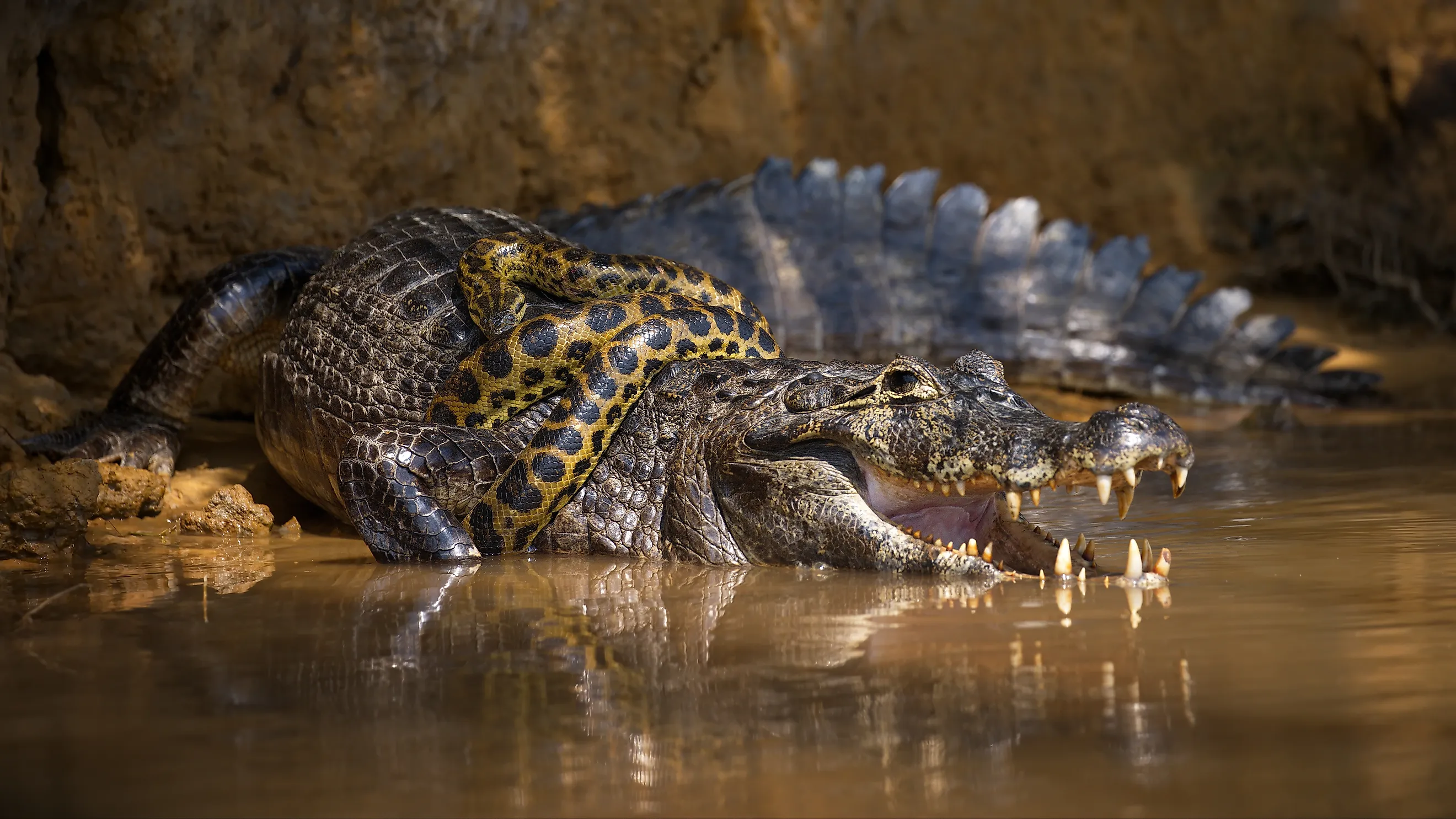
Anacondas are native to South America (particularly the Amazon and Orinoco basins), and a few Caribbean islands. Unlike the Burmese python, they spend the majority of their time in water, either fully submerged, or with just their eyes (which have evolved to sit on the top of their head) sticking above the surface, waiting for unsuspecting prey to come within reach. The green anaconda (Eunectes murinus) is the largest known species of snake, in terms of mass, and also one of the longest (the reticulated python can grow slightly longer). To put this in perspective, they can grow the length of a standard school bus, and reach 12 inches in diameter (note: breeding females are over five times larger than mature males). Its base color is olive, but it has dark blotches on top, lighter spots along the side, and two black stripes spanning from each eye and continuing along its blunt head. The yellow anaconda (Eunectes notaeus) has also been discovered in and around the Everglades. It is a mix of muted yellow with lots of black splotches, and tends to reach upwards of 15 feet in length.
The Florida Everglades closely resemble the tropical environments in which anacondas naturally roam. Everglades National Park totals over 1.5 million acres of minimally inhabited (and difficult to traverse) swamps, marshes, mangroves, and slow-moving rivers that not only give the semi-aquatic anaconda ample opportunity to camouflage but also plenty of fish, mammals, birds, and other reptiles to prey on (though given the escalating python invasion, many animal populations have been reduced by upwards of 99%).

Anacondas only need to eat once every four to six weeks (depending on the size of their previous meal). Therefore, they can patiently wait below the water's surface, deploying ambush tactics when the opportunity arises. Upon snatching the unassuming victim, an anaconda will use its powerful body to constrict the creature (either above or below the surface) until it asphyxiates. Though this unpleasant process takes only minutes to complete, the actual consumption and digestion are much more time-intensive. By unhinging the jaw, anacondas can swallow large animals (such as deer, dogs, sheep, and even alligators/caimans) whole. Upon doing so, digestion may take up to a week. Younger, or simply smaller individuals, will focus their efforts on turtles, fish, amphibians, and birds, able to climb trees and raid nests when need be.
In contrast to the egg-laying Burmese python, anacondas give birth to live babies (as many as 40, twice per year), who are already capable swimmers, meaning they can evade one of the few sources of peril for large constrictors in the Everglades: fire ants. While much can still be learned of these elusive giants, it is thought that wild anacondas have a lifespan of about ten years.
Investigating Reports

The first confirmed sighting of an anaconda in the Florida Everglades was in 2003. A local man named Jack Shealy, riding his bike, noticed an unusual-looking snake along a dirt road. Familiar with snakes and noting that the snake was only a few feet long, he captured it. He then took it to the nearby Trail Lakes Campground, where a staff member—a hepatologist—confirmed it was a juvenile green anaconda. Since keeping large snakes as pets was still legal in Florida, Shealy took the snake home. Sadly (or perhaps fortunately), it died after refusing to eat. This behavior suggests that the anaconda was born in the wild.
Subsequent sightings have tended to occur on the East Coast of the Everglades and have been shifting further upstate. Only a handful have been successfully captured, including one just outside of Naples, and many authorities maintain that viable breeding populations have yet to be established. However, according to USA Today, some scientists posit that a colony may have taken hold in Collier County's Fakahatchee Strand Preserve State Park.

It is clear that green and yellow anacondas are much less common in the Everglades and southern Florida compared to Burmese pythons. Tens or even hundreds of thousands of Southeast Asian constrictors, imported during the exotic pet boom starting in the 1980s, have overwhelmingly dominated the fragile ecosystem, representing one of the world's most problematic invasive species. To control their spread, Florida has launched the Python Elimination Program, which regularly involves hunters, along with the annual Python Challenge. This 10-day event offers a $10,000 cash prize to the person who catches and humanely kills the most pythons. Similar measures have not been taken against invasive anacondas.
Environmental Impact and Concerns

While anacondas remain an occasional blip on the Everglades' radar, their potential ecological impact could easily mimic that of the Burmese python, should breeding populations take hold. These apex predators could consume huge amounts of (already struggling) native animals. This, in and of itself, would be devastating to the ecosystem, but it would also cripple the other large predators in the area, such as alligators and even the elusive panther, who rely on overlapping food sources. Finally, just like the Burmese pythons are already doing, anacondas could spread novel diseases to native snakes.
Although hunting competitions and task forces to tackle anacondas in Florida haven't been established yet, some proactive measures are in place. Floridians are now prohibited from owning large exotic snakes like pythons and anacondas. The window for regulating pythons has closed. Additionally, owners of such snakes can donate them to the Florida Fish and Wildlife Exotic Pet Amnesty Program as a safe alternative to abandoning them in the wild. Lastly, the humane killing of anacondas, pythons, or any other invasive constrictor is allowed on private property without a hunting license, provided the landowner's permission.
If an anaconda does somehow sneak through this three-tiered net and is spotted in the wild, citizens and tourists alike should do their part by reporting it to the Florida Fish and Wildlife Conservation Commission, or IveGot1.org (or on the newly launched app), or by calling 1-888-Ive-Got1. The same protocols can be used for pythons or any other animal or plant that looks out of place in the Sunshine State.
Anacondas are not to be trifled with. Tales of their exploits may often be exaggerated, but the fact is, these are some of the largest snakes on the planet and pose a potential threat to native wildlife, livestock, pets, and perhaps even people. While they should be respected in their South American habitats, unfortunately, given that they are invasive to the Everglades (among other areas in Florida), they need to be removed or eliminated. For now, the few specimens that turn up in the vast Southern swamps shine additional light on the seemingly untenable python evasion. Nature relies on gradual changes and suffers greatly when rapidly reproducing invasive species are accidentally or intentionally set loose.