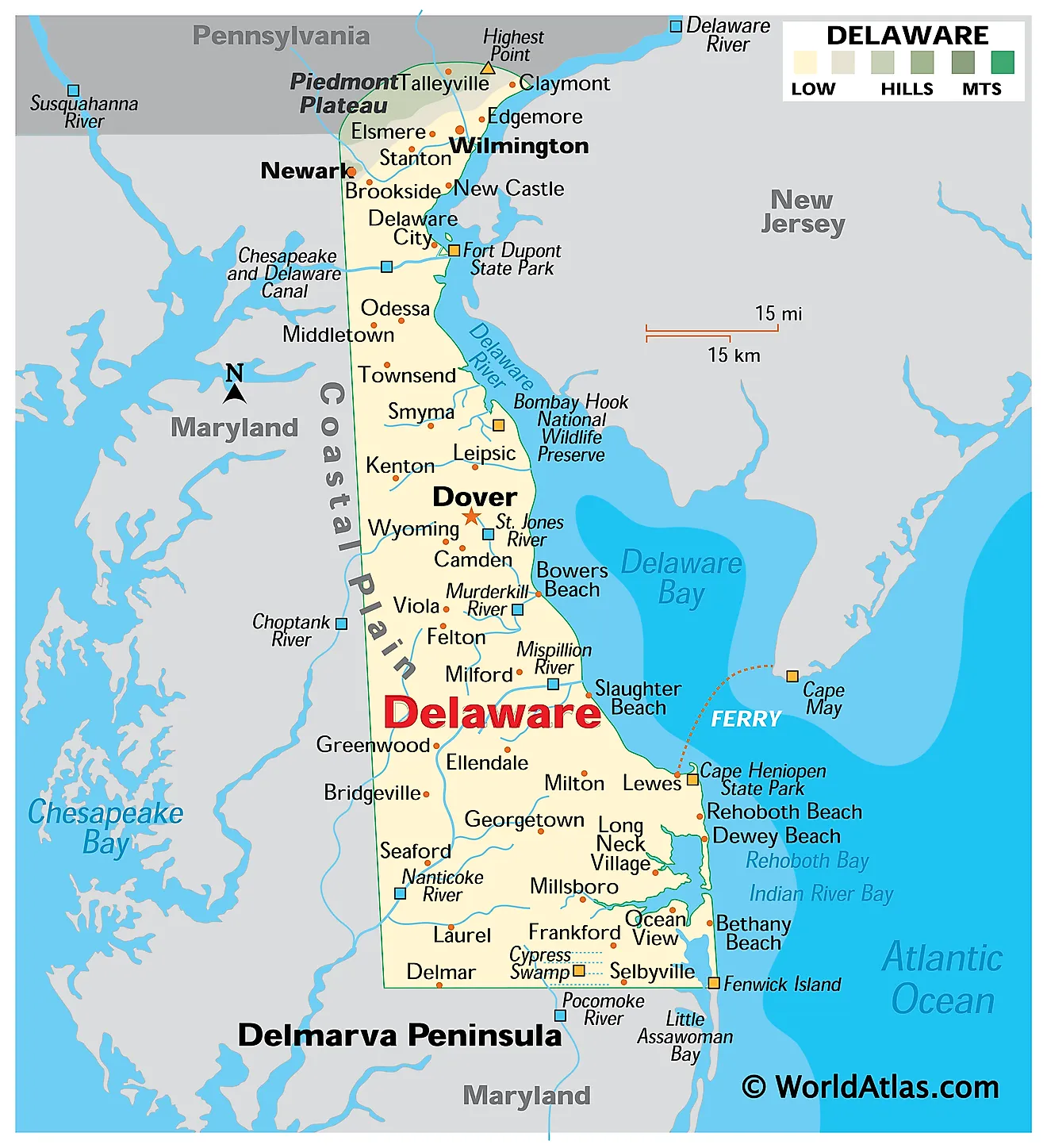
PRINT THIS MAP
James, Duke of York
Travel the World through Poster Art!
Caesar Rodney
Travel the World through Poster Art!
Prohibition
Travel the World through Poster Art!
Emancipation Proclamation of 1863
Travel the World through Poster Art!
Richard Petty, won the first NASCAR race at Dover Downs in 1969
Travel the World through Poster Art!
PRINT THIS MAP

|
|
|
Timeline

(1609) Englishman, Henry Hudson, discovered Delaware Bay, River

(1610) English sea captain, Samuel Argall, named bay and river after Lord De La Warr, Virginia governor

(1613) Explorer, Cornelius Jacobsen May, arrived in area, traded with Indians

(1631) Dutch colonists established Zwaanendael (present day Lewes)

(1632) Zwaanendael destroyed by Indians; all colonists killed

(1638) Dutch settlers, led by Peter Minuet, established Fort Christina, (now Wilmington)

(1639) First African slave brought to Delaware

(1644) England seized area, Delaware became part of New York colony

(1651) Peter Stuyvesant, New York Governor, established Fort Casimir

(1654) Fort Casimir captured by Swedish colonists, renamed Fort Trinity

(1655) Dutch captured all New Sweden, made part of New Netherland

(1664) Sir Robert Carr of England, drove Dutch out of Delaware, claimed land for James, Duke of York; Delaware became English colony

(1673) Dutch regained control

(1674) Dutch returned land to England

(1682) James, Duke of York, gave control of Delaware Colony to William Penn; Penn made it part of the colony of Pennsylvania, and established a representative form of government

(1683) Penn laid out city plan of Dover

(1698 - 1700) Pirates, including Captain Kidd, sailed along Delaware

(1701) Delaware region became known as Three Lower Counties, a separate legislature from Pennsylvania

(1704) First assembly of Three Lower Counties Upon Delaware met in New Castle

(1731) Willington founded by Thomas Willing

(1739) Willington renamed Wilmington

(1754 - 1763) French and Indian War took place

(1763) French and Indian War ended; Great Britain gained control of all lands held by France; England increased taxes on colonies to pay for war

(1764) Charles Mason, Jeremiah Dixon surveyed western boundary of Delaware

(1765) Stamp Act Congress held in protest of English taxation, Caesar Rodney and Thomas McKean represented Delaware

(1774) Delaware sent Caesar Rodney, Thomas McKean, George Read to First Continental Congress

(1775) Revolutionary War began

(1776) Delaware Assembly declared independence from England; Caesar Rodney, suffering from cancer and asthma, rode from Dover to Philadelphia to cast vote for independence; Three Lower Counties adopted constitution, became Delaware State

(1777) John McKinley became first governor of Delaware; Delaware signed Articles of Confederation; British troops marched across Delaware to Philadelphia; American troops retreated from British at Coochs Bridge; British occupied Wilmington; capital moved from New Castle to Dover

(1779) Delaware Assembly ratified Articles of Confederation

(1784) Thomas Coke, Francis Asbury established Methodist Church as separate denomination in U.S.

(1787) Delaware ratified U. S. Constitution; became nation's first state

(1788 - 1789) Abolitionist societies established in Wilmington, Dover

(1792) Second state constitution adopted; name changed to State of Delaware; public school fund established by state legislature; State House in Dover completed

(1798) British ship, DeBraak, sunk off Lewes; yellow fever epidemic spread to Wilmington

(1802) DuPont gunpowder mill established along Brandywine River near Wilmington

(1807) President Thomas Jefferson named Caesar Rodney U. S. Attorney General

(1812 - 1814) War of 1812 took place

(1814) Captain Thomas MacDonough of Delaware, defeated British on Lake Champlain (war's turning point); James Bayard of Delaware one of the signers of Treaty of Ghent ending War of 1812

(1828) Steamboat line between New Castle and Philadelphia opened

(1829) Delaware Canal opened; state legislature established public education system

(1832) Delaware adopted third state constitution; first peach orchard planted

(1838) Philadelphia, Wilmington, Baltimore Railroad opened

(1844) America's first iron-hulled propeller steamship, the Bangor, launched at Wilmington

(1847) Proposed Senate act to abolish slavery defeated by one vote

(1855) State-wide prohibition law enacted

(1857) Prohibition law repealed

(1861 - 1865) Civil War occurred; more than 12,000 troops from Delaware joined Union Army; a few hundred joined Confederate Army

(1861) Delaware rejected invitation to join Confederacy; troops from Philadelphia garrisoned at Fort Delaware

(1862) Delaware troops distinguished themselves at Battle of Antietam; because of their reputation as fighters, they were nicknamed "Blue Hens" due to bluish cocks they had with them during campaigns

(1863) Emancipation Proclamation issued by President Lincoln; slaves not freed as Delaware fought for Union

(1865) 13th Amendment to U. S. Constitution abolished slavery; Delaware freed slaves

(1868) Delaware legislature voted against 14th Amendment to U. S. Constitution which guaranteed equal protection for all races

(1869) First women's suffrage convention held in Delaware

(1870) Delaware legislature voted against 15th Amendment to U. S. Constitution, which gave blacks right to vote

(1875) Separate schools and funding for white children, African-American children established

(1885) Thomas Bayard appointed Secretary of State

(1887) Steel-hulled racing yacht built in Wilmington, The Volunteer, won America's Cup

(1889) Punishing of women at whipping post or pillory prohibited by law

(1891) Delmar nearly destroyed by fire

(1893) Thomas F. Bayard appointed first U. S. Ambassador to Great Britain; in boundary dispute with Maryland, Delaware received land - "the Wedge"

(1897) Present state constitution adopted

(1901) 13th, 14th, 15th Constitutional Amendments ratified by legislature

(1907) State licensed first automobile; Emily Bissell introduced Christmas Seal

(1910) Battleship USS Delaware commissioned

(1911 - 1924) T. Coleman DuPont built highway running length of state, gave to State of Delaware

(1911) Upton Sinclair, ten others arrested for violating Sunday blue law by playing tennis and baseball

(1915) Child Labor Law enacted

(1917 - 1918) Approximately 10,000 Delawareans served in World War I

(1934) U. S. Supreme Court confirmed Delaware's right to control Delaware River

(1935) Dr. Wallace Carothers discovered first synthetic fiber at DuPont Experimental Station

(1939) DuPont opened nylon plant in Seaford; exhibited nylon stockings at World Fairs in San Francisco, New York

(1941 - 1945) Approximately 30,000 Delaware men and women served in World War II

(1942) Air bases created at New Castle, Dover

(1950) University of Delaware ordered to end segregation by Delaware Court of Chancery

(1951) First span of Delaware Bridge opened between Delaware and New Jersey

(1963) Delaware General Assembly outlawed racial segregation in public places; President John F. Kennedy opened Delaware Turnpike

(1968) Riots broke out in Wilmington after assassination of Martin Luther King, Jr.; National Guard occupied city for ten months; second span of Delaware Bridge opened

(1969) Legislature passed bill ending discrimination in rental or sale of housing; Richard Petty won first NASCAR-sanctioned race at Dover Downs

(1975) Former Negro League baseball player, William "Judy" Johnson became state's first player elected to the National Baseball Hall of Fame

(1978) Daniel Nathans won Nobel Prize in Medicine for work with molecular hormones; Delaware began busing children from inner-city neighborhoods to Wilmington suburbs, helped establish integrated busing across U.S.

(1980) State adopted constitutional limit restricting government spending to 95% of expected revenue

(1995) Legislature approved use of slot machines at Dover Downs, Harrington and Delaware Park

(1999) Delaware native, Jacqueline Jones, won MacArthur Genius Award

(2000) Ruth Ann Minner elected first woman governor of Delaware

(2002) Ban on smoking in public places took effect; Delaware suffered from drought

Contact Us | Privacy Statement

Copyrighted by Graphic Maps
All rights reserved!

All maps, graphics, flags and original descriptions created by Graphic Maps, a d/b/a of the Woolwine-Moen Group, unless otherwise noted and/or directly linked to the source, and use of same for any application whatsoever (with the exception of outline maps) requires written permission.

We make no copyright claim on any statistical data on this page, nor on any non-original graphics, and/or pictures not produced by us. Certain statistical data is gathered from the CIA World Factbook, as well as numerous public domain reference materials.

Every effort is made to be as accurate as possible when disseminating information on any worldwide destination. We are not responsible for unintentional data entry errors or omissions. If you would like to submit an addition, change or correction, or suggest a new link, please forward it to our map department and we will give it our immediate attention.

|
|
|
|

|