Maps of Honduras
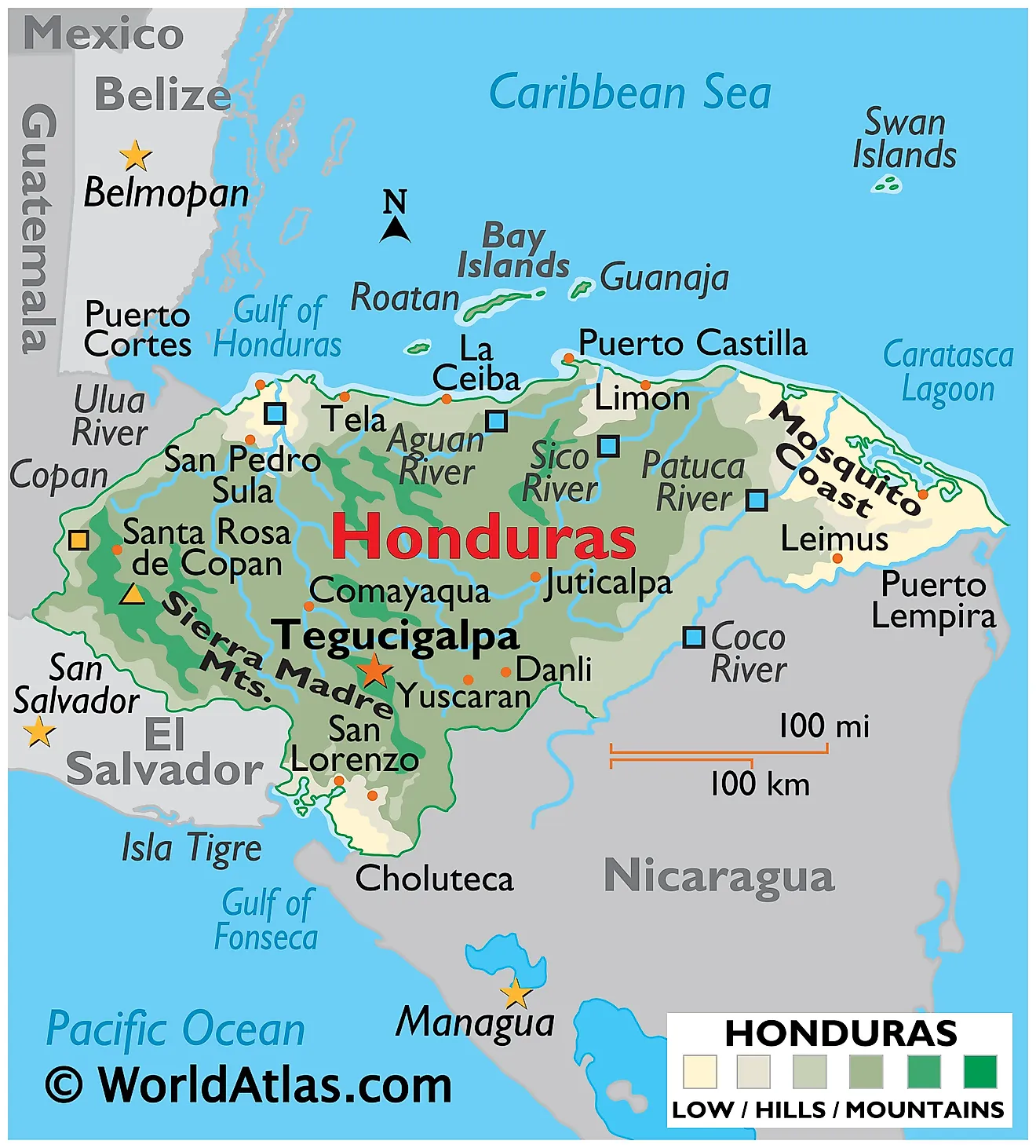
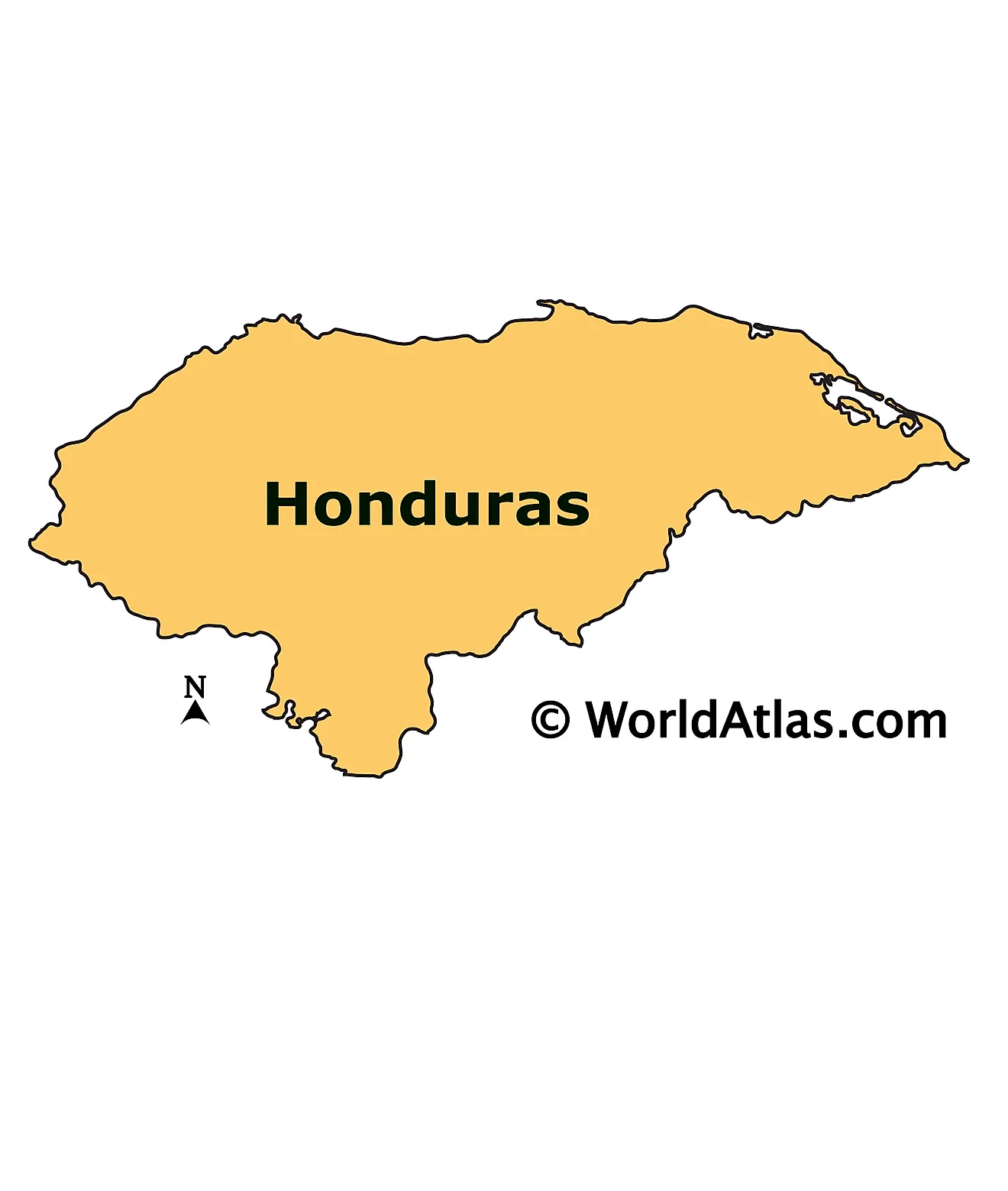
Honduras occupies an area of 112,492 sq. km (43,433 sq. mi) in Central America. As observed on the physical map of Honduras, the country has three major topographical regions. These are a vast interior plateau of hills and mountains that dominate the landscape; the Caribbean lowlands, and the Pacific lowlands- fringing the Gulf of Fonseca.
The Sierra Madre Mountains and forested interior hills are crisscrossed by a large series of rivers and wide, fertile valleys; fronted by sandy beaches. This mountain range stretches all the way down from Mexico in the north and ends right in the middle of Honduras. The 2,870 m (9,420 ft) high Cerro Las Minas located in the western part of the country is the highest point in Honduras.
The Caribbean lowlands extend along its entire northern coastline, and there, in the northeast, as marked on the map, the Mosquito Coast is a broad uninhabited stretch of thick jungle, lagoons, and mangrove swamps. Often just referred to as the "North Coast" this portion of Honduras is home to the most developed parts of the country.
The Pacific lowlands surround the Gulf of Fonseca, and that land also becomes somewhat swampy near the coast. The country has numerous cays and islands in the Caribbean Sea, including Isla de la Bahia (Bay Islands), the tiny Cayos Cocinos (Hog Islands), and the remote Swan Islands. A few long-dormant volcanic islands stand in the Gulf of Fonseca, including Tigre and Zacate.
The major bodies of water are Lake Yojoa, which is the only significant lake in the entire nation, and the Caratasca Lagoon in the northeast. This region of Honduras is dominated by many coastal lagoons. The most important rivers include the Aquan, Coco, Patuca, Sico, and Ulua.
Departments of Honduras Map
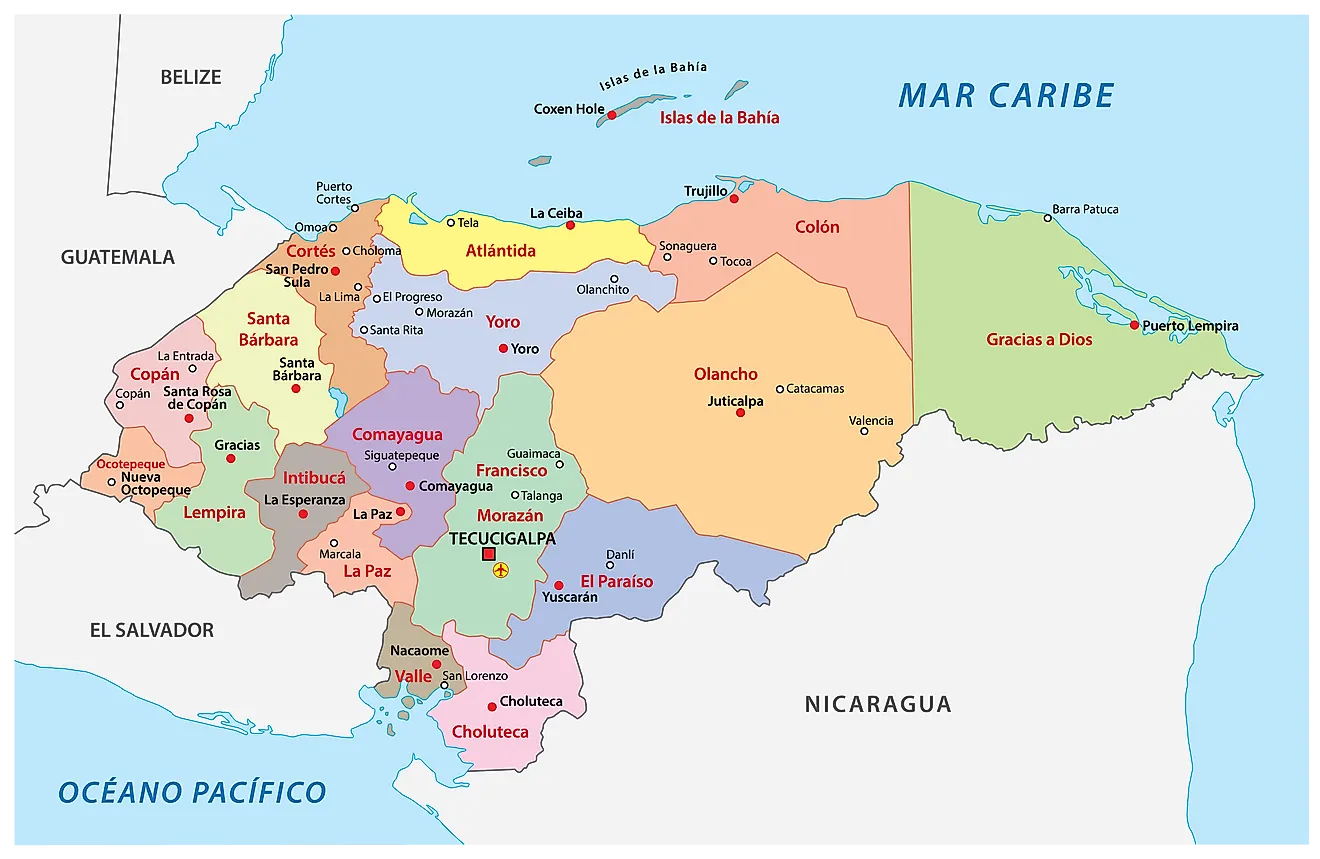
Honduras (officially, the Republic of Honduras) is divided into 18 departments (departamentos, sing. departamento). In alphabetical order, the departments are: Atlantida, Choluteca, Colon, Comayagua, Copan, Cortes, El Paraiso, Francisco Morazan, Gracias a Dios, Intibuca, Islas de la Bahia, La Paz, Lempira, Ocotepeque, Olancho, Santa Barbara, Valle, and Yoro. These departments are further subdivided into 298 municipalities.
Situated in a valley and surrounded by mountains, in the southern-central region of the country is, Tegucigalpa – the capital, the largest and the most populous city of Honduras. It is also the administrative, cultural, educational, and economic center of the country.
Where is Honduras?
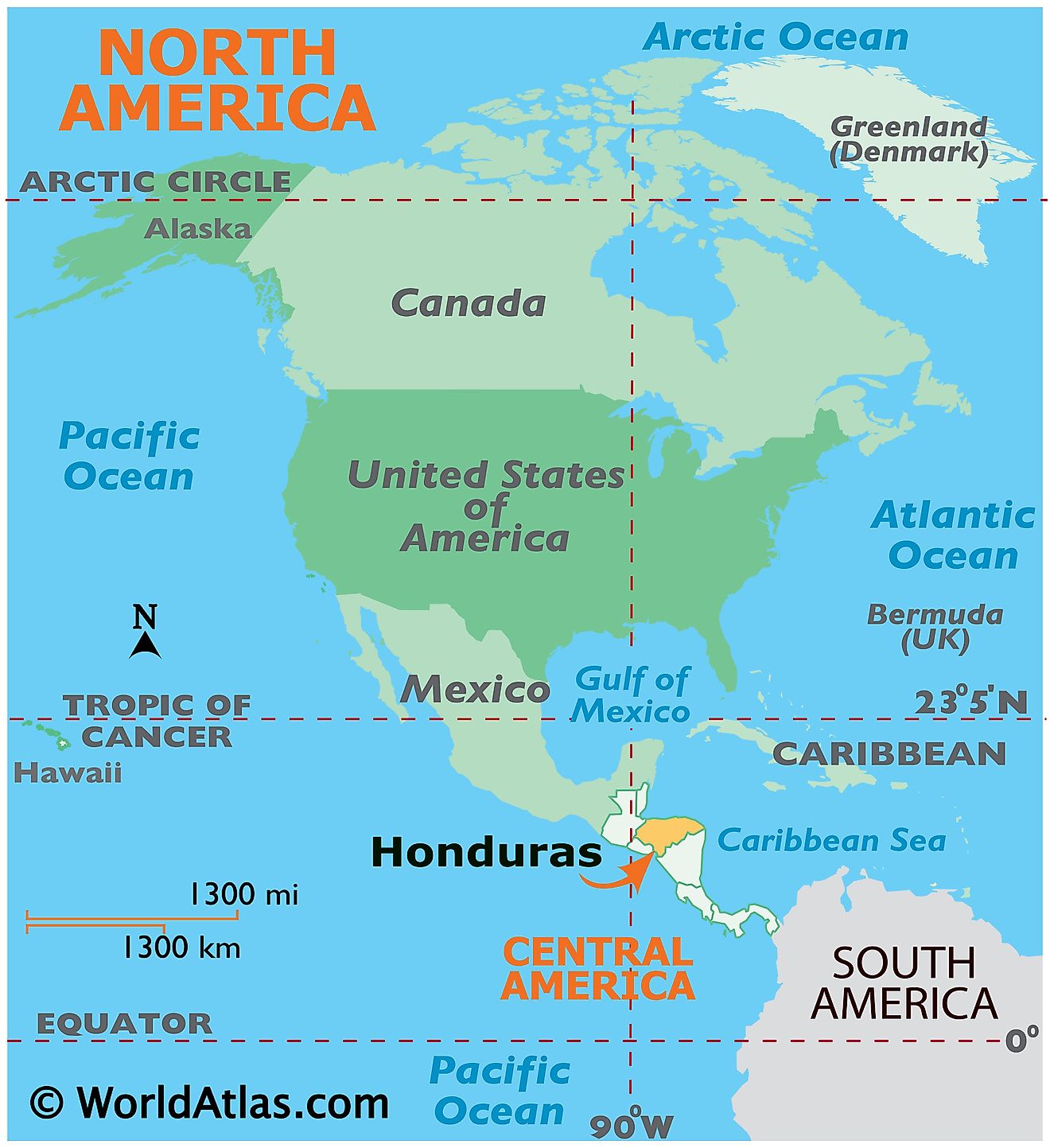
Honduras is a country located in Central America. It is positioned in the Northern and Western hemispheres of the Earth. Honduras is bordered by Guatemala to the west; by El Salvador to the southwest; and by Nicaragua to the southeast. It is also bounded by the Pacific Ocean at the Gulf of Fonseca to the south and by the Caribbean Sea at the Gulf of Honduras to the north.
Honduras Bordering Countries: Guatemala, Nicaragua, El Salvador.
Regional Maps: Map of North America
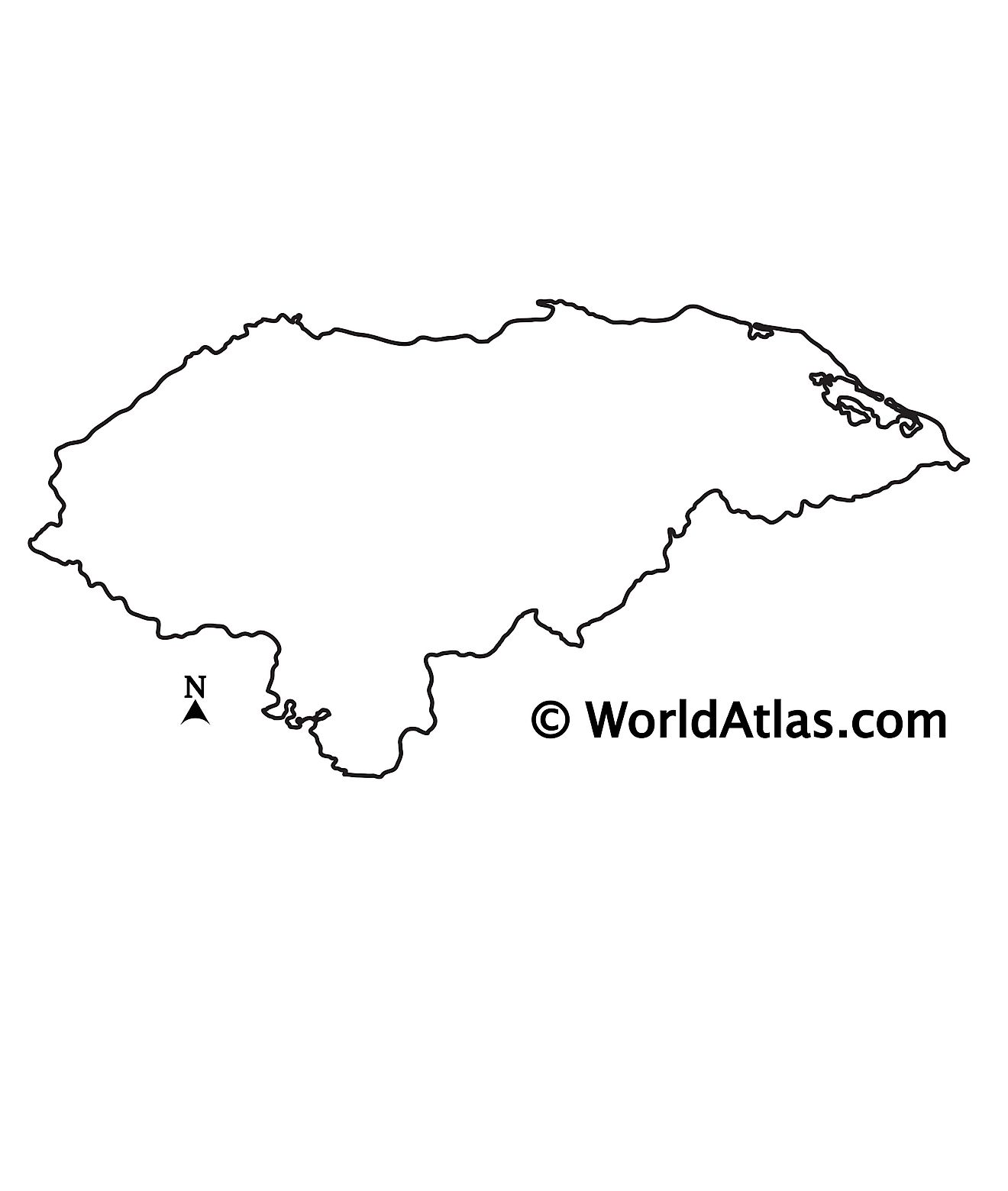
Outline Map of Honduras
Key Facts
| Legal Name | Republic of Honduras |
|---|---|
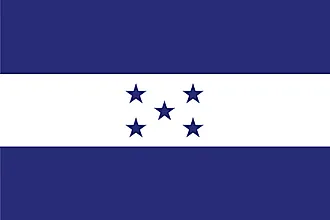
| Flag |
|
| Capital City | Tegucigalpa; note - article eight of the Honduran constitution states that the twin cities of Tegucigalpa and Comayaguela, jointly, constitute the capital of the Republic of Honduras; however, virtually all governmental institutions are on the Tegucigalpa |
| 14 06 N, 87 13 W | |
| Total Area | 112,090.00 km2 |
| Land Area | 111,890.00 km2 |
| Water Area | 200.00 km2 |
| Population | 9,529,188 |
| Major Cities |
|
| Currency | Lempiras (HNL) |
| GDP | $37.09 Billion |
| GDP Per Capita | $3,892.67 |
This page was last updated on November 28, 2023