A Brief Description

The lands of Honduras were long inhabited by a mixture of indigenous Indian peoples, with the Maya culture certainly recognized as the most progressive, and justifiably celebrated yet today.

In 1502, on his final voyage to the New World, Christopher Columbus sailed into the area, stopping briefly in the Bay Islands. Subsequently a few Spanish navigators passively explored the region, but it wasn't until 1524 that the Spanish began the serious conquest of Honduras.

Initially, these European invaders selfishly fought among themselves for control, and this new Spanish colony was in total disarray and all but abandoned; then gold and silver were discovered in the 1530s, new settlers arrived by the boat load, and typically, the indigenous indians and imported slaves were forced into hard labor.

Despite a revolt of the native people in 1537, one led by Lempira, a local chieftain, and revered national hero, the spread of colonization and mining continued across the land. The initial prosperity from precious metals soon wained, and eventually the rural agricultural industries proved the only real revenues in this struggling colony.

Adding to the financial dismay of the Spanish Crown, the English aggressively entered Honduras, building small settlements along the Caribbean coastline and in the Bay Islands. These two powers fought for control for over a century, until the Spanish finally drove the British out in 1780s.

After the overthrow of the Spanish King by Napoleon, Honduras and others declared their independence from Spain in 1821. Then, Honduras, as well as Costa Rica, El Salvador, Guatemala and Nicaragua formed the United Provinces of Central America, but that federation quickly dissolved, and Honduras became an independent republic in 1838.

In this new upstart country, chaos soon followed, and over the next 150 years the country suffered through countless coups, citizen rebellions and revolts, a long line of military regimes and rulers, incursions and regional wars.

Just as stressed-out Honduras appeared to stabilize, Hurricane Mitch ravished the country in 1998, leaving over 11,000 people dead and all but destroying major cities such as San Pedro Sula and even Tegucigalpa. Recovery costs have now exceeded 4 billion US dollars.

Volcanoes are long dormant in Honduras, but the political system still flares, and the next major eruption could be just around the corner.

Read more about Honduras here.

Beach resort, Roatan Island, Honduras
Travel the World through Poster Art!
Facts and Figures

Name Honduras

(long form) Republic of Honduras

Population 6,975,200

Population & Density (all countries) here

Capital City Tegucigalpa (1,435,000)

Currency Lempira (HNL)

Currency Converter
here

Languages Spanish, Amerindian dialects

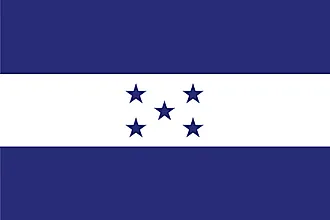
Flag here

National Day September 15

Religions Catholic (97%), Protestant (3%)

Geographic Coordinates

Latitude/Longitude (Capital City)
14º 06' N, 87º 13' W

Relative Location
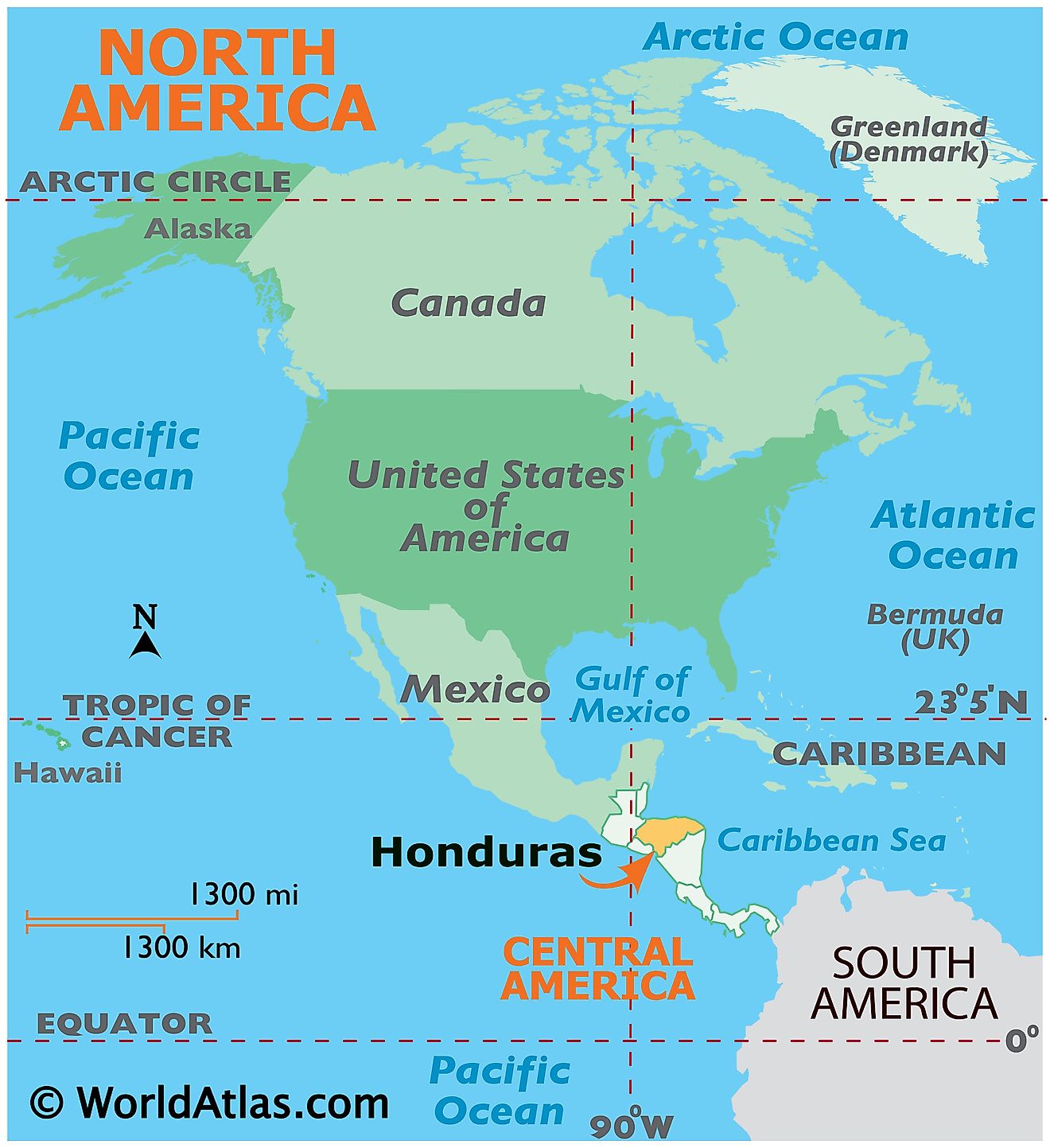
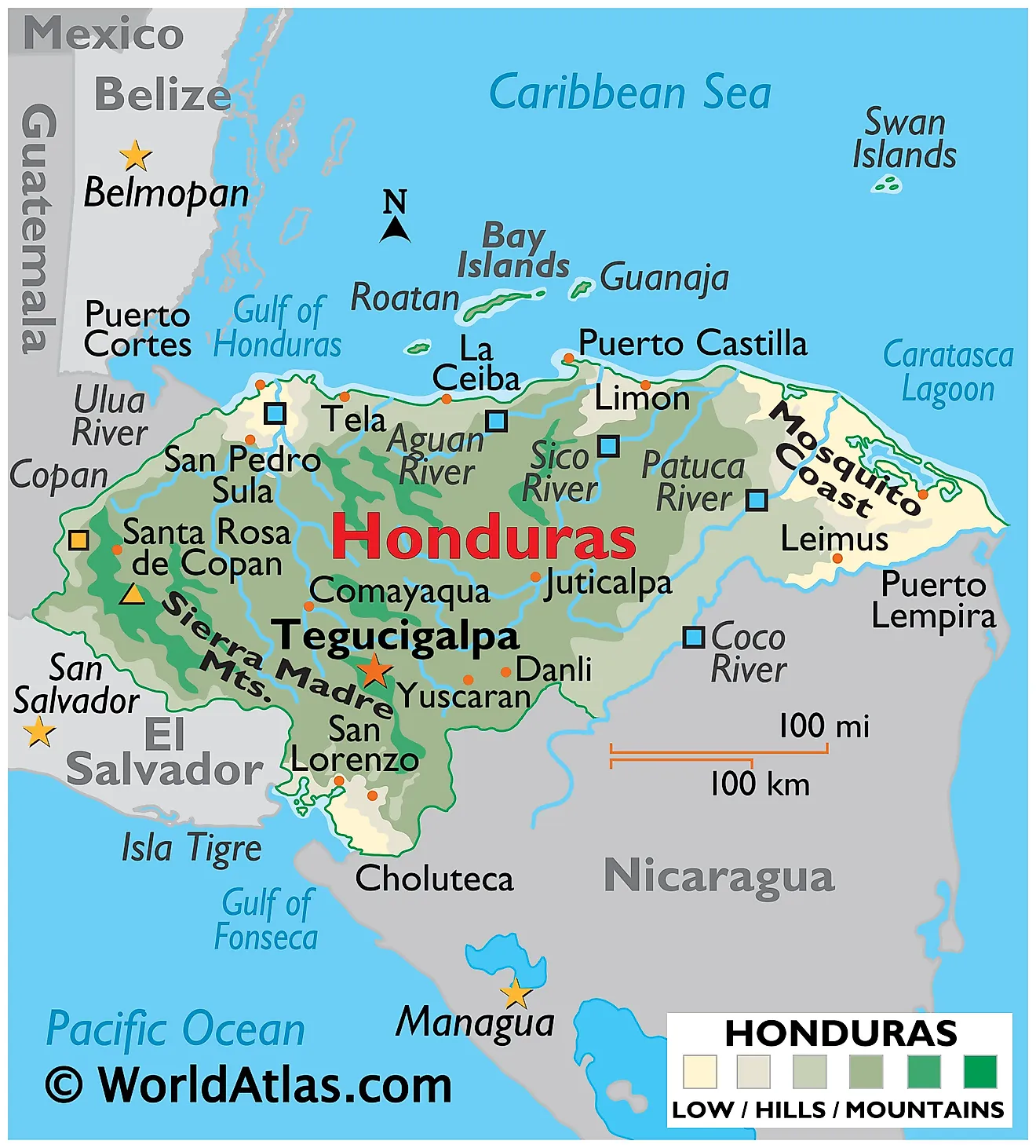
Honduras is positioned in both the northern and western hemispheres. Located in North America in the middle of the Central America isthmus - a somewhat narrow strip of land that connects North and South America - the country is bordered by Guatemala, El Salvador, Nicaragua and the Gulf of Honduras, Gulf of Fonseca, Caribbean Sea and Pacific Ocean.

Land Statistics

Coastline 510 miles (820 km)

Land Areas

(land) 43,201 sq miles (111,890 sq km)

(water) 77 sq miles (200 sq km)

(TOTAL) 43,278 sq miles (112,090 sq km)

Land Area (all countries) here

Landforms
Honduras has three major topographical regions, including a vast interior plateau of hills and mountains that dominate the landscape; the Caribbean lowlands, and the Pacific lowlands- fringing the Gulf of Fonseca.

The forested interior hills (picture here) and the Sierra Madre Mountains are crisscrossed by a large series of rivers and wide, fertile valleys; fronted by sandy beaches, the Caribbean lowlands extend along its entire northern coastline, and there, in the northeast, the Mosquito Coast is a broad uninhabited stretch of thick jungle, lagoons and mangrove swamps; the Pacific lowlands surround the Gulf of Fonseca, and that land also becomes somewhat swampy near the coast.

The country has numerous cays and islands in the Caribbean Sea, including Isla de la Bahia (Bay Islands), the tiny Cayos Cocinos (Hog Islands), and the remote Swan Islands. A few long-dormant volcanic islands stand in the Gulf of Fonseca, including Tigre and Zacate.

Honduras is water-rich; the most important rivers include the Aquan, Coco, Patuca, Sico and Ulua; Lake Yojoa is the only significant lake, and the Caratasca Lagoon in the northeast is the largest of many coastal lagoons.

Highest Pt. Cerro Las Minas - 9,416 ft. (2,870 m)

Lowest Pt. Caribbean Sea - 0 ft. (0 m)

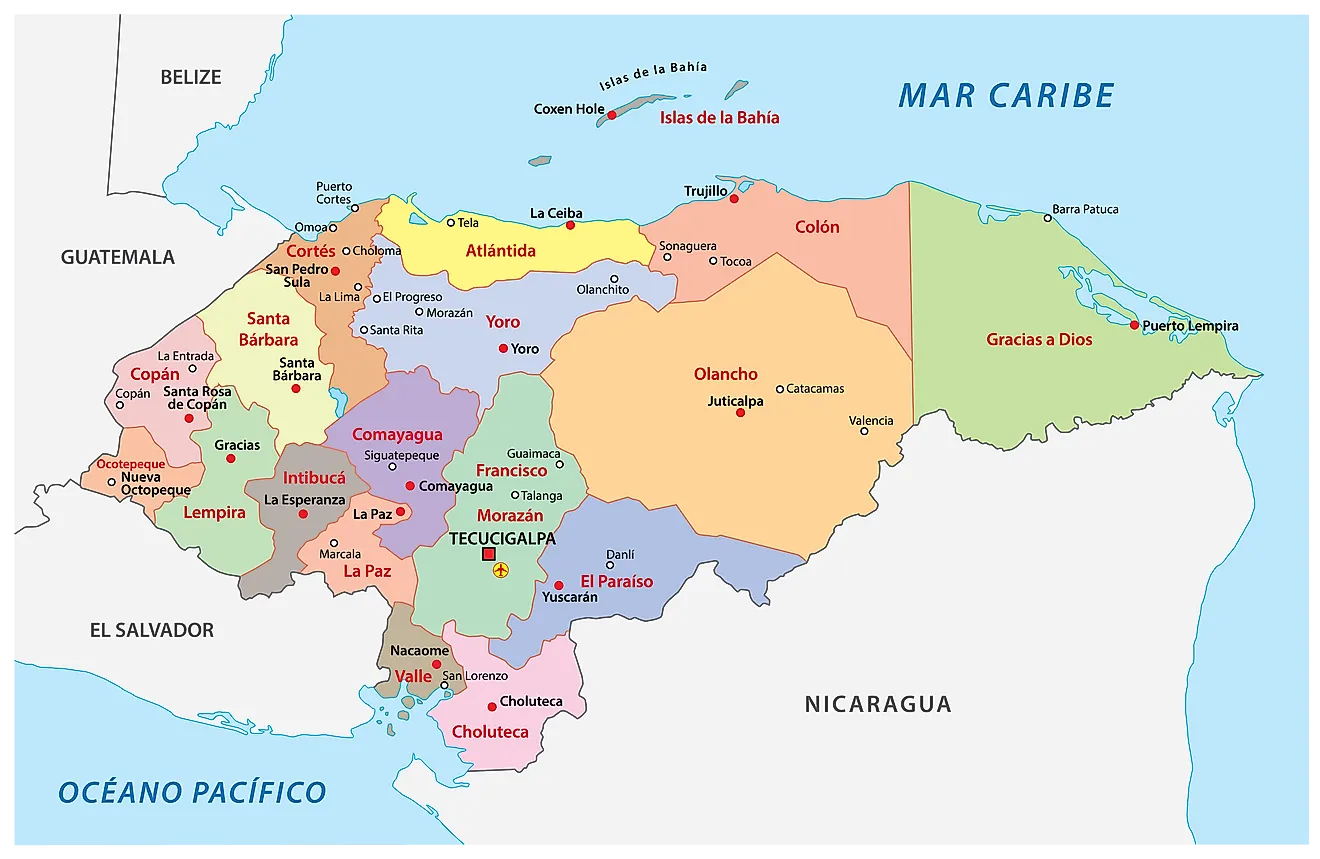
Land Divisions 18 departments; including Atlantida, Choluteca, Colon, Comayagua, Copan, Cortes, El Paraiso, Francisco Morazan, Gracias a Dios, Intibuca, Islas de la Bahia, La Paz, Lempira, Ocotepeque, Olancho, Santa Barbara, Valle and Yoro.


Contact Us | Privacy Statement

Copyrighted by Graphic Maps
All rights reserved!

All maps, graphics, flags and original descriptions created by Graphic Maps, a d/b/a of the Woolwine-Moen Group, unless otherwise noted and/or directly linked to the source, and use of same for any application whatsoever (with the exception of outline maps) requires written permission.

We make no copyright claim on any statistical data on this page, nor on any non-original graphics, and/or pictures not produced by us. Certain statistical data is gathered from the CIA World Factbook, as well as numerous public domain reference materials.

Every effort is made to be as accurate as possible when disseminating information on any worldwide destination. We are not responsible for unintentional data entry errors or omissions. If you would like to submit an addition, change or correction, or suggest a new link, please forward it to our map department and we will give it our immediate attention.

|
|
Maps

Honduras (large color) Map here

Honduras Outline Map here

Honduras CIA version here

Honduras Maps at UT here

Gulf of Fonseca map here!

Ring of Fire map here!

- - - - - - - - - - - - - - - - - - - - - - - - - - - - -

Central America (Capital Cities)
here!

Central America (Maps at UT)
here!

Central America (Outline)
here!

Central America (Volcanoes)
here!

Panama Canal here!

- - - - - - - - - - - - - - - - - - - - - - - - - - - - -

North America (Capital Cities)
here!

North America (Lakes)
here!

North America (Landforms)
here!

North America (Outline)
here!

North America (Rivers)
here!

North America (Country Test) here!

- - - - - - - - - - - - - - - - - - - -

World Outline Maps (printable) here

World Time Zone Map here


Recommended Links

Honduras (Complete) info on the (GDP)
economy, imports and exports, natural resources, government, population, military, transportation, and more here

Honduras Embassy (Washington, DC) web site

Honduras Photos at TrekEarth.com here

Explore Honduras here

Mayan Ruins at Copan here

Travel to Honduras here

Dramatic Maya ruins, Copan, Honduras
Travel the World through Poster Art!

Time and Weather


Climate
The weather in Honduras is certainly tropical, but moderates in the higher elevations of the interior.

In the interior regions the temperatures average near 70° F, (21° C) throughout the year, while in the much warmer, and certainly more humid coastal regions, temperatures average near 80° F.

Rainfall is generally heaviest in the east and northeast, and along parts of the northern coast. A dry season occurs in the central highlands and along the mountain slopes facing the Pacific, (November - May).

Traveler Info

Attractions:
Honduras is an exotic, mostly unexplored paradise for travelers of any age, one complete with numerous biological treasures, haunting Maya ruins and some of the best beaches, islands, reefs and scuba diving sites in the western hemisphere.

Major points-of-interest include the Maya ruins at Copan; the Bay Islands and the sunny beaches at Roatan; fifteen national parks and ten biological reserves and the colonial monuments and churches in the capital city of Tegucigalpa, as well as the cities of Comayagua, Gracias, Omoa, Trujillo and Yuscaran.

All travelers planning a trip to Honduras are encouraged to review the Travel Warnings posted by the U.S. Department of State.

Country Dialing Code 504

Electricity Honduras uses 110/220 volts AC (60 HZ)

Electrical adapters, products and tips here

Travel Warnings
here

PASSPORTS - TRAVEL VISAS


NOTE: Before making your travel plans to any worldwide destination, we strongly recommend you authenticate important details regarding all passport and visa requirements. The experienced people at Travel Visa Pro can answer all of your questions!

A scary face, Copan ruins, Honduras
Travel the World through Poster Art!
|
|
Central America
Countries

Belize

Costa Rica

El Salvador

Guatemala

Honduras

Nicaragua

Panama

NORTH AMERICA
COUNTRIES


Antigua
and Tobago

Bahamas

Barbados

Belize

Canada

Costa Rica

Cuba

Dominica

Dominican Rep.

El Salvador

Grenada

Guatemala

Haiti

Honduras

Jamaica

Mexico

Nicaragua

Panama

St. Kitts & Nevis

St. Lucia

St. Vincent and
the Grenadines

Trindad
and Tobago

United States

A brown booby, Honduras
Travel the World through Poster Art!

Central America
Countries


Belize

Costa Rica

El Salvador

Guatemala

Honduras

Nicaragua

Panama

NORTH AMERICA
COUNTRIES


Antigua
and Tobago

Bahamas

Barbados

Belize

Canada

Costa Rica

Cuba

Dominica

Dominican Rep.

El Salvador

Grenada

Guatemala

Haiti

Honduras

Jamaica

Mexico

Nicaragua

Panama

St. Kitts & Nevis

St. Lucia

St. Vincent and
the Grenadines

Trindad
and Tobago

United States

Central America
Countries


Belize

Costa Rica

El Salvador

Guatemala

Honduras

Nicaragua

Panama

NORTH AMERICA
COUNTRIES


Antigua
and Tobago

Bahamas

Barbados

Belize

Canada

Costa Rica

Cuba

Dominica

Dominican Rep.

El Salvador

Grenada

Guatemala

Haiti

Honduras

Jamaica

Mexico

Nicaragua

Panama

St. Kitts & Nevis

St. Lucia

St. Vincent and
the Grenadines

Trindad
and Tobago

United States

|