A Brief Description

The ancient history of Bolivia is first and foremost woven into the great Andean empires of the Aymara civilization. This innovative and powerful culture was eventually conquered by the Incas at the end of the 15th century.

In their obsessive search for gold and silver, the Spanish arrived here in the 16th century; they quickly defeated the Incas, and changed the economic and social fabric of Bolivia forever.

During its 300 years of colonial rule, Spain continually searched for precious metals, and in the process forced Indian labor to do the work. The silver mines they discovered at Potosi proved to be the largest ever in the western hemisphere.

In 1809, the "Liberator", Simon Bolivar, (Bolivia's namesake) began the battle for independence. After the Spanish defeat in 1824, Bolivia finally gained its hard-fought freedom in 1825.

Typical of a new, upstart country, political instability, coups, countercoups and rewritten constitutions were commonplace, as numerous leaders tried to reform the country.

In the late 1800s, civilian governments came into power, and for almost fifty years Bolivia enjoyed relative political stability; its economy improved for all but the indigenous Indians.

Then, after losing a regional war with Paraguay in 1935, in which it lost much of its original territories, military control returned and a long series of military governments controlled the country till 1982, when the country again returned to a democratically elected form of government.

Today, though reform is in the air, it remains one of the poorest and least developed countries in South America, and dependent on foreign aid.

On the real positive side, this marvelous land of natural beauty has vast quantities of untapped gas, gold, oil and silver deposits, as well as a large palette of colorful attractions for all travelers.

Read more about Bolivia here!

La Paz, Bolivia
Travel the World through Poster Art!
Facts and Figures

Name Bolivia

(long form) Republic of Bolivia

Population 8,857,900

Population & Density (all countries) here

Capital City La Paz (seat of government) (812,000); Sucre (legal capital and seat of judiciary) (224,000)

Currency Boliviano (BOB)

Currency Converter
here

Languages Spanish, Quechua, Aymara, others

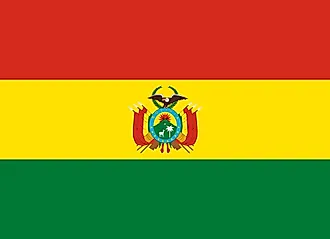
Flag here

National Day August 6

Religions Catholic (95%), Protestant (5%)

Geographic Coordinates

Latitude/Longitude (Capital City)
16º 30' S, 68º 10' W

Relative Location
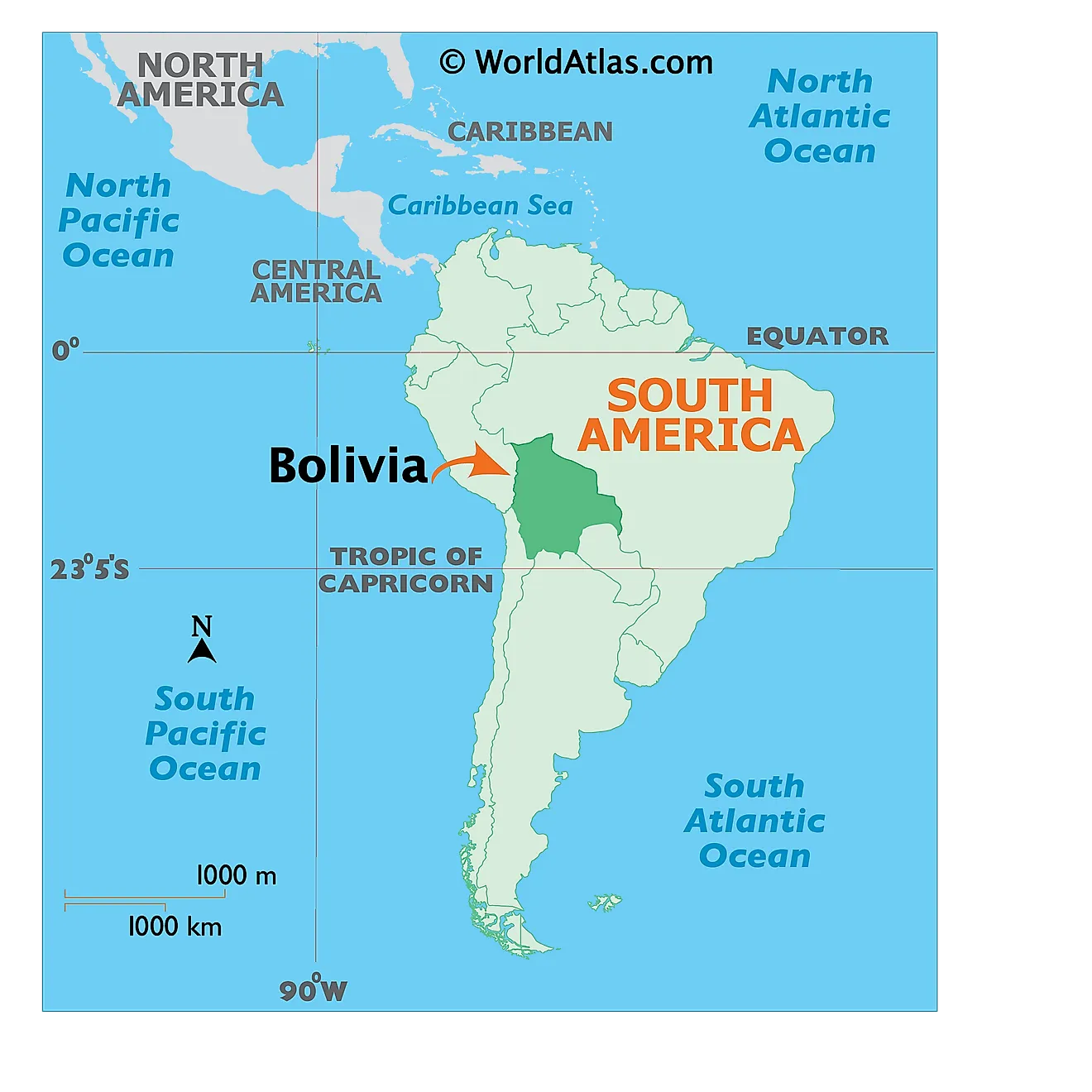
The landlocked country of Bolivia is positioned in the southern and western hemispheres.
It's located in west-central South America, and bordered by Peru, Brazil, Paraguay, Argentina and Chile.

Land Statistics

Coastline 0 miles (0 km) (landlocked)

Land Areas

(land) 418,685 sq miles (1,084,390 sq km)

(water) 5,479 sq miles (14,190 sq km)

(TOTAL) 424,164 sq miles (1,098,580 sq km)

Land Area (all countries) here

Landforms
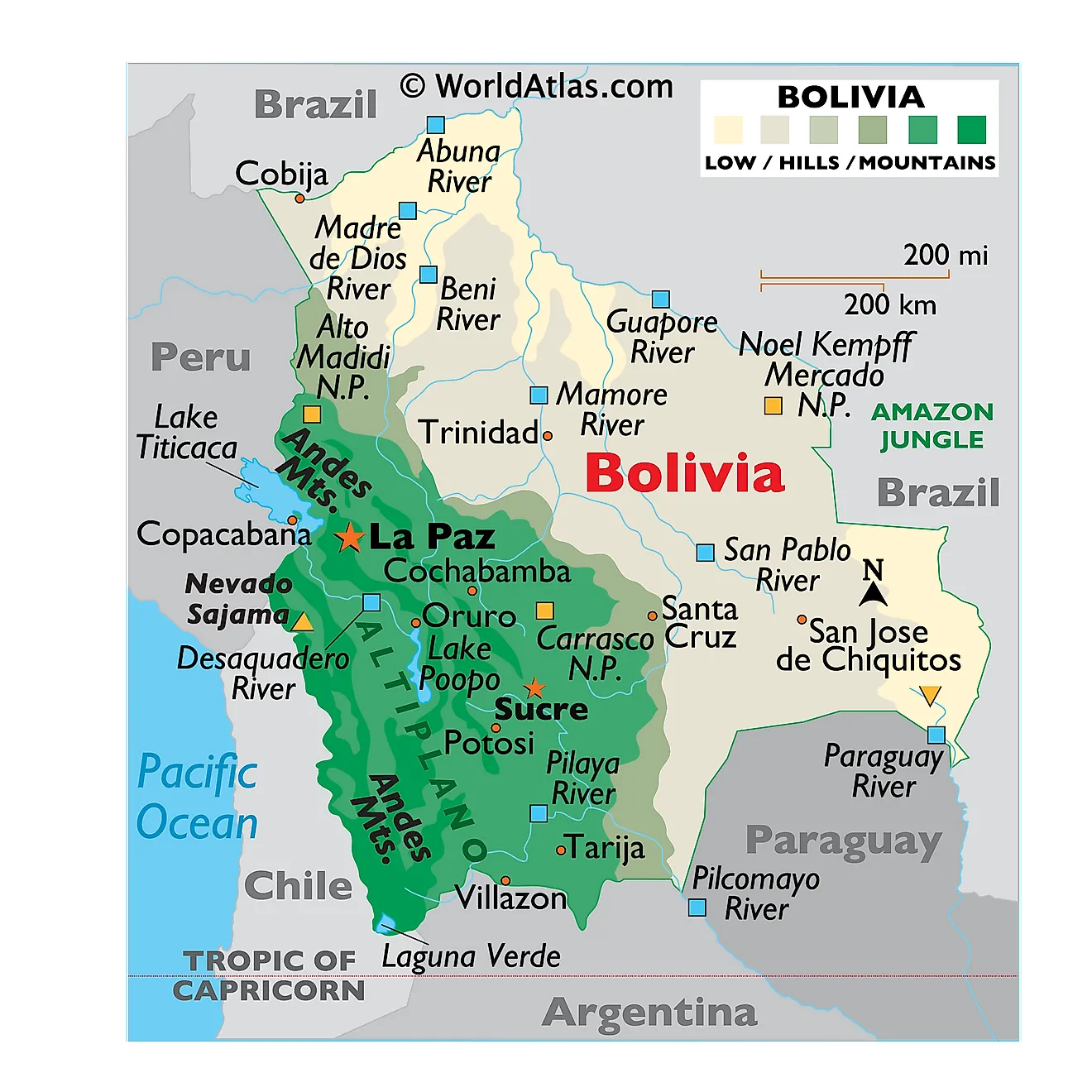
Bolivia's western half is covered by the Andes, as three meandering high mountain chains dominate the landscape.

The Cordillera Occidental (in the west) is a long line of mostly bleak, dormant volcanoes; the Cordillera Central stands in the middle, while the (eastern) Cordillera Oriental is a massive snow-capped series of stunning granite mountains.

The Altiplano (a high plateau) is sandwiched between the cordilleras. Once just deep valleys (or rifts) between the three mountain ranges, over eons of time it filled with sedimentary debris washed down from the surrounding peaks.

The eastern slopes of the Cordillera Oriental descend gently into rolling hills; numerous rivers flow eastward here, forming long narrow valleys. Northeast of La Paz, the landscape descends into fertile semitropical valleys, drained by narrow rivers. The southeast is covered by semi-arid plains that turn swampy during heavy rains.

Bolivia's Altiplano contains several salt flats, the dried remnants of ancient lakes; Uyuni Saltpan is the largest one, covering almost 3,500 sq miles.

Deep and cold, Lake Titicaca, 3,810 meters above sea level, is the highest navigable body of water in the world; salty Lake Poopo is the largest inland lake, varying greatly in size based on rainfall.

Most of Bolivia's significant rivers (or rios) are located central and north. Countrywide, important ones included the Beni, Desaquadero, Guapore, Madre de Dios and Mamore.

Highest Pt. Nevado Sajama - 21,463 ft. (6,542 m)

Lowest Pt. Paraguay River - 295 ft. (90 m)

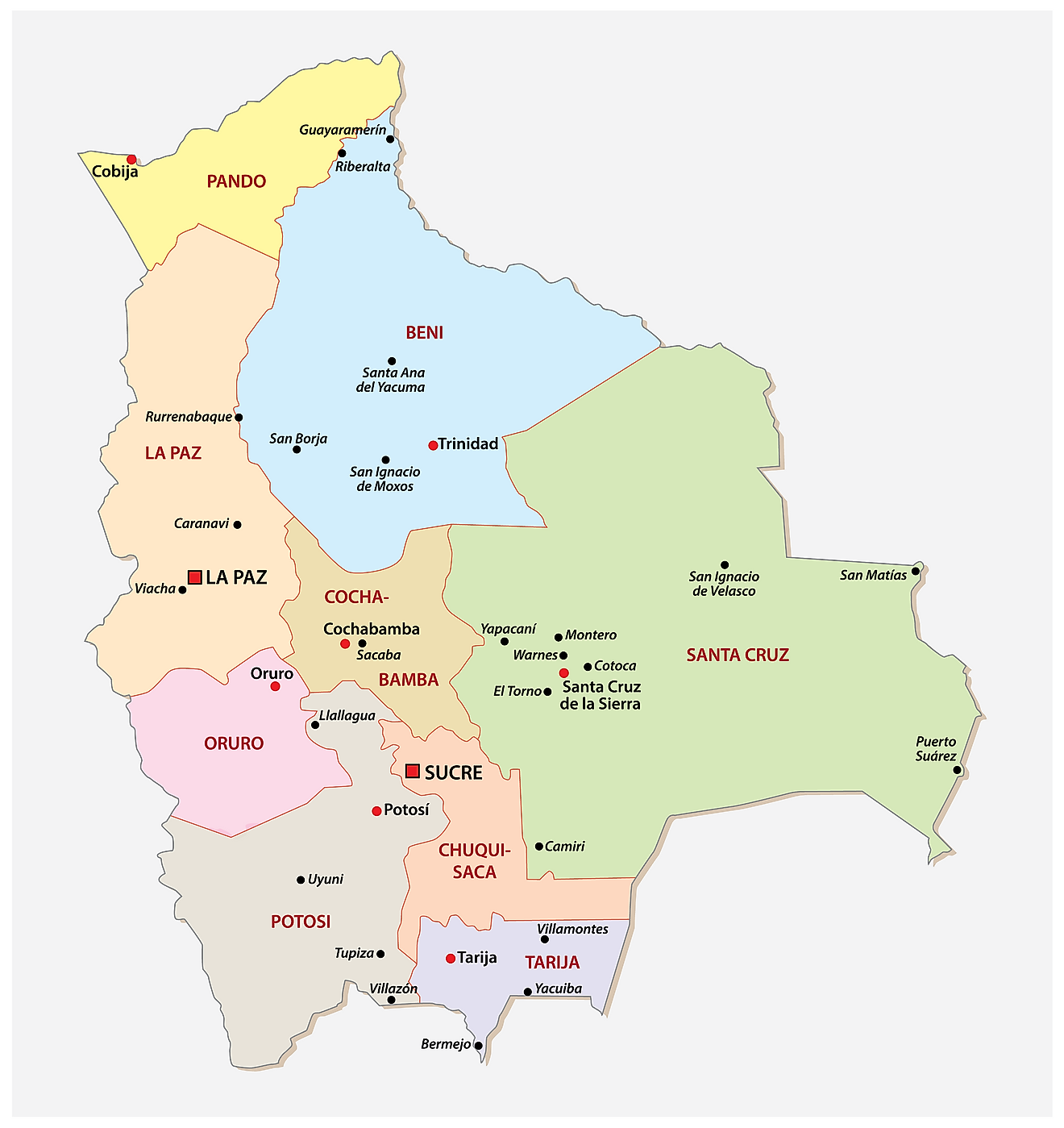
Land Divisions 9 departments: Chuquisaca, Cochabamba, Beni, La Paz, Oruro, Pando, Potosi, Santa Cruz and Tarija.


Contact Us | Privacy Statement

Copyrighted by Graphic Maps
All rights reserved!

All maps, graphics, flags and original descriptions created by Graphic Maps, a d/b/a of the Woolwine-Moen Group, unless otherwise noted and/or directly linked to the source, and use of same for any application whatsoever (with the exception of outline maps) requires written permission.

We make no copyright claim on any statistical data on this page, nor on any non-original graphics, and/or pictures not produced by us. Certain statistical data is gathered from the CIA World Factbook, as well as numerous public domain reference materials.

Every effort is made to be as accurate as possible when disseminating information on any worldwide destination. We are not responsible for unintentional data entry errors or omissions. If you would like to submit an addition, change or correction, or suggest a new link, please forward it to our map department and we will give it our immediate attention.

|
|
Maps

Bolivia (large color) Map here

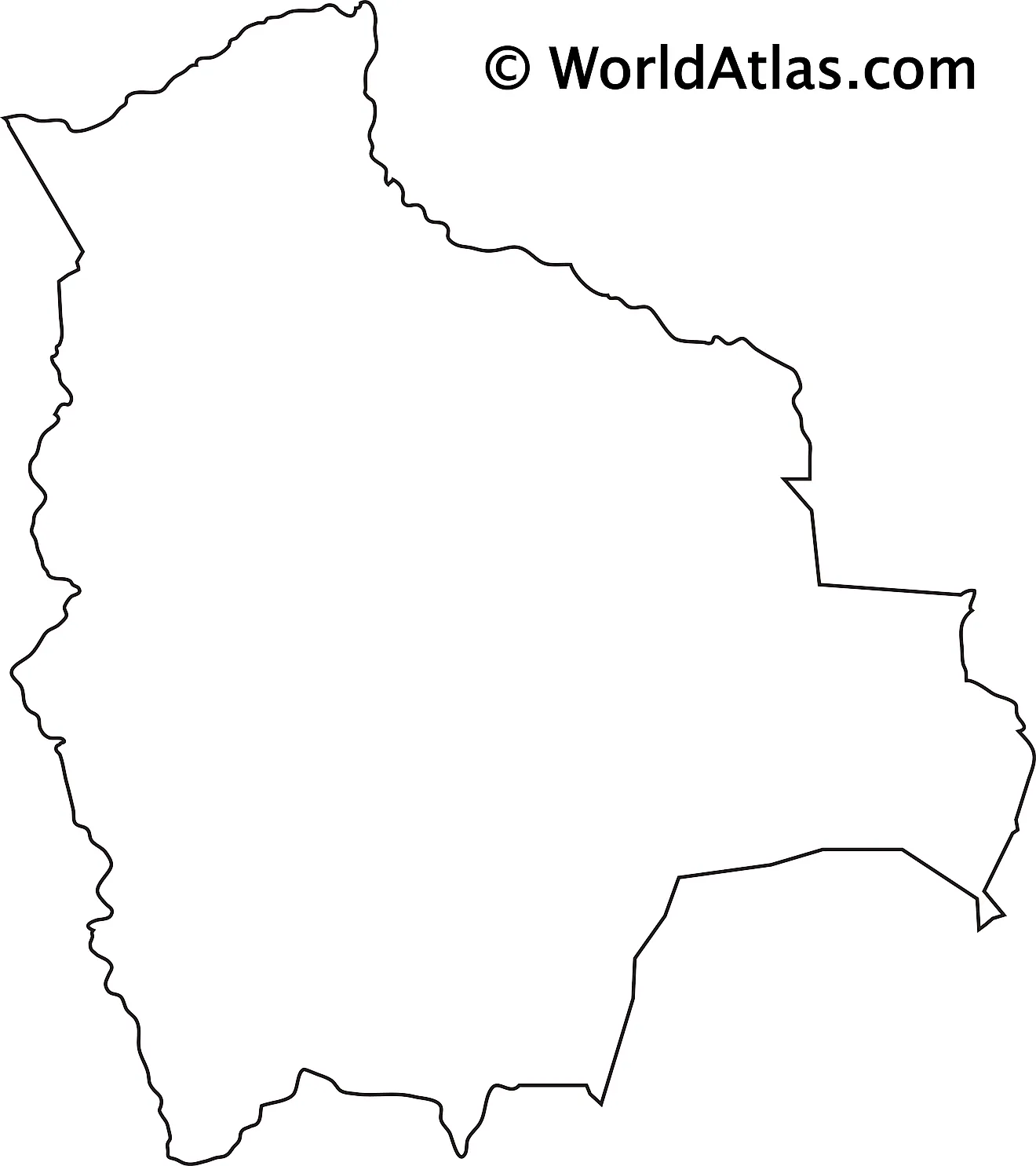
Bolivia Outline Map here

Bolivia CIA version here

Bolivia Maps at UT here

- - - - - - - - - - - - - - - - - - - - - - - - - - - - -

South America (Bodies of Water)
here!

South America (Capital Cities)
here!

South America (Landforms)
here!

South America (Outline)
here!

South America (Country Test) here!

- - - - - - - - - - - - - - - - - - - -

Ring of Fire map here

World Outline Maps (printable) here

World Time Zone Map here


Recommended Links

Bolivia (Complete) info on the (GDP)
economy, imports and exports, natural resources, government, population, military, transportation, and more here

Bolivian Embassy (Washington, DC) web site

Bolivia Tourism web site

Bolivia Photos at TrekEarth.com here

Lake Titicaca here

Uyuni Saltpan, Altiplano, Bolivia
Travel the World through Poster Art!

Time and Weather


Climate
In general terms the tropical eastern lowlands are warm (often hot), humid and rainy. The Andes are quite temperate in the lower foothills and sheltered valleys, but temperatures decrease by increased altitude, reaching Arctic-like levels in the higher elevations.

The elevated plateaus that ring the mountains (Altiplano) are ravaged by strong, cold winds, and an arid, overall chilly climate throughout most of the year.

High and low temperatures in Bolivia depend primarily on elevation and have very little seasonal variation. Overall, rainfall is heaviest in the summer months, with the southern areas of the country receiving the least amounts of precipitation.

La Paz, located high in the Andes, has different weather conditions depending on one's altitude within the city. Regardless, and overall, the average winter high temperatures reach the high 50s, while in summer, daily highs are in the low 70s. Afternoon rainfall is common in summer, and clear, sunny skies are winter staples.

Traveler Info

Attractions:
As the most elevated and isolated country in South America, Bolivia's nickname, "The Tibet of the Americas," seems the perfect moniker.

Major tourist attractions include La Paz, the highest capital city in the world, its colonial history and museums, "Witch Doctor's Market", and the nearby stunning Andean peaks; beautiful Lake Titicaca, the highest navigable lake in the world which includes the cultural charms of Copacabana and Inca history on Isla del Sol, and then, there's tours of the Bolivian Amazon - the planet's greatest ecosystem.

Add a beautiful group of national parks, dozens of significant archaeological sites, and a wide variety of colorful native-population festivals and holidays.

Country Dialing Code 591

Electricity Bolivia uses 110 volts in the western regions of the country, and 220 volts in the east.

Electrical adapters, products and tips here

Travel Warnings
here

PASSPORTS - TRAVEL VISAS


NOTE: Before making your travel plans to any worldwide destination, we strongly recommend you authenticate important details regarding all passport and visa requirements. The experienced people at Travel Visa Pro can answer all of your questions!


|
|
South America
Countries

Argentina

Bolivia

Brazil

Chile

Colombia

Ecuador

Guyana

Paraguay

Peru

Suriname

Uruguay

Venezuela

Falkland Islands
(a territory)

French Guiana
(a territory)

Galapagos Islands
(a territory)


Argentina

Bolivia

Brazil

Chile

Colombia

Ecuador

Guyana

Paraguay

Peru

Suriname

Uruguay

Venezuela

Falkland Islands
(a territory)

French Guiana
(a territory)

Galapagos Islands
(a territory)


Argentina

Bolivia

Brazil

Chile

Colombia

Ecuador

Guyana

Paraguay

Peru

Suriname

Uruguay

Venezuela

Falkland Islands
(a territory)

French Guiana
(a territory)

Galapagos Islands
(a territory)

Flute player, Bolivia
Travel the World through Poster Art!


Argentina

Bolivia

Brazil

Chile

Colombia

Ecuador

Guyana

Paraguay

Peru

Suriname

Uruguay

Venezuela

Falkland Islands
(a territory)

French Guiana
(a territory)

Galapagos Islands
(a territory)


Argentina

Bolivia

Brazil

Chile

Colombia

Ecuador

Guyana

Paraguay

Peru

Suriname

Uruguay

Venezuela

Falkland Islands
(a territory)

French Guiana
(a territory)

Galapagos Islands
(a territory)
|