return to Graphic Maps

worldatlas.com
dot
Africa | Antarctica | Arctic | Asia | Australia/Oceania | Caribbean | Central America | Europe | Islands of the World
Middle East | North America | South America | World Atlas | WIN $100 here


NICARAGUA arrow A Brief Description Fast Facts Flag Landforms Lat/Long Links Maps Time Traveler Info Weather

PRINT THIS MAP
A Brief Description

In 1502 Nicaragua was inhabited by over a million indigenous Indians when Christopher Columbus stopped briefly along its Caribbean coastline.

Twenty years later the Spanish had established permanent settlements here in their on-going colonization efforts across the Americas, and over time, most of its original people were decimated.

The Spanish colony of Nicaragua was ruled from the Spanish empire’s regional capital of Guatemala, with one exception - as the British influenced (or controlled) much of its Caribbean coastline, an area inhabited by Miskito (Mosquito) Indians.

After the overthrow of the Spanish King by Napoleon, Nicaragua and others declared their independence from Spain in 1821. Then, Nicaragua, as well as Costa Rica, El Salvador, Guatemala and Honduras formed the United Provinces of Central America, but that federation quickly dissolved, and Nicaragua became an independent republic in 1838.

As factions fought for control of this new country, the U.S. inserted its considerable stabilizing power, and in fact invaded Nicaragua on many occasions. In the early 20th century, the U.S. Marines left, and Nicaragua quickly fell under the repressive four-decade regime of the Somoza family.

Strong resistance to that brutal regime began in the late 1970s, organized by the Sandinista National Liberation Front. The Sandinistas eventually took control of the country, instigated land reforms, as well as important health and literacy changes.

The U.S. remained unhappy with the Somoza family's removal and the Reagan administration supported a heavily armed counterrevolutionary movement against the Sandinistas. They were called the “Contras” and they terrorized the countryside and inflicted great damage to the already weak economy.

The Contras were secretly funded by the U.S. Central Intelligence Agency (CIA), with revenues from the sale of weapons to Iran
(Iran-Contra Scandal). Well, the civil war ended in 1990, but Nicaragua, all but destroyed by decades of fighting, would soon be dealt another tragic blow.

In 1998, Hurricane Mitch arrived and became the worst natural disaster in Nicaragua's history; killing over 10,000 people, with more than 40,000 homes damaged or destroyed, and most bridges and roads simply washed away.

in 2004, most of Nicaragua's international debt was forgiven by the World Bank, and though the country still struggles to survive, there is much optimism in this beautiful, yet fragile land.

Read more about Nicaragua here.

In Affiliation with AllPosters.com
A rain forest morning in Central America
Travel the World through Poster Art!

Facts and Figures

arrow Name Nicaragua

(long form) Republic of Nicaragua

arrow Population 5,465,100

arrow Population & Density (all countries) here

arrow Capital City Managua (1.5 million)

arrow Currency Gold Cordoba (NIO)

arrow Currency Converter here

arrow Languages Spanish (official), Miskito and others

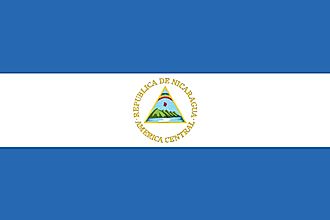
arrow Flag here

arrow National Day September 15

arrow Religions Catholic (73%), Evangelical (15%), Moravian (1.5%), others

Geographic Coordinates

arrow Latitude/Longitude (Capital City)
12º 09' N, 86º 17' W

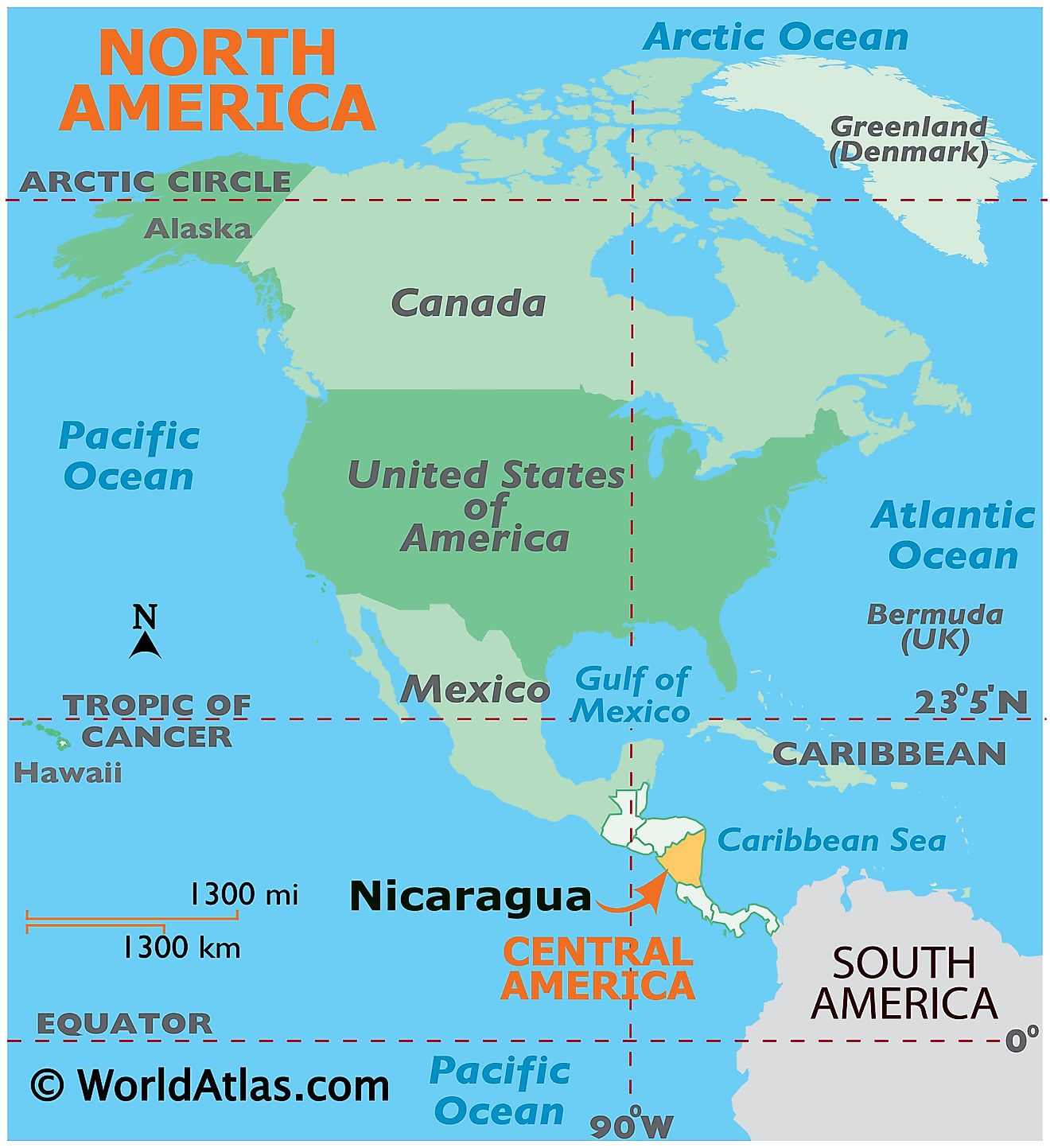
arrow Relative Location Nicaragua is positioned in both the northern and western
hemispheres. Located in North America in the middle of the Central America isthmus - a somewhat narrow strip of land that connects North and South America - the country is bordered by Honduras, Costa Rica, the Caribbean Sea and Pacific Ocean.

Land Statistics

arrow Coastline 565 miles (910 km)

arrow Land Areas

(land) 46,430 sq miles (120,254 sq km)

(water) 3,568 sq miles (9,240 sq km)

(TOTAL) 49,998 sq miles (129,494 sq km)

arrow Land Area (all countries) here

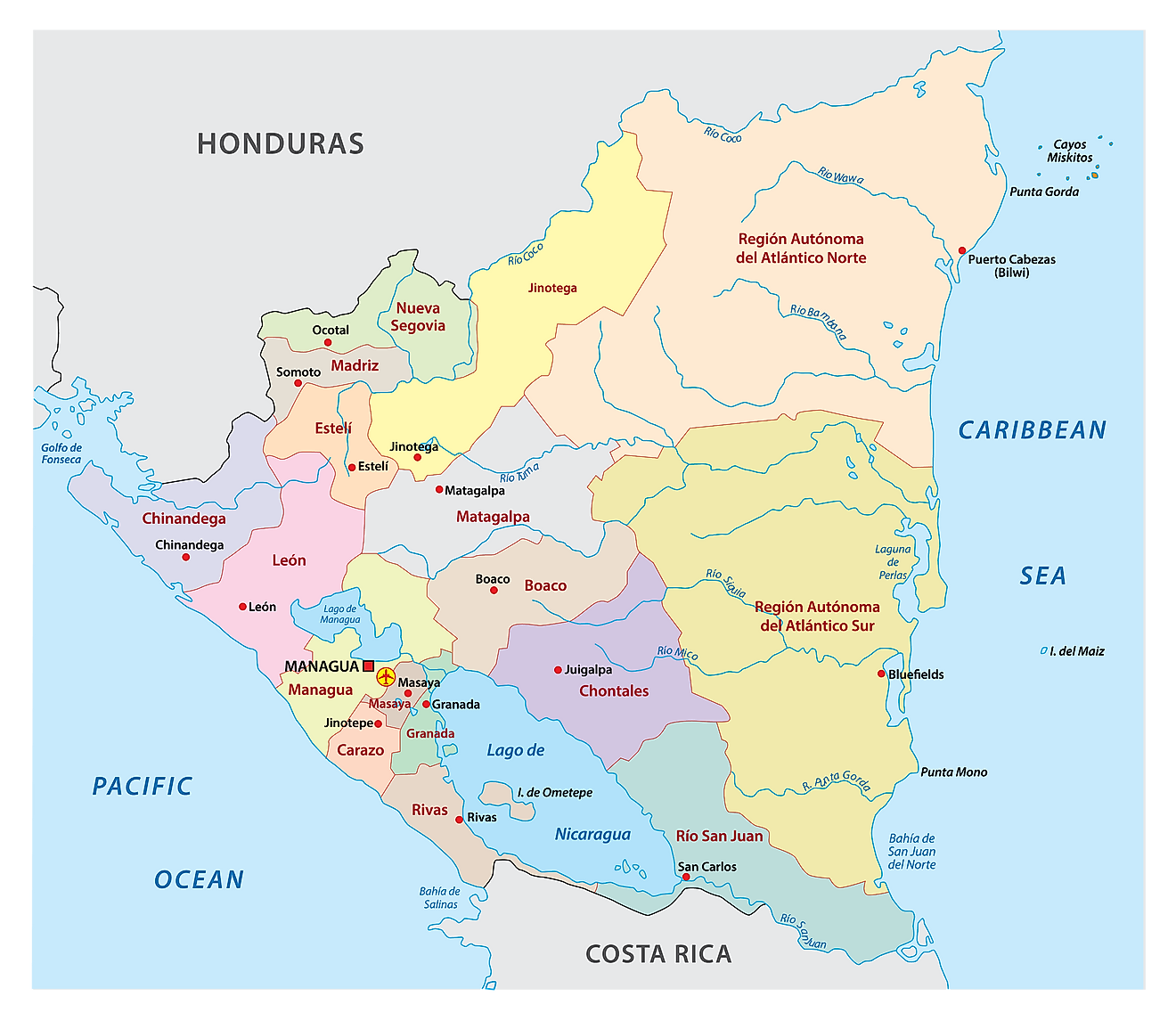
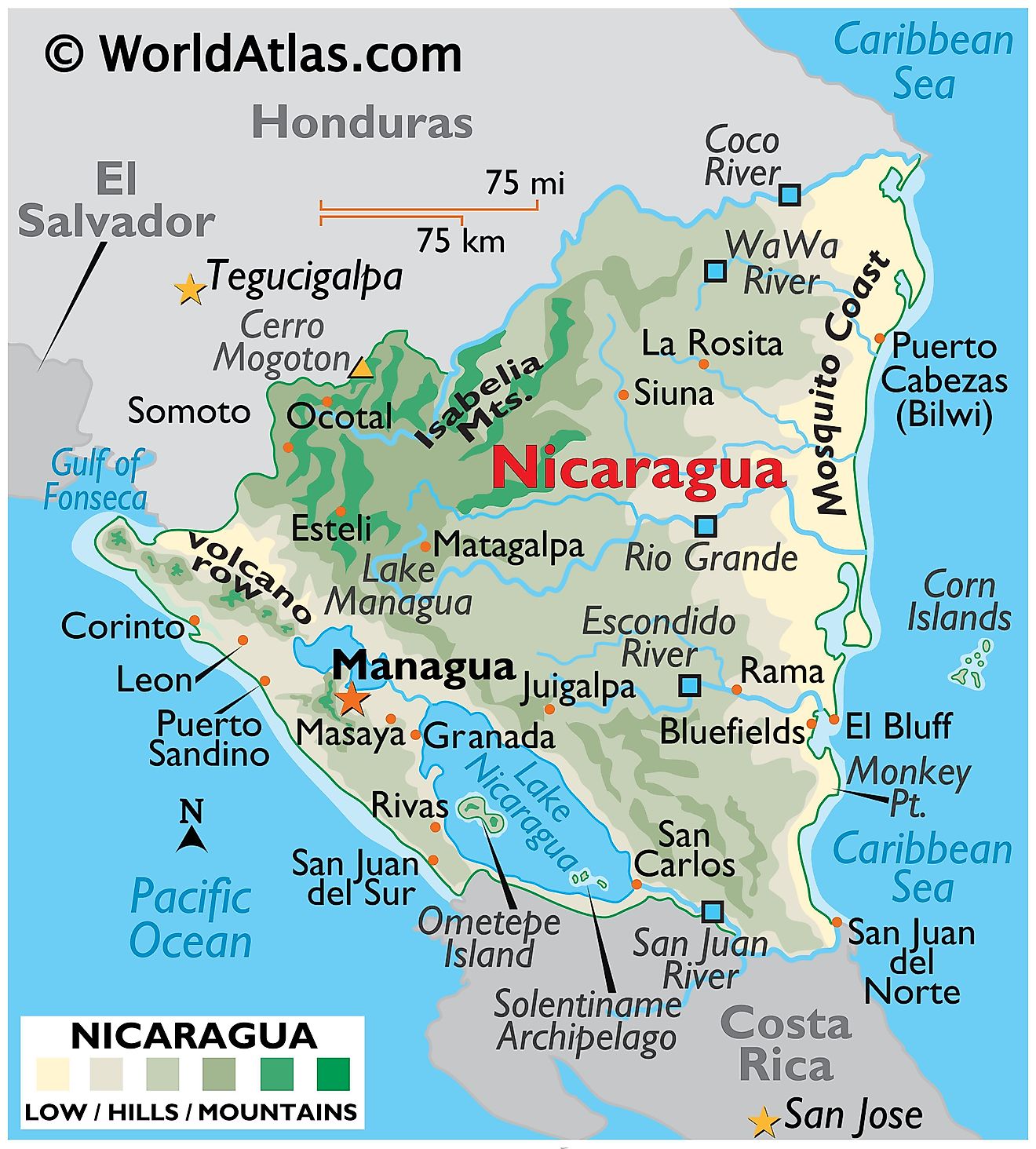
arrow Landforms Nicaragua is geographically divided into three major areas, including the Pacific Ocean Lowlands and Lakes, the Central Highlands and the Caribbean Lowlands.

The Pacific Lowlands extend from the Gulf of Fonseca to its border with Costa Rica; the sandy beaches here are fronted by a long chain (or row) of young, coned-shaped volcanoes, some active.

Two large freshwater lakes (Managa and Nicaragua) sit along the eastern rift of the volcanoes; both surrounded by rich, volcanic-soil plains. Lake Nicaragua's Ometepe Island is home to two volcanoes, Madras and (active) Conception.

The Central Highlands are a rugged terrain of forested mountains punctuated by deep valleys. The eastern edges of those highlands are covered by rain forests that slope gently into the Caribbean Lowlands, a flat expanse of savanna-like land that flows into the bays, lagoons, jungles and salt marshes of the Caribbean Sea (Mosquito Coast).

Nicaragua is a water-rich country with dozens of rivers and hundreds of small streams; the most significant rivers included the Coco, Escondido, Rio Grande and San Juan.

arrow Highest Pt. Mogoton - 7,999 ft. (2,438 m)

arrow Lowest Pt. Pacific Ocean - 0 ft. (0 m)

arrow Land Divisions 15 departments and two autonomous regions; the departments are: Boaco, Carazo, Chinandega, Chontales, Esteli, Granada, Jinotega, Leon, Madriz, Managua, Masaya, Matagalpa, Nueva Segovia, Rio San Juan and Rivas. The autonomous regions: Atlantico Norte and Atlantico Sur.

search and find


Contact Us | Privacy Statement

Copyrighted by Graphic Maps
All rights reserved!

All maps, graphics, flags and original descriptions created by Graphic Maps, a d/b/a of the Woolwine-Moen Group, unless otherwise noted and/or directly linked to the source, and use of same for any application whatsoever (with the exception of outline maps) requires written permission.

We make no copyright claim on any statistical data on this page, nor on any non-original graphics, and/or pictures not produced by us. Certain statistical data is gathered from the CIA World Factbook, as well as numerous public domain reference materials.

Every effort is made to be as accurate as possible when disseminating information on any worldwide destination. We are not responsible for unintentional data entry errors or omissions. If you would like to submit an addition, change or correction, or suggest a new link, please forward it to our map department and we will give it our immediate attention.


return to Graphic Maps
worldatlas.com
Maps

arrow Nicaragua (large color) Map
here

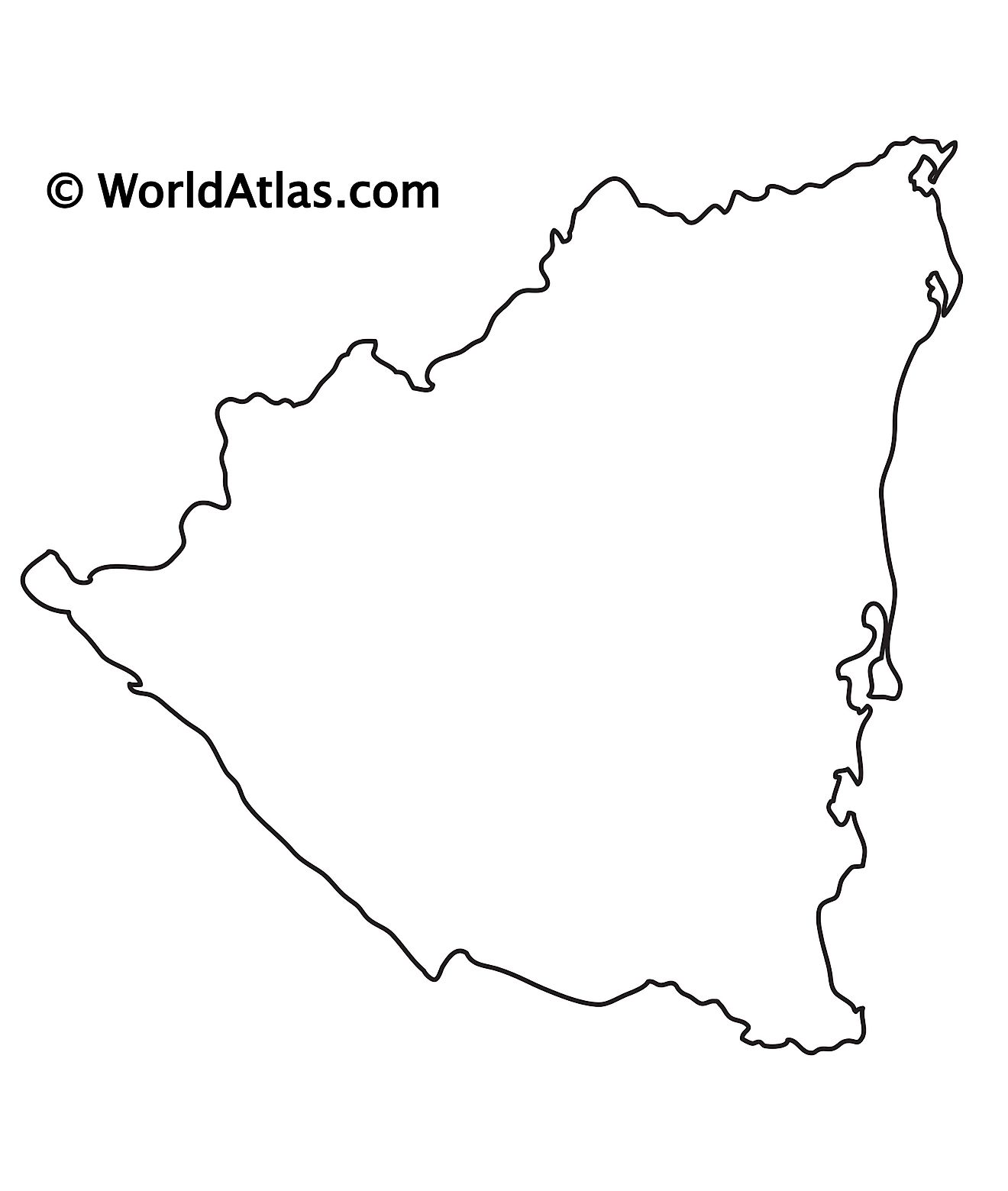
arrow Nicaragua Outline Map here

arrow Nicaragua CIA version here

arrow Nicaragua Maps at UT here

arrow Gulf of Fonseca map here!

arrow Lake Nicaragua map here!

arrow Ring of Fire map here!

- - - - - - - - - - - - - - - - - - - - - - - - - - - - -

arrow Central America (Capital Cities) here!

arrow Central America (Maps at UT) here!

arrow Central America (Outline) here!

arrow Central America (Volcanoes) here!

arrow Panama Canal here!

- - - - - - - - - - - - - - - - - - - - - - - - - - - - -

arrow North America (Capital Cities) here!

arrow North America (Lakes) here!

arrow North America (Landforms) here!

arrow North America (Outline) here!

arrow North America (Rivers) here!

arrow North America (Country Test) here!

- - - - - - - - - - - - - - - - - - - -

arrow World Outline Maps (printable) here

arrow World Time Zone Map here


Recommended Links

arrow Nicaragua (Complete) info on the (GDP) economy, imports and exports, natural resources, government, population, military, transportation, and more
here

arrow Nicaragua Consulate (Washington, DC) here

arrow Nicaragua Photos at TrekEarth.com here

arrow Nicaragua Institute of Tourism here

arrow Nicaragua Travel here

arrow Nicaragua Volcanoes here

arrow Unbeatable Managua here

arrow What to do in Nicaragua here


In Affiliation with AllPosters.com
San Cristobal volcano, Nicaragua
Travel the World through Poster Art!


Time and Weather


arrow Climate Tropical Nicaragua is warm and humid (often hot), and with any mountainous country temperatures vary by altitude.

The average year-round high temperature across the country is right at 82° F (28°C). The major variations are in the central mountains where daily high averages are in the low 70s.

The rainy season is (May - October) and rainfall amounts vary; the Caribbean Lowlands receive the most, often exceeding 200'' in some areas; while inland amounts are much, much lower.

Click for Forecast Click for Forecast

Traveler Info

arrow Attractions: Severe damage from civil war, earthquakes and hurricanes has kept Nicaragua off the radar screen of most international travelers, and yet, this beautiful country has much to offer, including vast areas of untouched natural beauty in its national parks and forest preserves, silver white beaches, volcanoes, rain forests, Spanish colonial cities and much more.

Major points-of-interest include the capital city of Managua, though badly damaged by earthquakes, many of the city's Spanish colonial buildings remain including the National Palace, Fine Arts Palace and Government House; nearby Masaya Volcano National Park, Xiloa crater lake; volcanic footprints at La Loma hill; the churches of Leon; the ruins of Leon Viego, a conquistador burial place; the many attractions of the colonial city of Granada, including Casa de los Leones, San Francisco Convent, Lake Nicaragua boat tours and the not-to-be-missed volcanoes on Ometepe Island.

Nicaragua's Caribbean coast attractions includes Escondido River boat tours, rain forest eco-tourism sites; the carefree, reggae lifestyle of Bluefields, and the coral reefs and diving venues of the Corn Islands.

Tourism facilities in Nicaragua are improving daily, and very suitable accommodations are easily found in the major cities. All travelers to Nicaragua are encouraged to read the U.S. State Department's Travel Warnings, linked below.

arrow Country Dialing Code 505

arrow Electricity Nicaragua uses 120 volts AC (60 HZ)

Electrical adapters, products and tips
here

arrow Travel Warnings here

arrow Visa Information here

arrow arrow PLEASE NOTE: Before making travel plans for any worldwide destination, we strongly recommend you authenticate important details regarding visas, local health care, customs, etc. We always find it helpful to contact the nearest consulate of any country before beginning a journey into a foreign land.

Central America
Countries

arrow

Belize

Costa Rica

El Salvador

Guatemala

Honduras

Nicaragua

Panama


NORTH AMERICA
COUNTRIES


arrow

Antigua
and Tobago

Bahamas

Barbados

Belize

Canada

Costa Rica

Cuba

Dominica

Dominican Rep.

El Salvador

Grenada

Guatemala

Haiti

Honduras

Jamaica

Mexico

Nicaragua

Panama

St. Kitts & Nevis

St. Lucia

St. Vincent and
the Grenadines

Trindad
and Tobago

United States


In Affiliation with AllPosters.com
Palms on a beach in Central America
Travel the World through Poster Art!


Central America
Countries


arrow

Belize

Costa Rica

El Salvador

Guatemala

Honduras

Nicaragua

Panama


NORTH AMERICA
COUNTRIES


arrow

Antigua
and Tobago

Bahamas

Barbados

Belize

Canada

Costa Rica

Cuba

Dominica

Dominican Rep.

El Salvador

Grenada

Guatemala

Haiti

Honduras

Jamaica

Mexico

Nicaragua

Panama

St. Kitts & Nevis

St. Lucia

St. Vincent and
the Grenadines

Trindad
and Tobago

United States

Central America
Countries


arrow

Belize

Costa Rica

El Salvador

Guatemala

Honduras

Nicaragua

Panama


dot search and find