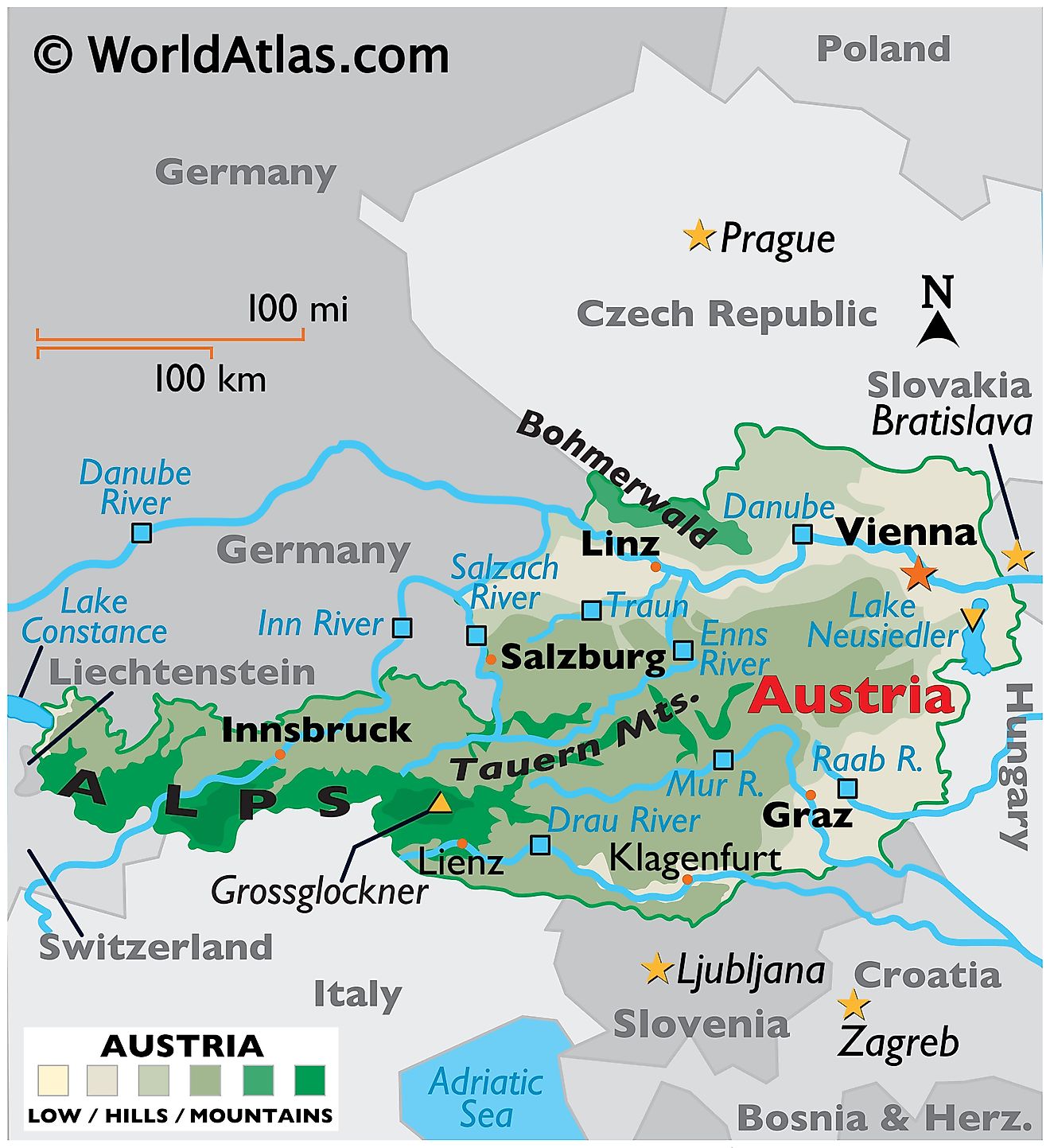
Description

Inhabited since the Stone Age, the Austrian area has a long history of occupations, territorial struggles, war and rulers. The most significant rulers, the Germanic Habsburgs, ruled Austria for 640 years. Their imperial culture was centered in Vienna, a true masterpiece of a city.

That Austrian Empire (Habsburgs) were completely dismantled by 1918, at the end of World War I. During World War II, Adolf Hitler annexed all that remained into the German Third Reich. That war ended in 1945, with Hitler defeated, and the Allies began a brief occupation and reconstruction effort.

On May 15th, 1955, the Austrian State Treaty proclaimed Austria to be an independent republic, and its modern history began in earnest.

Landlocked in central Europe, Austria is today one of the continent's most influential countrys in both economic and political issues. Over the last half-century, the extraordinary Alpine scenery and cultural attractions of Austria and its cities, have transformed it into a major tourism destination.

Perhaps no one country can match the musical resumé of Austria. It's the homeland of legendary composers like Brahms, Haydn, Mahler, Mozart, Schubert and the Strausses - both father and son. In addition, the German-born Ludwig van Beethoven lived in Vienna for most of his adult life.

The current biography of Austria (the home of the Viennese Waltz, the Vienna Boys Choir and dancing Lipizzaner horses), is one of progress and stability.

Combine that with an abundance of natural beauty, spectacular mountain vistas, castles, cosmopolitan cities, the Danube River Valley, music festivals, and of course - world class Alpine skiing and resorts - and Austria paints a very pleasant picture, indeed.
Posters and Prints of Austria

Economy

Austria joined the European Union on January 1, 1995 along with Sweden and Finland.

Currency Euro (details here)

Currency Converter (here)

GDP $226 Billion

GDP (per capita) $27,700

GDP (by sector) agriculture (2%), industry (33%), services (65%)

Agriculture Products grains, potatoes, sugar beets, wine, fruit; dairy products, cattle, pigs, poultry; lumber

Exports (major) machinery and equipment, motor vehicles and parts, paper and paperboard, metal goods, chemicals, iron and steel; textiles, foodstuffs

Imports (major) machinery and equipment, motor vehicles, chemicals, metal goods, oil and oil products; foodstuffs

Industries construction, machinery, vehicles and parts, food, chemicals, lumber and wood processing, paper and paperboard, communications equipment, tourism

Natural Resources iron ore, oil, timber, magnesite, lead, coal, lignite, copper, hydropower

Facts and Figures

Official Name Republic of Austria

Official Name (local) Republik Oesterreich

Capital Vienna (Wien)

Currency Euro (details here)

Language (major) German

Population 8,037,400 (2003)

Population (4 largest cities) Vienna (1,523,000), Graz (219,000), Linz (185,000) Salzburg (145,000)

Religions Roman Catholic 78%, Protestant 5%, Muslim and other 17%

Flag and Symbols


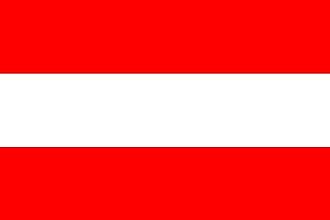
Austrian Flag (large, with description) here

Austrian Coat of Arms

Austrian National Anthem Land der Berge, Land am Strome (Land of the mountains, land on the river)

Government Info

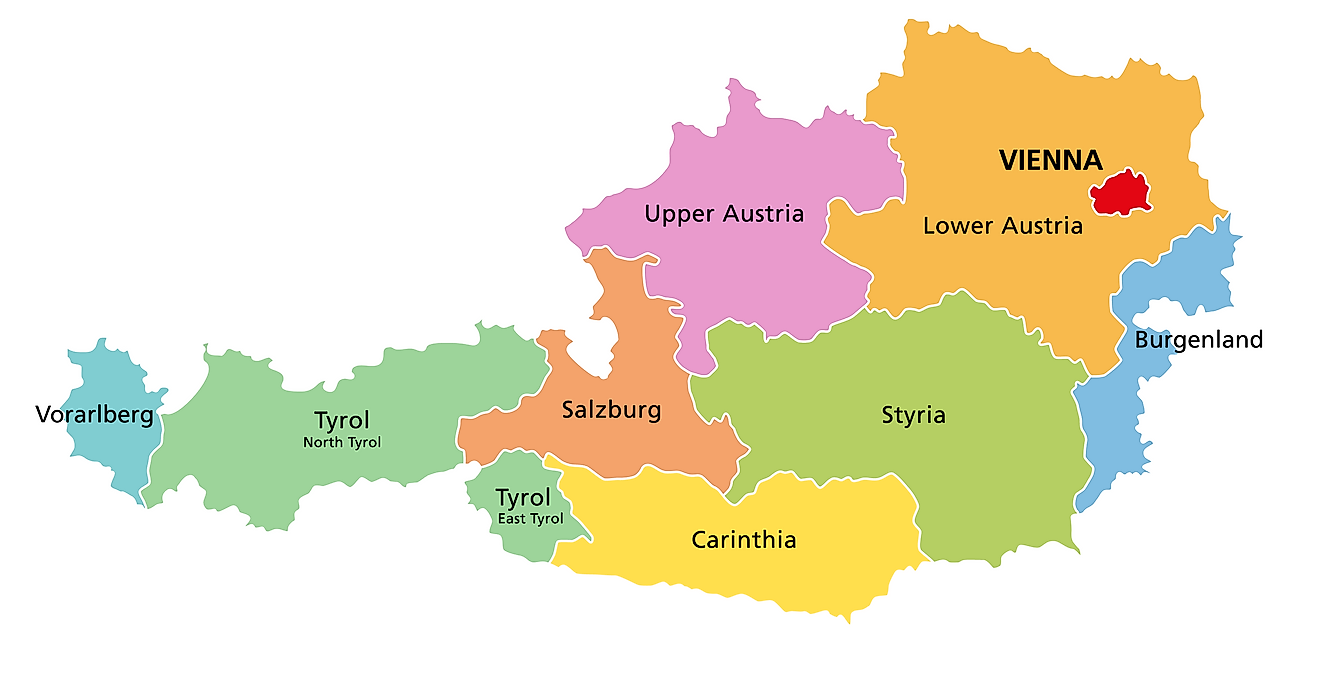
Administrative Divisions 9 states: Burgenland, Kaernten, Niederoesterreich, Oberoesterreich, Salzburg, Steiermark, Tirol, Vorarlberg and Wien

Executive Branch chief of state:
President Thomas Klestil
(additional government details here)

Government Type Federal Republic

Independence 1156 (from Bavaria)

National Holiday October 26 (National Day)

Land Statistics

LOCATION

(Absolute)
Latitude/Longitude 47° 20' N, 13° 20' E

(Relative)
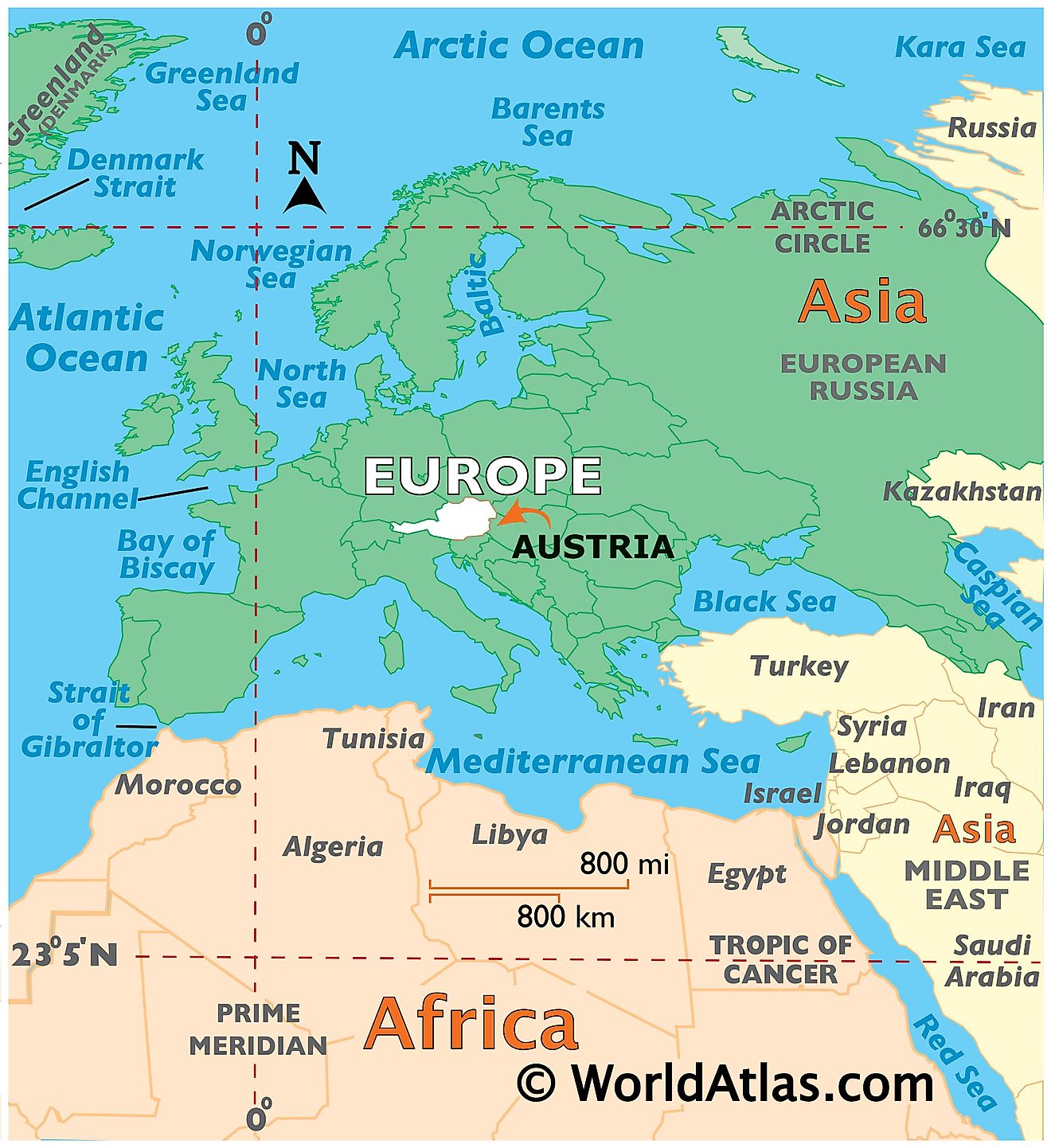
Austria is a landlocked, central European country.

Bordering Countries (8) Czech Republic, Germany, Hungary, Italy, Liechtenstein, Slovakia, Slovenia, and Switzerland

Border Length 1,682 miles, 2707 km

Area 32,377 sq miles, 83,858 sq km
(Land) 31,945 sq miles, 82,738 sq. km
(Water) 432 sq miles, 1,120 sq. km

Highest Point Grossglockner 12,460 ft. (3,798 m)
Web Cam: (here) Photo Page: (here)

Lowest Point Neusiedler See 508 ft. (155 m)

Length/Width 162/335 miles - 260/539 km

Coastline 0 (landlocked)

Mean Elevation unavailable

LANDFORMS

CLICK HERE for Austria Landforms Map

In essence, Austria has three main geographical areas.

The Lowlands of the east and southeast are the country's agriculture center. A sliver of lowland also fronts the Lake Constance area on its border with Switzerland.

In the Hill Country, north of the Danube River, the land rises into forested hills and lower mountains up to its border with the Czech Republic.

Most of Austria (70%), is covered by the Alpine Region, central and west, as the Alps extend on into Austria from Switzerland.

In this region several branches, spurs and forested, snow-capped ranges of the Alps dominate. The major ones include the Bavarian, Carnic and Otztaler ranges.

North Face of Grossglockner

The highest peaks are in the central Tauern Range. Grossglockner, the country's highest point, at 12,460 ft. (3,798 m), is located there.

The Tauern Range eventually slopes into the Danube River Valley, and into the eastern lowlands, from Vienna, south to its border with Slovenia.

The Danube (1,771 miles) (2,850 km), is the most significant river in the country. It's the second longest river in Europe, and a vital waterway for commerce. Additional rivers of size include the Drau, Enns, Inn, Mur, Raab and Traun.

Dozens and dozens of lakes run amidst the mountain ranges, especially in the south and to the immediate east of Salzburg. The largest in the county is Lake Neusiedler.

CLICK HERE for Austria Landforms Map

For a closer look at the topography of Austria, view this map

Landforms of Europe here

Rivers of Europe here


Famous Natives
People listed are almost always native born. We do, on occasion, include those that have lived in the country for part/or most of their adult life.
"A mostly random selection"

Marie Antoinette
queen of france

Ingeborg Bachmann
author, poet

Ludwig van Beethoven
composer

Johannes Brahms
composer

Anton Bruckner
composer

Archduke Charles of Austria
military commander

Elisabeth of Austria ("Sisi")
duchess, empress

Falco (Johann Holzl)
singer

Sigmund Freud
father of modern psychoanalysis

Johann Wolfgang von Goethe
poet, lyricist

Eduard Haas III
founder pez candy

Peter Handke
author

Joseph Haydn
composer

Friedensreich Hundertwasser
painter, architect

Francis Joseph
emperor of austria

Gustav Klimt
painter, illustrator

Hedy Lamarr
actress

Niki Lauda
race car driver

Ernst Mach physicist, philosopher

Gustav Mahler
composer

Klemens von Metternich
statesman

Leopold Mozart
composer, violinist

Wolfgang Amadeus Mozart
composer

Otto Preminger
movie director

Joseph Pulitzer
publisher

Egon Schiele
painter

Franz Schubert
composer

Arnold Schwarzenegger
actor

Johann Strauss (the elder) composer

Johann Strauss (the younger) composer

Bertha von Suttner author, nobel prize winner

Daniel Swarovski founder swarovski crystal

the Trapp Family sound of music fame

Kurt Waldheim former secretary general united nations, former president of austria

Oskar Werner actor

Ludwig Wittgenstein philosopher

Paul Wittgenstein pianist, arranger

Is someone missing from the list?
Submit your famous person
here!
Africa | Asia | Australia/Oceania
Europe | Islands/Oceans | Middle East
North America | South America
World Atlas


Contact Us | Privacy Statement

Copyrighted by Graphic Maps
All rights reserved!

All maps, graphics and original descriptions created by Graphic Maps, a d/b/a of the Woolwine-Moen Group, unless otherwise noted and/or directly linked to the source, and use of same for any application whatsoever requires written permission.

We make no copyright claim on any statistical data on this page, nor on any non-original graphics, and/or pictures not produced by us. Certain statistical data is gathered from the CIA World Factbook, as well as numerous public domain reference materials.

Every effort is made to be as accurate as possible when disseminating information on any worldwide destination. We are not responsible for unintentional data entry errors or omissions. If you would like to submit an addition, change or correction, or suggest a new link, please forward it to our map department and we will give it our immediate attention.
|
|
|
Maps (Austria)

Austria Large Color Map here

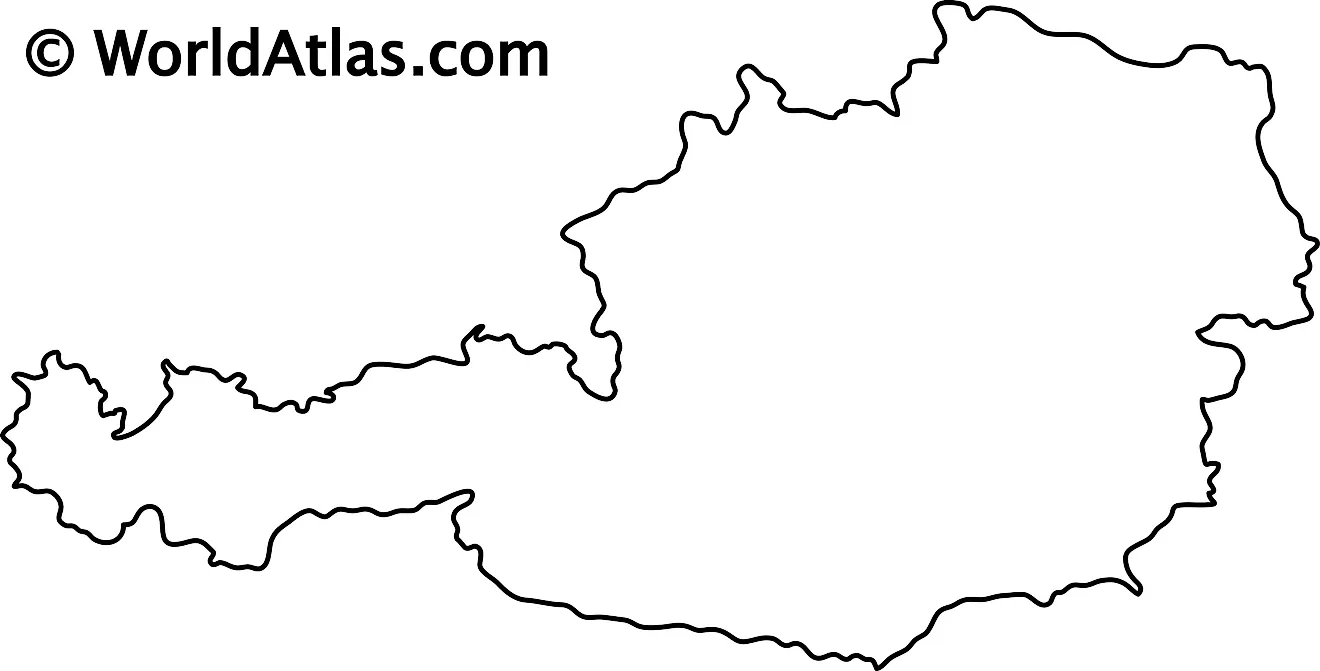
Austria Outline Map here

Austria Map (interactive) here

Austria Political Map (shows regions) here

Austria Railways Map here

Austria Topographical Relief Map here

Vienna Map here

Vienna Metro Map here

Vienna 1858 Map here

Austria from Space

Maps (Europe)

Europe Capital Cities Map here

Europe Continent Map (printable) here

Europe Landforms Map here

Europe (Name the Country) test

Europe Outline Map here

European Rivers Map here

Europe Topographical Relief Map here

Media

Austria Internet Search Engines here

Austria News here

Austria Today here

Austria Newspaper List here

Austria Radio Stations here

Austria Telephone Directory here

Radio Austria here

Suggested Links

Austrian Beer Guide here

Austrian Business Directories here

Austria Country Study here

Austria Culture here

Austrian Football (soccer) here

Austrian Genealogy Pages here

Austrian Holidays here

Austrian National Bank here

Austrian Sports Organization here

Swarovski Crystal here

Weather, Time and more

Austria International Dialing Codes here

Climate Austria has three very distinct climate zones.

In the eastern lowlands, the average high temperature in July is near 68° (20° C), while the January lows average near 30° (-1° C). Annual rainfall in this area is often less than 31 inches (800 mm).

The central region has a typical Alpine climate, with higher precipitation levels and shorter summers. Winters are long, and bring frequent rain to the lowlands and heavy snow to the mountains.

In the west, the weather is milder, but wetter. Precipitation amounts vary here depending on location and altitude, but annual amounts near 78 inches (2,000 mm) are possible. The average high temperature in July is near 62° (16° C), while the January lows average near 38° (3° C).


Mont Dachstein

Timeline of History

(16 B.C.) Almost all of present-day Austria was under Roman control, and called the Noricum Territory

(803) Charlemagne developed the Ostmark, or (East Mark) territory along the Danube

(955) That land became part of the Holy Roman Empire, after defeat of the Magyars

(1156) Reestablished as Ostmart by the Roman Emperor, Otto the Great

(1278) German King, Rudolf I of Habsburg, gained control, and the Habsburg dynasty ruled until 1918, and the conclusion of World War I

(1438) Duke Albert V, chosen successor to his father-in-law, Emperor Sigismund, a Holy Roman Emperor (1367-1437)

(1477-1519) Through marriage, the Emperor Maximilian took control of the low countries

(1519) Spanish King Charles, eventually known as the Holy Roman Emperor Charles V, came to power, later to abdicate his throne

(1556) His brother, Ferdinand I, living in Vienna, was declared ruler of Austria and Hungary and other surrounding lands, thus extending the Habsburg control and territories. King Charles' son, Phillip II, was given the remaining Spanish holdings

(1618) The Thirty Years' War destroyed much of central Europe; peace was finally reached in 1648

(1657-1705) Leopold I, Holy Roman Emperor, ruled the area for 48 years

(1683) Turk forces attacked Vienna, resulting Hungary eventually being returned to Austrian control

(1711-1740) The reign of Emperor Charles V

(1740) The reign of Maria Teresa, the daughter of Charles V begins, she ruled for 40 years. Marie Antoinette (later the Queen of France) was her youngest daughter

(1756) Wolgang Amadeua Mozart born in Salzburg

(1805) At Austerlitz, Napoleon defeated the Austrian forces

(1814-15) The Congress of Vienna successfully ended most central European conflicts

(1848) Revolution was in the air, and localized conflicts occur throughout the Habsburg Empire

(1866) Austria was defeated during the Austro-Prussian War, which forced a 1867 coalition between Austria and Hungary, and the new leadership of Emperor Franz Josef

(1914) The assassination of Archduke Franz Ferdinand and his wife, nephew of Franz Josef and heir to the Austro-Hungarian throne, was the catalyst for a series of events that led to World War I

(1918) The Habsburgs were defeated during that war, and Austria was declared a republic

(1919) Treaty of St Germain defined Austria's new boundaries

(1939-1945) World War II raged across Europe. Adolf Hitler annexed all of Austria into the German Third Reich

(1945-1955) At war's end, Soviet troops liberated Vienna, and other Allied forces began their occupation of the country

(1955) The Austrian State Treaty proclaimed Austria to be an independent republic

(1964) The Olympic Games held in Austria, with spring-like weather, Troops were forced to bring in snow

(1986) Kurt Waldheim elected President of Austria

(1992) Thomas Klestil replaced Kurt Waldheim as President of Austria, re-elected in 1998

(1994) Austria joined the European Union

(2002) A group of state owned companies agreed to pay $65 million to a fund earmarked for survivors of the Nazi Holocaust

(2002) Severe flooding along the Danube caused by torrential rain

(2003) Austrian native son, Arnold Schwarzenegger elected Governor of California, USA

Traveler Information

Attractions (a brief summary) Alpine skiing, castles, cosmopolitan cities, medieval villages and towns, monasteries, stunning mountain scenery, and of course, the city of Vienna, "the Music capital of the World," and its Imperial Habsburg era points-of-interest.

This list could go on and on, so we've summarized most, complete with direct links, in the varied travel categories featured below.

Electricity Austria uses 220 volts AC (50 cycles)

Electrical adapters, products and tips here

Times to Travel Austria is an attractive destination for visitors at anytime of the year. The country is organized, the roads are good, the trains run on time, and there are lodging facilities for every budget.

July and August are (high season) months; the country is crowded and the prices are higher. The Christmas and Easter seasons (especially in Vienna), and to a lesser degree in the other large cities, bring significant crowds, so advance reservations are recommended.

PASSPORTS - TRAVEL VISAS


NOTE: Before making your travel plans to any worldwide destination, we strongly recommend you authenticate important details regarding all passport and visa requirements. The experienced people at Travel Visa Pro can answer all of your questions!

ATTRACTIONS - POINTS OF INTEREST - TOURS

Austria Cycling Tours here

Austria Hiking here

Austria National Parks here

Austria Skiing here

Castles in Austria here

Golf in Austria here

Hohe Tauern National Park here

CITIES - COUNTRY - REGIONS

Austria National Tourism Office here

Burgenland Tourism here

Graz Tourism here

Innsbruck Tourism here

Linz Tourism here

Salzburg Tourism here

Tirol Tourism here

Vienna Tourism here

Virtual Vienna here

EMBASSIES - PASSPORTS - VISAS

Austrian Embassy (Washington, D.C.) here

Austria Visa Information here

U.S. Embassy (Vienna) here

LANGUAGE

German Words here

German Words in English Language here

Language Translations here

Learn German here

MEDICAL INFO & TRAVEL ADVICE

Medical Information for Travelers here

Medical Information (CDC) web site

Travel Tips and Publications here

Travel Warnings here

PUBLICATIONS - VIDEOS - WEBCAMS

Austria Travel Videos here

Austria Webcams here

Live Cams Vienna here

Mallnitz (mountain village) Webcams here

TRANSPORTATION

Austrian Airlines here

Austria Transportation Links here

European Rail Travel here

Rail Europe here
|
|
|
European
Countries

Albania

Andorra

Armenia

Austria

Azerbaijan

Belgium

Belarus

Bosnia-Herzegovina

Bulgaria

Croatia

Cyprus

Czech Republic

Denmark

Estonia

Finland

France

Georgia

Germany

Greece

Hungary

Iceland

Ireland

Italy

Latvia

Liechtenstein

Lithuania

Luxembourg

Macedonia

Malta

Moldova

Monaco

Montenegro

Netherlands

Norway

Poland

Portugal

Romania

San Marino

Serbia

Slovakia

Slovenia

Spain

Sweden

Switzerland

Turkey

Ukraine

United Kingdom
including:
England
Scotland
Northern Ireland
Wales

Vatican City
Albania

Andorra

Armenia

Austria

Azerbaijan

Belgium

Belarus

Bosnia-Herzegovina

Bulgaria

Croatia

Cyprus

Czech Republic

Denmark

Estonia

Finland

France

Georgia

Germany

Greece

Hungary

Iceland

Ireland

Italy

Latvia

Liechtenstein

Lithuania

Luxembourg

Macedonia

Malta

Moldova

Monaco

Montenegro

Netherlands

Norway

Poland

Portugal

Romania

San Marino

Serbia

Slovakia

Slovenia

Spain

Sweden

Switzerland

Turkey

Ukraine

United Kingdom
including:
England
Scotland
Northern Ireland
Wales

Vatican City
Albania

Andorra

Armenia

Austria

Azerbaijan

Belgium

Belarus

Bosnia-Herzegovina

Bulgaria

Croatia

Cyprus

Czech Republic

Denmark

Estonia

Finland

France

Georgia

Germany

Greece

Hungary

Iceland

Ireland

Italy

Latvia

Liechtenstein

Lithuania

Luxembourg

Macedonia

Malta

Moldova

Monaco

Montenegro

Netherlands

Norway

Poland

Portugal

Romania

San Marino

Serbia

Slovakia

Slovenia

Spain

Sweden

Switzerland

Turkey

Ukraine

United Kingdom
including:
England
Scotland
Northern Ireland
Wales

Vatican City
Albania

Andorra

Armenia

Austria

Azerbaijan

Belgium

Belarus

Bosnia-Herzegovina

Bulgaria

Croatia

Cyprus

Czech Republic

Denmark

Estonia

Finland

France

Georgia

Germany

Greece

Hungary

Iceland

Ireland

Italy

Latvia

Liechtenstein

Lithuania

Luxembourg

Macedonia

Malta

Moldova

Monaco

Montenegro

Netherlands

Norway

Poland

Portugal

Romania

San Marino

Serbia

Slovakia

Slovenia

Spain

Sweden

Switzerland

Turkey

Ukraine

United Kingdom
including:
England
Scotland
Northern Ireland
Wales

Vatican City
|
|
|


|