Maps of Cote d'Ivoire
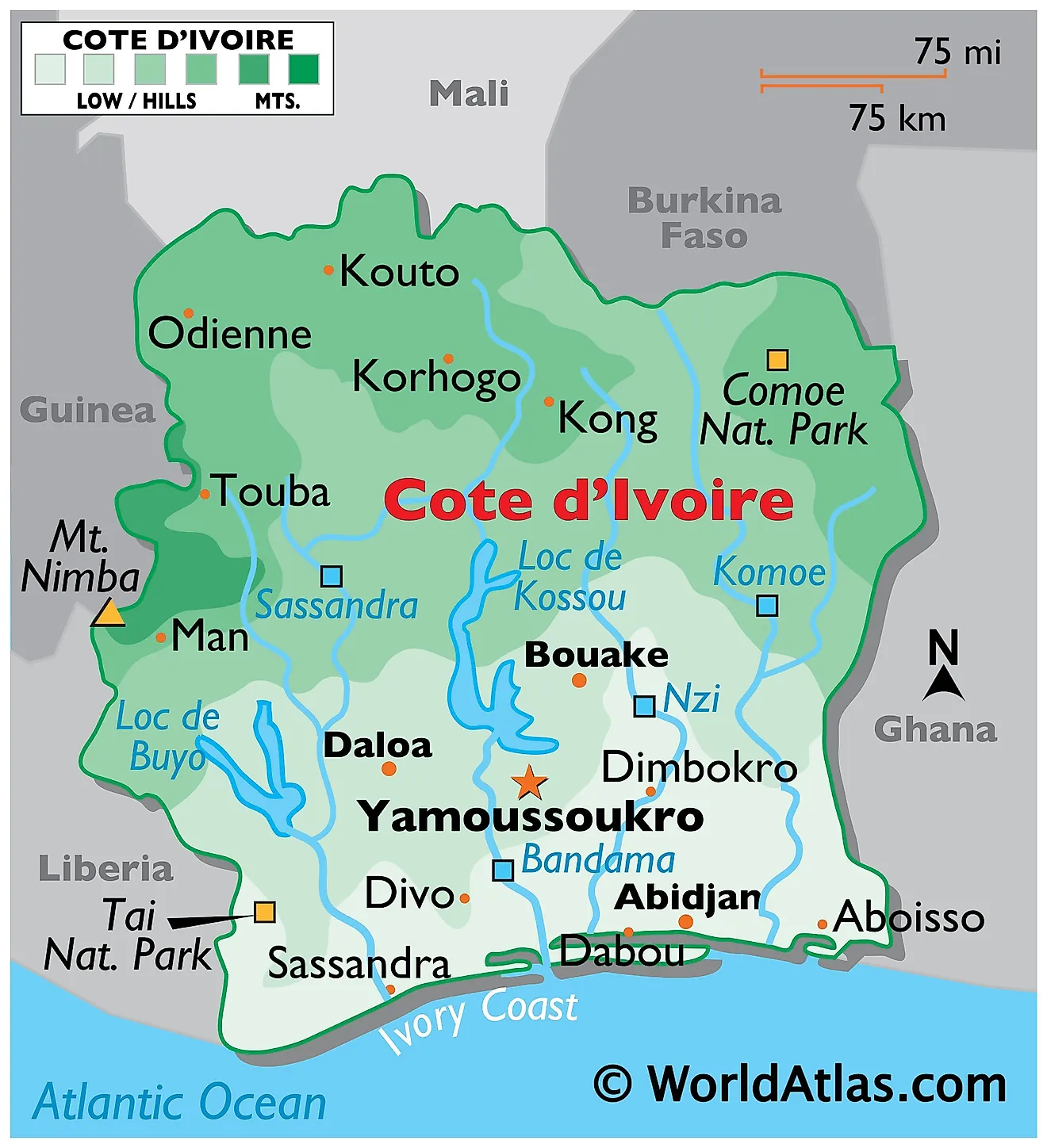
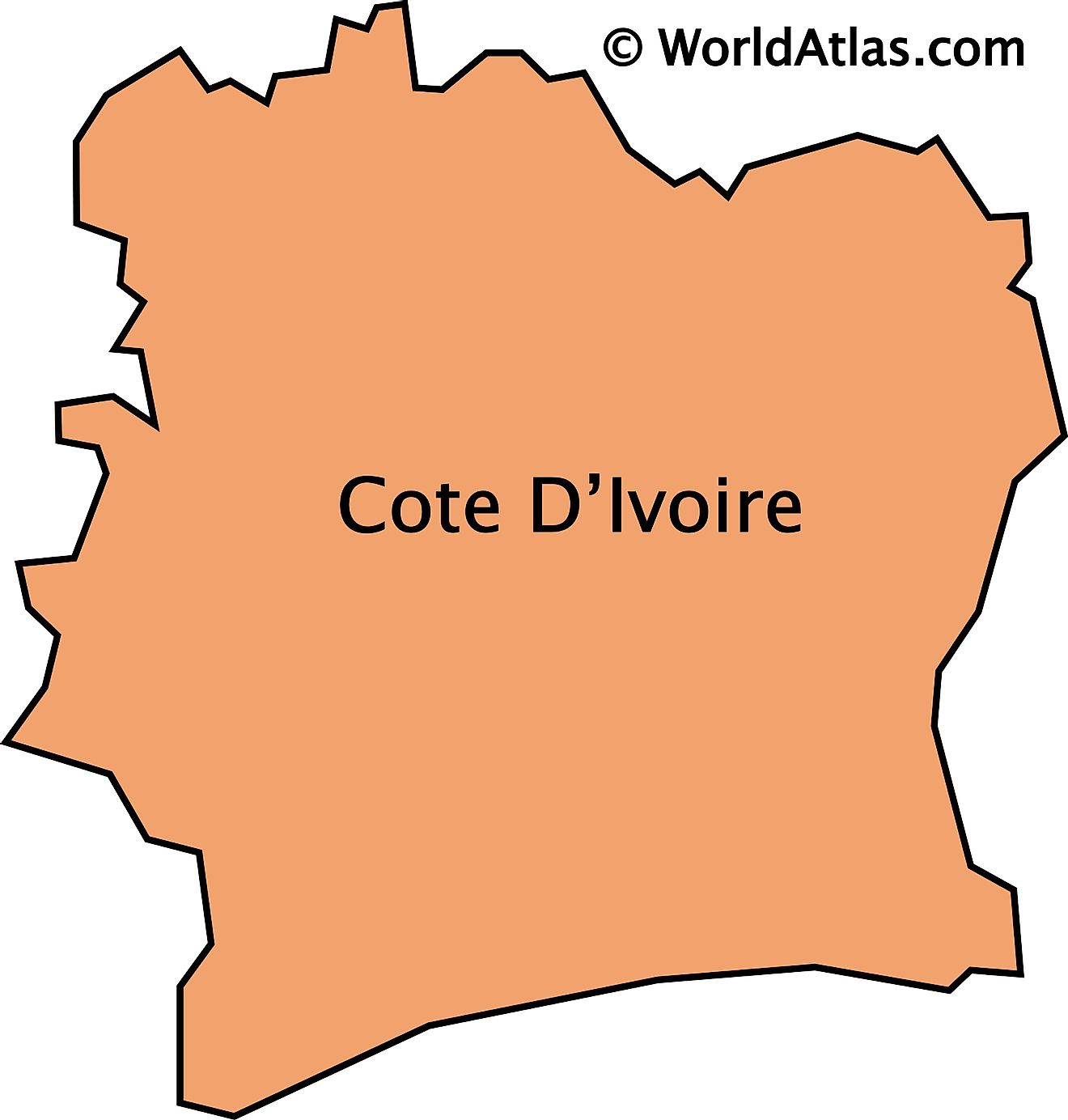
The Ivory Coast or Côte d'Ivoire is a country in West Africa covering an area of 322,463 sq. km.
Most of Cote d'Ivoire (north to south) is a forested plateau, one that gradually slopes down to the Atlantic Ocean coastal areas. Exceptions are the edges of the Guinea Highlands (4000 - 5000 ft. peaks) on its western border with Guinea, in the far northwest, and the elevated savanna and forest of the northeast.
The coast of the country is about 64 km wide and is dotted with lagoons to the east. A long submarine sandbar just offshore of the coast makes the sea difficult to access.
Extending across the middle of the country is the Guinean forest-savanna mosaic, a transition zone between the coastal forests and interior savannas.
Marked on the map with a yellow upright triangle, the highest point of Cote d'Ivoire is Mount Nimba at 1,752 m. It is located on its western highland region in the Mount Nimba Strict Nature Reserve. It is a UNESCO World Heritage Site.
The lowest point is the Gulf of Guinea (0 m).
Major rivers, including the Bandama, Komoe and Sassandra, drain the plateau and enter the Gulf of Guinea. These rivers are not easy to navigate due to the presence of numerous waterfalls and rapids. Large lakes include Loc de Buya and Loc de Kossou and are marked on the map above.
Districts of Cote d'Ivoire Map
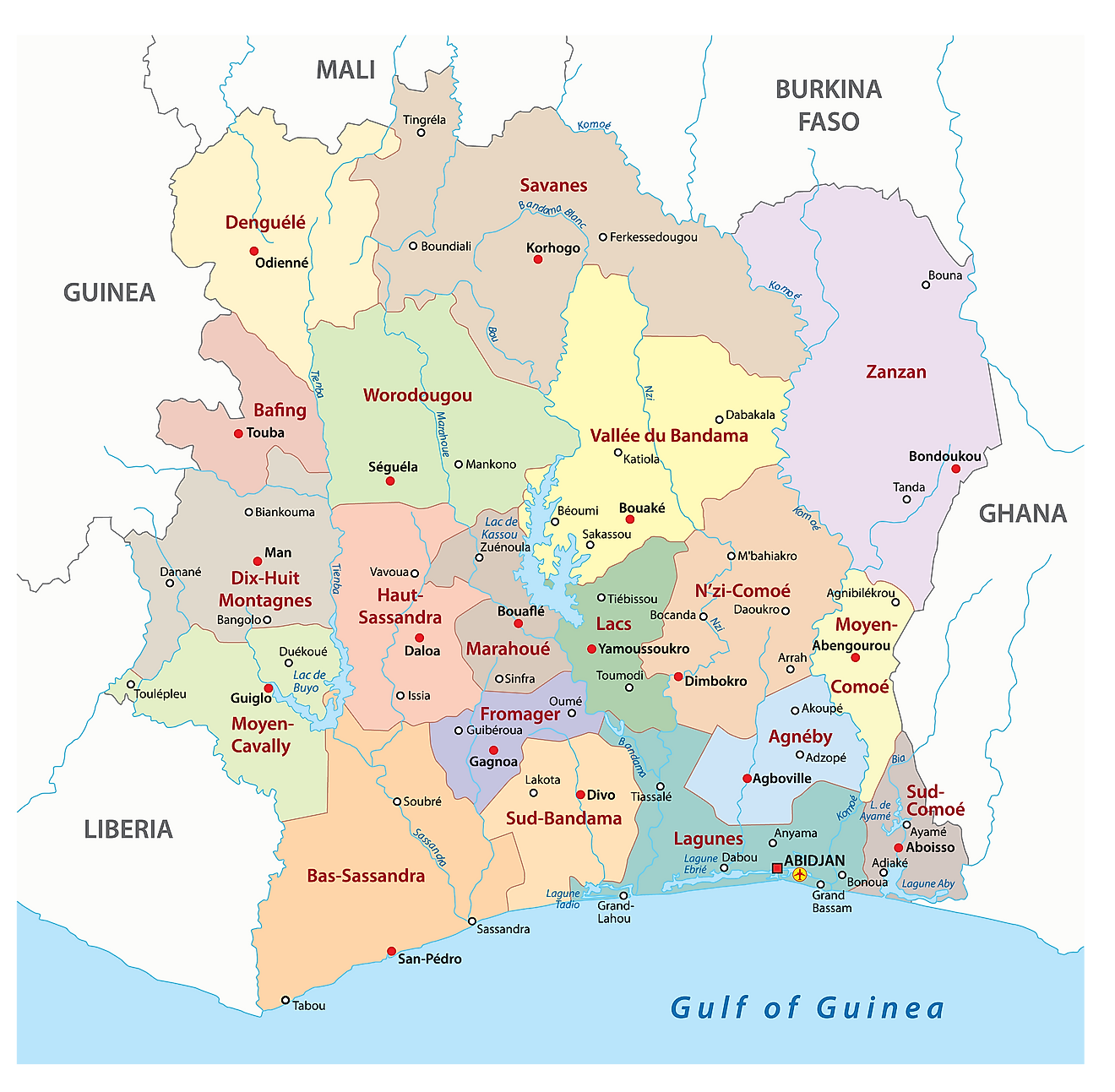
Ivory Coast has 14 districts including two cities designated as autonomous districts. The 12 non-city districts are Bas-Sassandra, Comoe, Denguele, Goh-Djiboua, Lacs, Lagunes, Montagnes, Sassandra-Marahoue, Savanes, Vallee du Bandama, Woroba, and, Zanzan. The two cities that are autonomous districts are Abidjan and Yamoussoukro. The districts are further divided into 31 regions which are divided into 108 departments and then sub-prefectures. Abidjan is the capital city of Ivory Coast.
Where is Cote d'Ivoire?
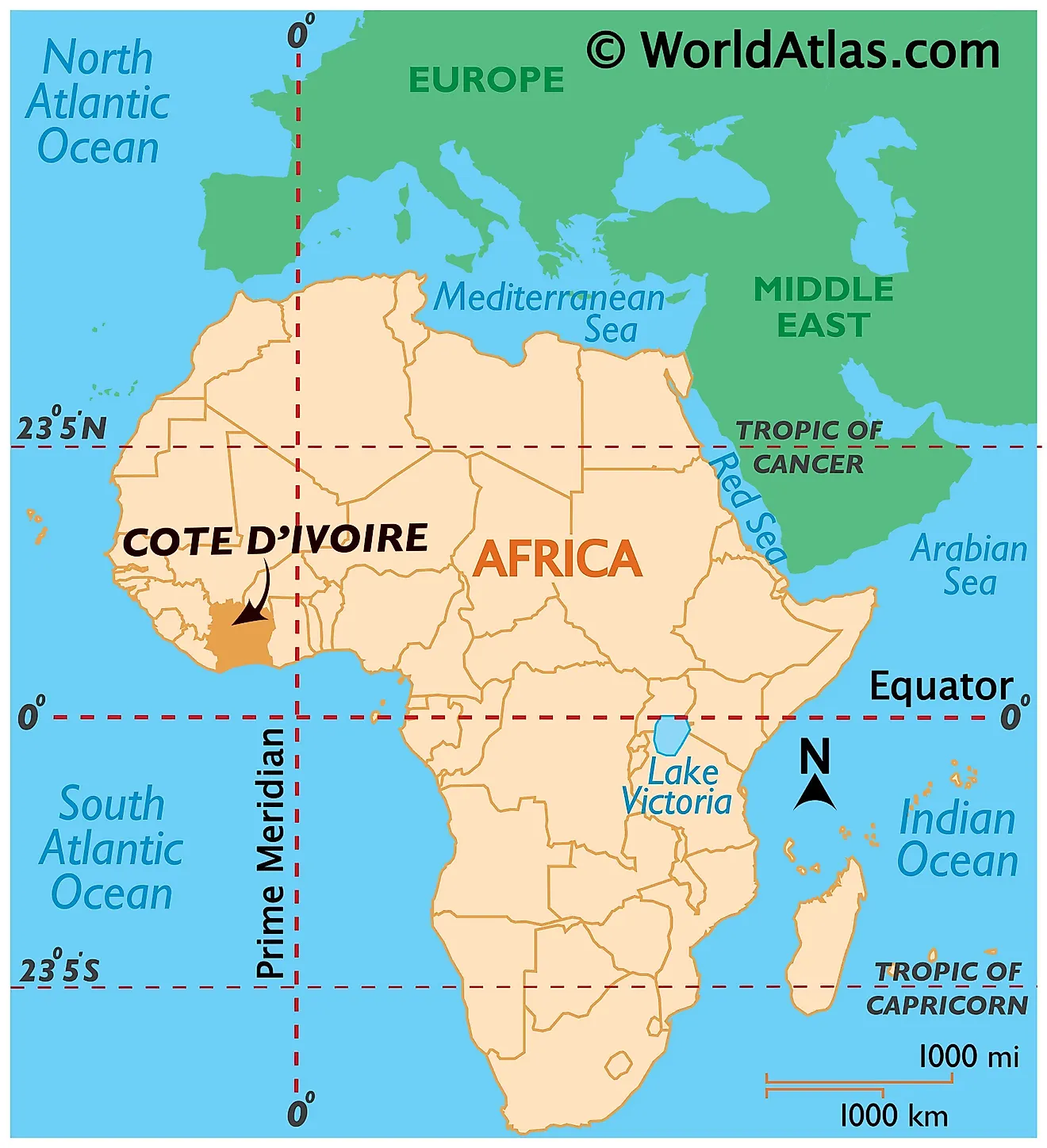
Ivory Coast is located in West Africa in the Western and Northern Hemispheres of the Earth. It is bordered by five countries. These are Guinea and Mali to the northwest, Liberia to the west, Burkina Faso to the northeast, and Ghana to the east. It has a coastline on the Gulf of Guinea to the south.
Cote d'Ivoire Bordering Countries: Mali, Burkina Faso, Ghana, Guinea, Liberia.
Regional Maps: Map of Africa
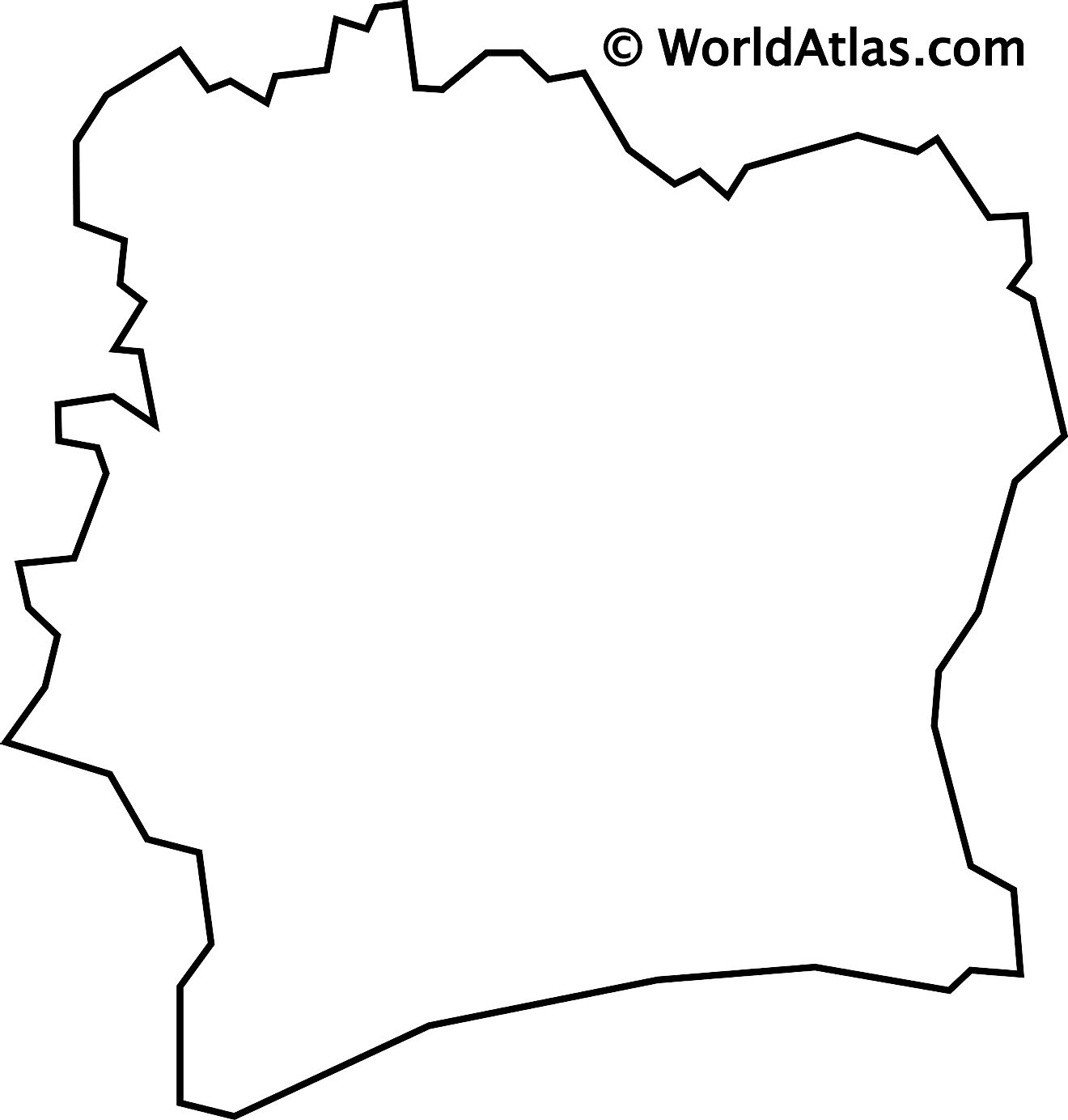
Outline Map of Cote d'Ivoire
Key Facts
| Legal Name | Republic of Cote d'Ivoire |
|---|---|
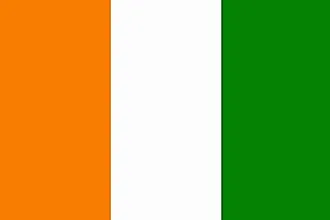
| Flag |
|
| Capital City | Yamoussoukro (legislative capital), Abidjan (administrative capital); note - although Yamoussoukro has been the official capital since 1983, Abidjan remains the administrative capital as well as the officially designated economic capital; the US, like oth |
| 6 49 N, 5 16 W | |
| Total Area | 322,463.00 km2 |
| Land Area | 318,003.00 km2 |
| Water Area | 4,460.00 km2 |
| Population | 25,716,544 |
| Major Cities |
|
| Currency | Communaute Financiere Africaine francs (XOF) |
| GDP | $58.79 Billion |
| GDP Per Capita | $2,286.16 |
This page was last updated on February 24, 2021