Countries That Use the Euro
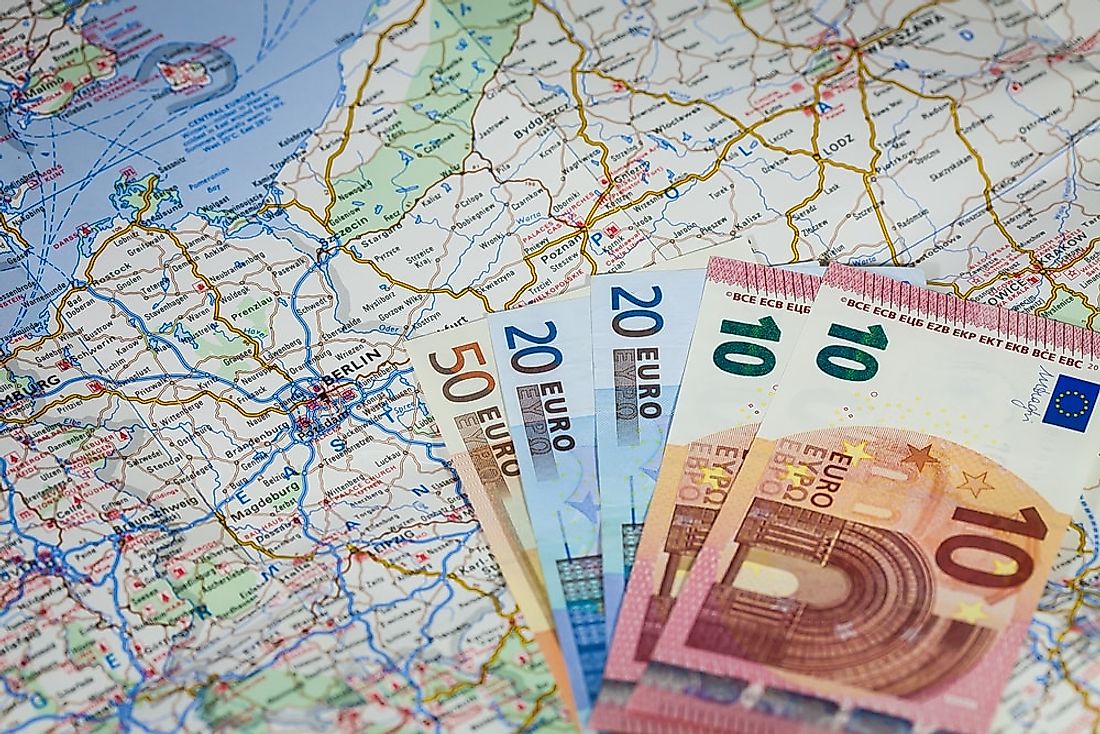
The eurozone is a collection of 19 countries from the European Union who have agreed to use the euro as their common currency and sole legal tender in their countries. A country must be a member of the EU in order to be part of the eurozone.
Biggest Eurozone Countries
Germany
Germany is a developed country with very high living standards. It is the third largest exporter and importer of goods globally. The economy has highly skilled labor force, a large capital stock, high level of innovation and very low corruption levels. It also has one of the lowest unemployment rates (4.7%) in the world. The automobile industry in the country is one of the most competitive and makes up a large percentage of the country's IQ together with the IT sector. The country has high life expectancy with an average of 80 years and a low fertility rate of 1.41 children per woman. The death rate exceeds the birth rate and currently, Germany has a population of around 80.1 million.
France
France has a unitary semi-presidential government. French is the national and the official language of the country. It has a mixed economy with the government having a substantive intervention and enterprises. One of the biggest industries in France is the aerospace industry which is led by the European consortium Airbus. Wines from Champagne and Bordeaux are major exports of the nation. The population of the country is at 66.6 million people with an average growth rate of +0.6% annually.
Italy
The country is a unitary parliamentary state led by the president and the prime minister. Italy is divided into twenty regions with five of the regions having a special autonomous status that enables them to enact legislation for their local matters. The economy of the country is a mixed capitalist economy which is the third largest in the eurozone. The agricultural sector is also highly developed and competitive with the country being the leading global wine producer. The great recession in the early 1980s negatively affected the Italian economy coupled with European sovereign-debt crisis. The population of Italy is around 60 million.
Spain
The Kingdom of Spain has a unitary parliamentary system of governance. Madrid is the largest and the capital city of the country. Spain is divided into 17 administrative regions and two autonomous municipalities. The country’s total population stands at around 46 million.
Eurozone Countries
| Austria |
| Belgium |
| Cyprus |
| Estonia |
| Finland |
| France |
| Germany |
| Greece |
| Ireland |
| Italy |
| Latvia |
| Lithuania |
| Luxembourg |
| Malta |
| Netherlands |
| Portugal |
| Slovakia |
| Slovenia |
| Spain |