US States By Electoral Votes
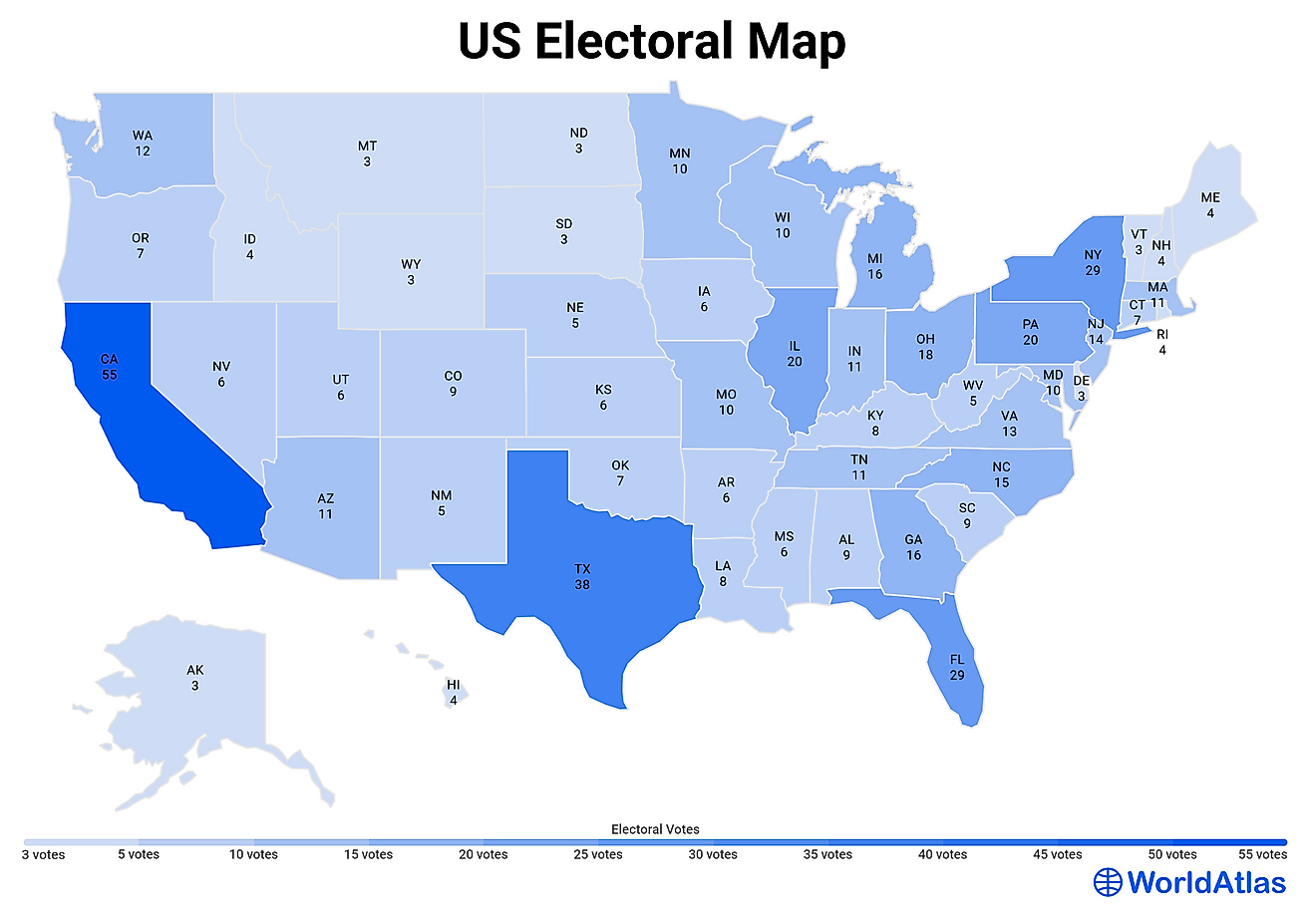
- California and Texas have the most electoral college votes, with 55 and 38 votes respectively.
- Florida and New York are tied for 3rd place, with 29 electoral college votes each.
- There are 7 states, along with DC, that have 3 electoral votes, which is the minimum.
The Electoral College is a body of electors formed under the authority of the United States Constitution. The body is formed every four years during a national election for the purpose of electing the two highest leadership positions in the US, the president, and vice president. The body is made up of 538 members, which means a candidate needs at least 270 votes to win. These members are sourced from each of the 50 US states, and the number of electors from a state is determined by the number of members it has in both the House of Representatives and Senate. Presently, the two houses have 535 members, with 435 coming from the House of Representatives and 100 from the Senate. The additional three come from the District of Colombia, as stipulated by the Twenty-Third Amendment.
The Three US States with the Most Electoral Votes
California has the most electoral seats of any US state, with a total of 55, while Texas ranks second with 38 seats. Florida and New York each have 29 seats, while Illinois and Pennsylvania are also tied, with 20 seats per state. Seven states and the District of Columbia (D.C.) have the minimum number of seats, which is three, namely Alaska, Vermont, Delaware, North Dakota, South Dakota, Wyoming, and Montana.
California
California is located in the country's Pacific region. In addition to having the most electoral seats, it is also the most populous state, with an estimated population of 39.6 million. Nicknamed the Golden State, California is also the third-largest state in terms of area. The state's large population is the main reason why it has such a high number of votes in the House of Representatives (53) and 2 senators in the Senate. Additionally, the speaker of the Lower House is from California.
Texas
Texas is the nation’s second-largest state, with an area of about 268,581 sq mi, and a large estimated population of 29 million. Like California, the state's high number of representatives in the Lower House (36) is due to its large population. The additional two seats are from the two senators, who are both currently Republicans. In the previous presidential election, more than half of the votes from Texas went to the Republican contender.
New York
The state of New York is situated in the country’s northeastern region and is one of the original Thirteen Colonies. Nicknamed the Empire State, New York has the fourth highest population in the US, estimated at 19.5 million, and an area of about 54,555 sq mi. In addition to two senators, the rest of New York's electoral representation comes from members of the Lower House. The current number of representatives is a significant decrease from the 47 votes it had between 1933 and 1953.
Twenty-third Amendment to the US Constitution
The Twenty-Third Amendment to the US Constitution allows citizens living in the District of Columbia to vote in presidential elections. Essentially, the amendment extends the rights of a state to the district. Ratified on March 29, 1961, it grants the District of Columbia the number of electors that does not exceed the number of votes granted to the least populous state, which is three.
List of US States by Electoral Votes
| Rank | US State | Electoral Votes (2016 Election) |
|---|---|---|
| 1 | California | 55 |
| 2 | Texas | 38 |
| 3 | Florida | 29 |
| 4 | New York | 29 |
| 5 | Illinois | 20 |
| 6 | Pennsylvania | 20 |
| 7 | Ohio | 18 |
| 8 | Georgia | 16 |
| 9 | Michigan | 16 |
| 10 | North Carolina | 15 |
| 11 | New Jersey | 14 |
| 12 | Virginia | 13 |
| 13 | Arizona | 11 |
| 14 | Tennessee | 11 |
| 15 | Indiana | 11 |
| 16 | Massachusetts | 11 |
| 17 | Washington | 10 |
| 18 | Minnesota | 10 |
| 19 | Missouri | 10 |
| 20 | Wisconsin | 10 |
| 21 | Maryland | 10 |
| 22 | Colorado | 9 |
| 23 | Alabama | 9 |
| 24 | South Carolina | 9 |
| 25 | Kentucky | 8 |
| 26 | Oregon | 7 |
| 27 | Oklahoma | 7 |
| 28 | Connecticut | 7 |
| 29 | Nevada | 6 |
| 30 | Utah | 6 |
| 31 | Kansas | 6 |
| 32 | Iowa | 6 |
| 33 | Arkansas | 6 |
| 34 | Louisiana | 6 |
| 35 | Mississippi | 6 |
| 36 | New Mexico | 5 |
| 37 | Nebraska | 5 |
| 38 | West Virginia | 5 |
| 39 | Idaho | 4 |
| 40 | Rhode Island | 4 |
| 41 | New Hampshire | 4 |
| 42 | Maine | 4 |
| 43 | Hawaii | 4 |
| 44 | Montana | 3 |
| 45 | Wyoming | 3 |
| 46 | South Dakota | 3 |
| 47 | North Dakota | 3 |
| 48 | Washington D.C. | 3 |
| 49 | Delaware | 3 |
| 50 | Vermont | 3 |
| 51 | Alaska | 3 |