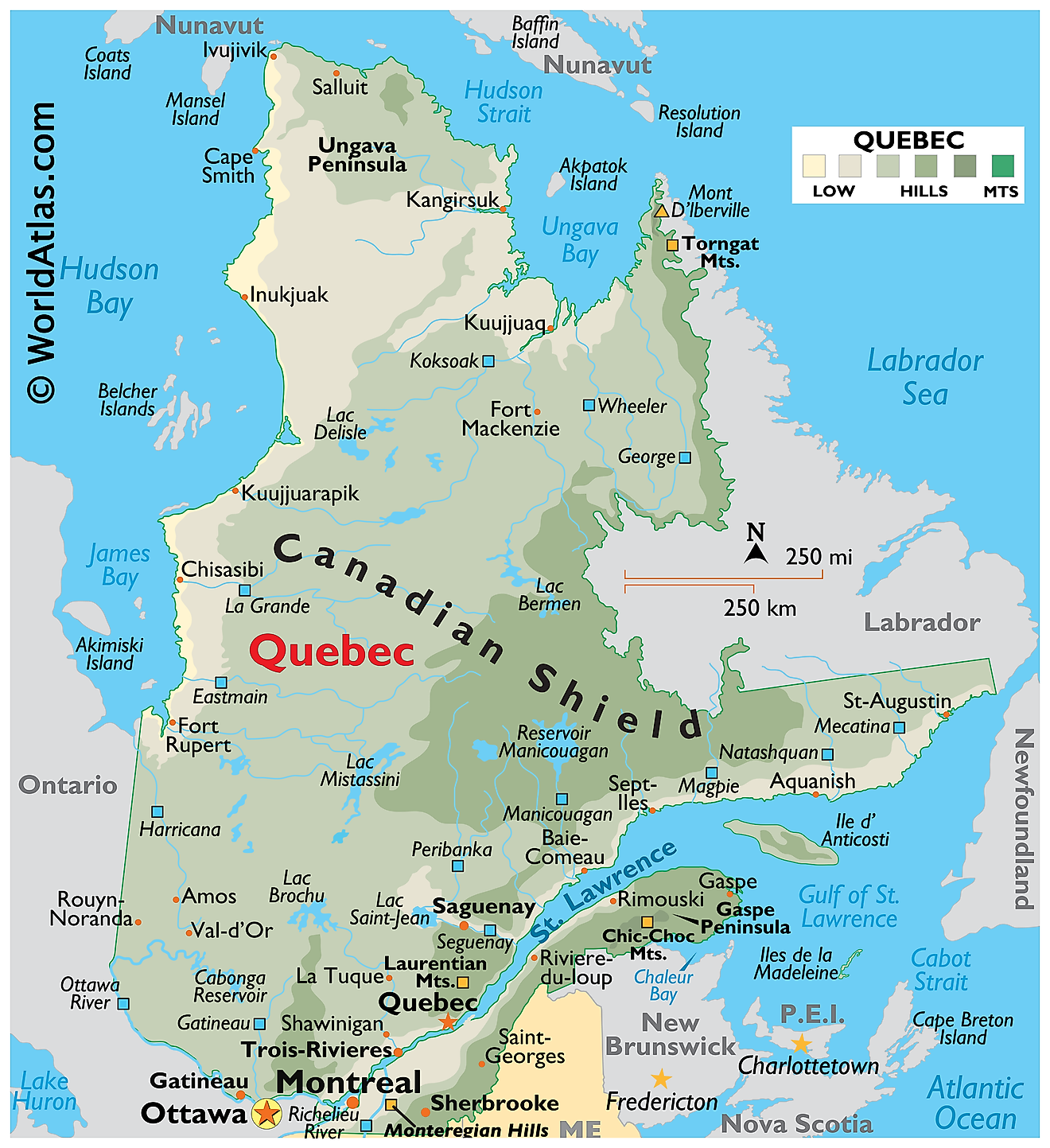
PRINT THIS MAP

Samuel De Champlain
Travel the World through Poster Art!

Statue of King Louis XIV, Quebec City
Travel the World through Poster Art!

New France - 1750
Travel the World through Poster Art!

Canadian Pacific Railroad poster
Travel the World through Poster Art!

W.L. Mackenzie, Franklin D. Roosevelt and Winston Churchill meet in 1944 for a World War II conference in Quebec City, Quebec, Canada
Travel the World through Poster Art!

Olympic Stadium, Montreal
Travel the World through Poster Art!

Quebec and Canada flags at full mast
Travel the World through Poster Art!

PRINT THIS MAP

Contact Us | Privacy Statement

Copyrighted by Graphic Maps
All rights reserved!

All maps, graphics, flags, photos and original descriptions created by Graphic Maps, a d/b/a of the Woolwine-Moen Group, unless otherwise noted and/or directly linked to the source, and use of same for any application whatsoever (with the exception of outline maps) requires written permission.

We make no copyright claim on any statistical data on this page, nor on any non-original graphics, and/or pictures not produced by us. Certain statistical data is gathered from the CIA World Factbook, as well as numerous public domain reference materials.

Every effort is made to be as accurate as possible when disseminating information on any worldwide destination. We are not responsible for unintentional data entry errors or omissions. If you would like to submit an addition, change or correction, or suggest a new link, please forward it to our map department and we will give it our immediate attention.

|
|
|
|
Timeline

(1534) French Explorer, Jacques Cartier, planted cross on Gaspe
Peninsula, south shore of Saint Lawrence River, claimed area for France; first province of New France

(1535) Expedition led by Jacques Cartier sailed into Saint Lawrence River

(1541) Jean-Francois de la Roque de Roberval made lieutenant of new France; given orders to establish colony; Cartier founded Charlesbourg Royal, first French establishment in America

(1581 - 1584) Expeditions organized by French merchants explored Canada for fur

(1609) Samuel De Champlain joined expedition against Iroquois; French and Hurons victorious

(1627) Seigneurial system introduced by King Louis XIV of France, forbade settlement in New France by anyone other than Roman Catholics

(1629) French trading post, Tadoussac, captured by brothers David, Lous, Thomas Kirke of England; demanded Champlain to surrender Quebec

(1632) Treaty of Saint-Germain-en-Laye signed; Acadia and Quebec returned to France; Couillard-Hebert family received first back slave

(1634) Sieur de La Violette founded fur trading post and fort, now Trois Rivieres

(1641) French and Iroquois Wars began

(1648) Huron country destroyed, Hurons relocated to ile D'Orleans

(1663) New France became royal province under King Louis XIV

(1665) Carignan-Saleires regiment destroyed five Mohawk villages

(1666) Carignan-Saleires soldiers invaded Iroquois territory, burned villages, destroyed crops

(1685) King Louis XIV decreed Code noir (Black Code) , ordered all Jews out of French colonial empire; defined slavery rules, restricted activities of free Negroes; forbade any religious activities other than Roman Catholic

(1689) Iroquois warriors attacked Lachine settlement, klled or tortured most inhabitants (Lachine Massacre)

(1701) 39 First Nation tribes, French Colonial Government signed Great Peace of Montreal

(1702) Queen Anne's War between France and Great Britain began

(1712) New France extended from Newfoundland to Lake Superior, from Hudson Bay to Gulf of Mexico

(1713) Treaty of Utrecht ended Queen Anne's War

(1731) Construction began on Chemin du roy (King's Road) between Quebec City and Montreal

(1734) Marie-Joseph Angelique, black slave, hanged for burning owner's house

(1754) Beginning of French and Indian War between Great Britain and France

(1759) Quebec City siege began; British troops defeated French troops in Battle of Plains of Abraham near Quebec City; Quebec City surrendered; government of New France moved to Montreal

(1760) French Forces defeated British during Battle of Sainte-Foy on Plains of Abraham; French forces attacked Quebec City, failed to capture city from British; British ships arrived at Quebec City, French army forced back to Montreal; Governor Vaudreuil surrendered to British army at Montreal

(1763) Seven Years War ended with signing of Treaty of Paris; France gave northerly portion of New France to Britain, kept Guadaloupe; Chief Pontiac led raids against British trading posts; British Parliament issued Royal Proclamation to rename New France to Province of Quebec

(1764) Civil courts established

(1774) First Continental Congress issued Articles of Association, condemned Quebec Act for creating arbitrary government

(1775) Green Mountain Boys, led by Ethan Allen and Benedict Arnold, raided Fort Saint-Jean; Second Continental Congress worte open letter inviting people of Canada to join in Revolution; Continental Army invaded Quebec, besieged Fort Saint-Jean; Fort Saint-Jean surrendered; Montreal surrendered to Americans; Green Mountain Boys troops defeated at Quebec City

(1776) British, German troops arrived, drove Americans out of province

(1784) Colonial petitioners requested British Parliament to create House of Assembly for Province of Quebec without regard to nationality or religion

(1786) John Molson founded Molson Breweries

(1792) First election of Lower Canada held; first parliament of Lower Canada opened

(1804) Legislative Assembly of Lower Canada voted to abolish slavery

(1812) War of 1812 - second invasion of Canada by Americans

(1818) Frontier between British North America, United States established at 49th northern parallel

(1830) Port of Montreal created

(1832) Rioting broke out during by-election in Montreal, British soldiers opened fire, three killed; cholera epidemic killed 6,000; Assembly passed law giving full political rights to Jewish citizens of Lower Canada

(1837) British attacked village of St. Denis, Patriote forces won; British were victorious in Battle of Saint-Charles between Great Britain and Lower Canada rebels; Patriots took control of Saint-Eustache; Martial law declared in Montreal; British troops sacked and burned village of Saint-Benoit

(1838) Robert Nelson, Patriots General, gathered volunteers, Freres chasseurs, sympathetic Americans, launched attack on British in Lower Canada; Nelson proclaimed independence of Lower Canada; amnesty given to all prisoners except eight; Freres chasseurs took positions in Beauharnois, Sainte-Martine, Saint-Mathias; British won Battle of Lacolle; last battle of the Lower Canada Rebellion occurred at Battle of Odelltown

(1841) Act of Union passed by British Parliament

(1848) Union Act amended, became legal to use French language in Parliament and Courts

(1849) Parliament of Canada passed Rebellion Losses Bill, compensated people who suffered property damages during Rebellions of 1837 in Lower Canada; riot started, Parliament of Canada buildings in Montreal burned down

(1867) New Brunswick and Nova Scotia joined Ontario and Quebec in the new Dominion of Canada; Honourable Sir Narcisse-Fortunat Belleau appointed first lieutenant-governor; Pierre-Joseph-Oliver Chauveau became first premier

(1870) Major forest fire in Saguenay-Lac-Saint-Jean region left third of population homeless

(1875) New electoral law enforced secret ballot


(1885) Canadian Pacific railroad completed (Montreal to Vancouver)

(1887) First premiers' conference held in Quebec City

(1889) Rockslide in Quebec City killed 45 people

(1891) Premier Honore Mercier removed from office after being accused of corruption (cleared of all charges the following year)

(1893-1895) Albert Peter Low explored Quebec-Labrador peninsula

(1898) Quebec boundary extension act expanded provincial boundaries - included land of the aboriginal Cree

(1900) Academie de musique de Quebec theatre destroyed by fire

(1907) Part of the Quebec bridge collapsed, killed 75 workmen

(1912) Quebec Boundaries Extension Act passed, northern boundary extended from Quebec to Hudson Strait

(1917) Government enforced conscription, rioting occurred

(1918) Women won right to vote in Canadian federal elections

(1921) Ku Klux Klan established in Montreal

(1922) Joseph-Armand Bombardier engineered first prototype of snowmobile; CKAC Radio begain broadcasting, first radio station in Quebec

(1931) Statute of Westminster provided all existing dominions of British Empire were fully independent of United Kingdom

(1936) Canadian government began printing bilingual currency

(1939) Canada began participation in World War II

(1940) Quebec women received right to vote and run for office in provincial elections

(1944) W.L. Mackenzie, Franklin D. Roosevelt and Winston Churchill meet for a World War II conference in Quebec City

(1949) Joseph-Albert Guay responsible for in-flight bombing killing all aboard (one of first in-flight airplane bombings in history); asbestos strikes occurred in town of Asbestos and Thetford Mines

(1954) Separate provincial income tax introduced

(1955) Richard Riot - Fans protested suspension of Montreal hockey player, Maurice Richard; riots occurred

(1961) Claire Kirkland-Casgrain became first woman member of Legislative Assembly and cabinet member

(1963) Voting age lowered from 21 to 18 years

(1969) Bill 63 allowed parents freedom to choose their children's language of instruction; baseball franchise, Montreal Expos, began playing; FLQ (Front de Liberation du Quebec) bombed Montreal Stock Exchange; Montreal's police, firefighters staged wildcat strike

(1970) British Trade Commissioner, James Cross, abducted by Front de liberation du Quebec, martial law declared, civil rights suspended; Quebec
joined the federal medicare system

(1971) The first CANDU reactor began operation at Gentilly; landslide at Saquenay destroyed 40 houses and killed 31 people

(1972) 200,000 public service workers struck, largest strike in Canadian history

(1976) Montreal hosted summer Olympics

(1977) Bill 101 (Charter of the French Language) became law, defined French as the language of majority of population, only official language of Quebec; English speaking workers, businessmen left province

(1980) Quebec-Newfoundland government signed Churchill Falls hydro agreement

(1981) French-only sign law passed

(1984) National Assembly shooting spree killed 3 and injured 13 people

(1987) Quebec City first city in North America awarded World Heritage status

(1988) Canada-U.S. Free Trade Agreement negotiated

(1989) Geomagnetic storm caused province-wide blackout, lasted 9 hours, affected New York City; Ecole Polytechnique Massacre occurred - Marc Lepine shot 28 people, killed himself

(1990) Oka Crisis - land dispute between Mohawk Nation and town of Oka

(1992) Superior Court gave paralyzed Nancy B. right to disconnect from a respirator, resulted in her death

(1993) North American Free Trade Agreement goes into effect

(1994) Civil Code of Quebec replaced Civil Code of Lower Canada

(1996) 2,000 people rioted in Quebec City after rock concert; severe flooding in Saguenay Region devastated area, one of Canada's costliest natural disasters

(1998) Ice storm struck Montreal, southwestern Quebec, destroyed power lines and pylons, "triangle of darkness" left area south of Montreal without power for three weeks

(2001) Quebec City hosted Summit of the Americas

(2002) Child prostitution bust in Quebec City, many well-known people arrested

(2004) First same-sex marriage celebrated

(2005) 80,000 college students protested a cut to bursary funds by the government

(2006) Writer Jean-Paul Desbiens died, his book opened the door to the Quiet Revolution

(2007) 400th anniversary celebrated


|
|
|
|

|